Qing Dynasty
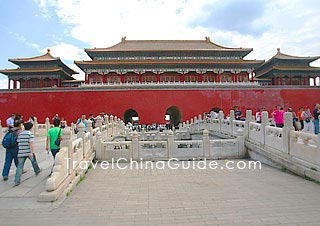 |
| Forbidden City, Beijing |
Before Qing's establishment, there was a regime called 'Latter Jin' that had been set up by Nurhachu, leader of the Man Ethnic Minority. Actually, Man people were the offspring of the Nuzhen people who had always been living in Northeast China. After reunifying all the Nuzhen tribes, Nurhachu proclaimed himself emperor in 1616. Thus a new regime called Latter Jin was founded in Hetu Ala (in current Liaoning Province) during the reign of Emperor Shenzong of the Ming Dynasty (1368 - 1644).
In 1636, Huang Taiji, son of Nurhachu moved the capital to Shenyang (currently the capital city of Liaoning Province) and changed the regime title into 'Qing'. In 1644 when peasant's uprising leader Li Zicheng ended Ming and set up a new regime in Beijing, the Qing army seduced a general named Wu Sangui to rebel against Li Zicheng. With Wu's help, the Qing army successfully captured Beijing and rooted their regime there.
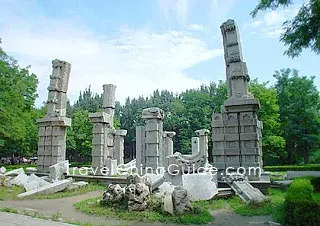 |
| Old Summer Palace was destroyed by British and French troop in 1860 |
At the beginning, the Qing court carried out a series of policies to revive the social economy and alleviate the class contradiction. In politics, following Ming's ruling pattern, the imperial rulers continued to strengthen the centralized system. Meanwhile, the court resumed the 'Sheng' administrative system that established by Yuan(1271 - 1368). Especially, in the frontiers like Tibet, Xinjiang, Mongol and Taiwan Island, the court set out to enhance the power of the imperial ruling.
By the middle of the 18th century, the feudal economy of the Qing Dynasty reached a zenith, spanning the reign of Emperor Kangxi, Emperor Yongzheng and Emperor Qianlong. So that period was usually called 'the golden age of three emperors'. In that period, both culture and science were much more prosperous than any other periods. The notable book, The Imperial Collection of Four, was edited in that period. Also, a group of scholars and artists such as Cao Xueqin (writer of A Dream of Red Mansions), Wu Jingzi (writer of The Scholars) and Kong Shangren (writer of The Peach Blossom Fan) gradually appeared. In the field of science, the achievements in architecture were outstanding.
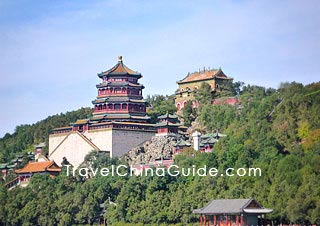 |
| Summer Palace, Beijing |
After the middle period, all kinds of social contradictions increasingly surfaced and Qing began to decline. Under the corrupt ruling of the later rulers, various rebellions and uprisings broke out. In 1840 when the Opium War broke out, the Qing court was faced with troubles at home and aggression from abroad. During that period, measures were adopted by imperial rulers and some radical peasants to bolster their power. The Westernization Movement, the Reform Movement of 1898 and the Taiping Rebellion were the most influential ones, but none of them had ever succeeded in saving the dying Qing Dynasty.
Finally, the Revolution of 1911 led by Sun Yat-sen broke out and overthrew the Empire of Qing, bringing two thousand years of Chinese feudal monarchy to an end.
Emperors
| Order | Name | Notes | Reign Time (years) |
|---|---|---|---|
| 1 | Emperor Taizu (Nurhachu) | Founder of the Latter Jin regime which later turned into the Qing regime; He created the military organization called Banner System. | 1616 - 1626 |
| 2 | Emperor Taizong (Huang Taiji) | The eighth son of Nurhachu; actually the first emperor of the Qing Dynasty. He moved the capital to Shenyang. | 1626 - 1643 |
| 3 | Emperor Shunzhi (Fulin) | Son of Huang Taiji; In his reign, the Qing army defeated the Ming Dynasty (1368 - 1644) and moved the capital into Beijing. | 1643 - 1661 |
| 4 | Emperor Kangxi (Xuanye) | The third son of Emperor Shunzhi; One of the greatest emperors in the Qing Dynasty; His reign was the beginning of the heyday of the dynasty. | 1661 - 1722 |
| 5 | Emperor Yongzheng (Yinzhen) | The fourth son of Emperor Kangxi; A fairly wise and competent emperor who maintained the prosperity of the Qing Dynasty | 1722 - 1735 |
| 6 | Emperor Qianlong (Hongli) | Son of Emperor Yongzheng; Inheriting the prosperity brought by his predecessors, his reign reached the zenith. | 1735 - 1796 |
| 7 | Emperor Jiaqing (Yongyan) | Son of Emperor Qianlong; He prosecuted the infamous corrupt official, He Shen, who used to be a favorite chancellor of Emperor Qianlong. | 1796 - 1820 |
| 8 | Emperor Daoguang (Minning) | Son of Emperor Jiaqing; His reign saw the outbreak of the First Opium War in 1840, from which China entered the modern history. | 1820 - 1850 |
| 9 | Emperor Xianfeng (Yizhu) | Son of Emperor Daoguang; In his reign, the Qing Dynasty apparently began to decline. The well-known Taiping Rebellion broke out in that period. | 1850 - 1861 |
| 10 | Emperor Tongzhi (Zaichun) | Son of Emperor Xianfeng and Empress Dowager Cixi; died early | 1861 - 1875 |
| 11 | Emperor Guangxu (Zaitian) | Grandson of Emperor Daoguang; a progressive emperor who tried lots of methods to save the declining Qing Dynasty | 1875 - 1908 |
| 12 | Emperor Xuantong (Puyi) | The last emperor of the Qing Dynasty and the last feudal monarch of China; He was imprisoned at Shenyang till 1959 when Chairman Mao remitted him. | 1908 - 1911 |