 |
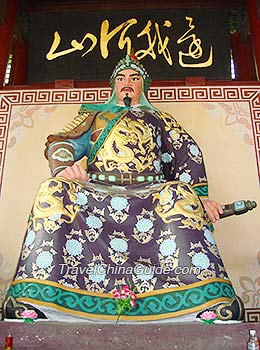
Statue of Yue Fei,
a famous general in
the Southern Song Dynasty |
Establishment
After the downfall of the Northern Song Dynasty (960 - 1127), the Jin army captured many members of the imperial family, except Zhao Gou, the younger brother of the last emperor. In 1127, the Jin dynasty withdrew its troops from
Kaifeng (capital of the Northern Song) and enthroned a puppet emperor. Due to the people's resentment of his betrayal of the Song Dynasty, he soon yielded the throne to Zhao Gou. However, due to continuous attacks by the Jin army, the newly-installed regime had to flee to Lin'an (currently Hangzhou in Zhejiang Province). In 1131, Lin'an was officially established as the capital of the Southern Song Dynasty, with Zhao Gou as its first emperor - Emperor Gaozong.
War Affairs
From the establishment to the downfall, the Southern Song Dynasty never extricated itself completely from the endless battles with the Jin Dynasty (1115 - 1234) and the Mongolian Kingdom. To some extent the concept of ‘viewing literacy as more important than the military', put forth during the Northern Song Dynasty, guided the Southern Song's rulers, who tried any attempt to make peace with their enemies, contributing to continual alien invasions. That is why the Southern Song Dynasty is considered as the weakest dynasty in Chinese history.
With the Jin Dynasty
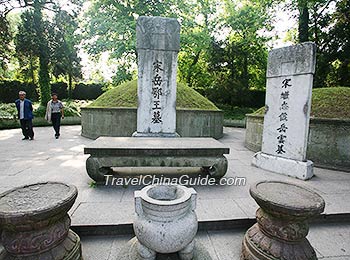 |
| Tomb of General Yue Fei, Hangzhou |
The territorial boundary between the Southern Song and the Jin was the Huaihe River and the Dasanguan Pass (in current Baoji City in Shaanxi Province). Since the founding of the Southern Song dynasty, the Jin court launched frequent attacks on the Song but each was repelled by the fierce resistance of the Song court's loyal generals. Among them, the most valiant was Yue Fei, who repeled the Jin army many times. Unfortunately, Yue Fei and his father were later falsely charged by a treacherous court official named Qin Hui and were executed by Emperor Gaozong.
After the reign of Emperor Gaozong, the relation between the Song and the Jin entered a comparatively stable stage. During Emperor Xiaozong's reign the Song court launched several northern expeditions in the hope of recovering the lost territory but they were in vain. By 1207 the military force of the Jin had gradually abated, while the newly-founded Mongolian regime became stronger. In 1214 when the Jin court plunged its troops southward another time, the Song army aligned itself with Mongolian army to fight against the Jin army. In 1234, the entire Jin regime was captured by the allied forces.
With Mongolian Kingdom
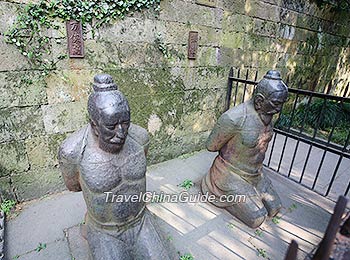 |
Iron statues of Zhang Jun and Mo Qixie,
who murdered Yue Fei
together with Qin Hui and his wife |
Mongolian Kingdom was another strong enemy confronted by the Song court after the Jin's downfall. Immediately after the ruin of Jin, rulers of Song wanted to recover the lost territory by taking the advantage of the Mongolian troops' withdrawal, but the Song court failed to achieve this goal due to the weakness of its military force. Taking this act of the Song as an excuse, the Mongolians tried to invade southward several times, beginning in 1235, but they failed again and again because of the Song soldiers' bravery. However, the Song court did not take the opportunity of the Mongolians' withdrawal to recover the lost territory. Instead, the weak rulers of Song again initiated peace gestures, which foreshadowed the defeat of the Southern Song by the Mongolians.
Downfall
After the death of the former king of the Mongolians, his younger brother - Kublai Khan - became the new king. In 1271 Kublai Khan established a new dynasty - the Yuan (1271 - 1368). In 1276 the Yuan court launched a massive attack on the Southern Song, culminating in the capture of the Song's capital, Lin'an, and the downfall of the Southern Song.
- Last updated on Aug. 08, 2025 by Gabby Li -