Sui Dynasty
Started from 581 and ended in 618, the Sui Dynasty lasted for only 38 years and had only three emperors. With a tyrannical second emperor - Emperor Yang, this dynasty was often compared to the Qin Dynasty (221 BC - 206 BC). However, the whole nation was reunified and certain economic and political advances were achieved in the period.
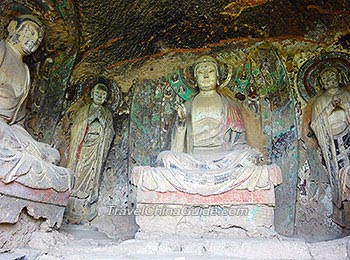 |
| Buddha statues in Maiji Mountain, carved in the Sui Dynasty |
Establishment
At the end of the Northern and Southern Dynasties (386 - 589), the whole nation had undergone a long period of division. People who had endured sufferings of war were longing for the unification but neither the Northern Dynasties nor Southern Dynasties realized this goal.
In Northern Zhou (557 - 581), Yang Jian, who was born to the noble class and was the Chengxiang (Prime Minister) of the last emperor, monopolized the political and military power and suppressed the separatist forces as well as some other royal forces. In 581, Yang Jian replaced Northern Zhou with Sui and proclaimed himself Emperor Wen. Thus Sui was founded, with Chang'an (currently Xian) the capital and Luoyang the auxiliary capital. In 589, the Sui Court defeated the last of the Southern Dynasties, Chen, and unified the whole nation.
Economical and Political Prosperity
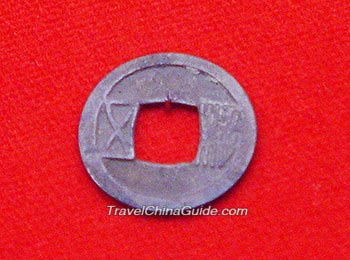 |
| Sui Coins inscribed with characters "Wu Zhu", |
As a result of the reunification, the society became stable and peaceful which encouraged economical and political development.
At the beginning, the agricultural acreage increased greatly which promoted the crop yield. The skills industry made some new advances with the shipbuilding technology reaching a new high level. Meanwhile, the commerce in Luoyang was fairly prosperous and in order to develop the national economy, a series of policies, such as Juntian (equal division of fields) System and Zutiao (tax moderation) System, were carried out. This equally distributed the farmland and moderated the tax rates while increasing the fiscal revenue.
In order to enhance the communication between southern and northern areas, Emperor Yang ordered his people to dredge a grand canal running from north and south. Centering on Luoyang, the Grand Canal was more than 2.5 miles long and functioned as the main artery in the Nation's transportation. The Grand Canal played an important role in economical and cultural exchange between southern and northern areas.
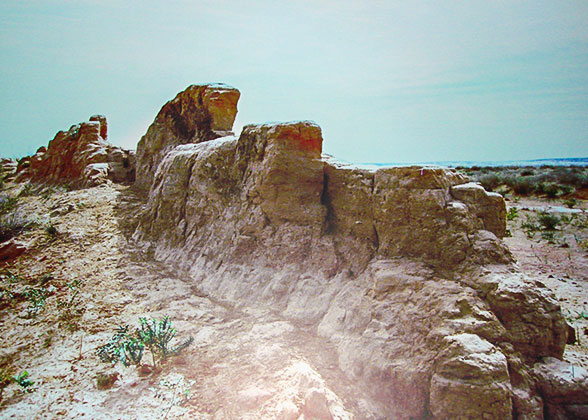 |
| Relics of Great Wall of Sui Dynasty, Yanchi County, Ningxia |
There were also many changes in political life. A new political system - Three Departments and Six Ministries was established - the first in Chinese history. Under this system, the royal power was enhanced and the work division in the court became detailed. Since this period, the method of selecting talent was thoroughly overhauled. The traditional Jiupin Zhongzheng (nine ranks of officials) Hierarchical System was replaced by the Imperial Examination System, which connected studying, the taking of examinations and attaining an official position. It had a profound influence on the selection of talent in Chinese history.
Decline and Ruin
The decline of the Sui Dynasty started from the second monarch, Emperor Yang, who was a typical tyrant. His reputation was that of a son who lacked respect for his parents, committed patricide and usurped the throne.
Emperor Yang led a luxurious and corrupt life. Upon gaining the throne, he employed two million laborers to build the second capital city of Luoyang and was even reputed to have cruised along the river in a large dragon ship, with thousands of ships following in attendance.
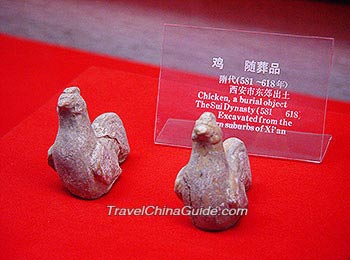 |
| Pottery of Chicken, Sui burial objects |
Craving greatness and success, Emperor Yang also waged war against Gaoli (currently Korea). Both burdensome military service and heavy corvee labor forced peasants to leave their farmland. Later, famine was common and caused by the resulting desolation leaving all the countryside in extreme misery.
In 611, peasants from Mt. Changbaishan in Shandong began a rebellion. Before long, rebels from all over the country formed into several powerful groups. Among them, the main military force was called the Wagang Army which was led by Zhai Rang and Li Mi. The force captured the granary of the Sui Court and issued the food to the peasants.
As a result, the Sui regime became rather unstable and in 618, when Emperor Yang was strangled by one of his subordinates, it completely collapsed.
Emperors
| Order | Name | Notes | Reign Time (years) |
|---|---|---|---|
| 1 | Sui Wendi (Yang Jian) | He was father-in-law of the last emperor of Northern Zhou; After the emperor died, he seized the throne for himself and established the Sui Dynasty | 581 - 604 |
| 2 | Sui Yangdi (Yang Guang) | The second son of Sui Wendi; known as a tyrant who led the dynasty to decline | 604 - 617 |
| 3 | Sui Gongdi (Yang You) | The last emperor of Sui Dynasty who yielded the throne to Li Yuan (later Emperor Gaozu of the Tang Dynasty (618 - 907) | 617 - 618 |