Western Zhou Dynasty
Lasting from the 11th century BC to 771 BC, the Western Zhou Dynasty was established by King Wu. The capital city was set in Haojing (now in the southern part of Xian, Shaanxi Province). This dynasty included the reigns of 13 emperors and played a very important role in Chinese history. Because of its great developments, the Western Zhou is renowned as the period which saw the height of splendor of Prehistoric Times.
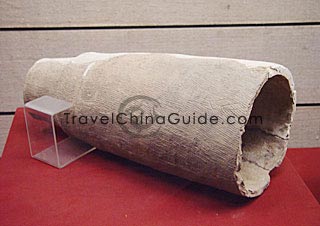 |
| Pottery Waterpipe, Building Material |
Political History
Originally a dependency of the Shang, the Zhou developed quickly under the reign of King Wen (Wenwang) and King Wu (Wuwang). In 1046 BC, King Wu defeated the Shang and established the Zhou. This signaled what is called the Western Zhou in Chinese history.
King Wu distributed lands both to his relatives, and meritorious ministers and each founded a small state. All the states fell under the rule of King Wu. After the king died, his son King Cheng succeeded. With the help of his uncle, he made the country became prosperous and stable. The country was further developed under the reigns of King Kang, Zhao, Mu and others. Until the tyrant, King Li came to the throne, the state was in chaos. His rule was overthrown by the people and he was exiled.
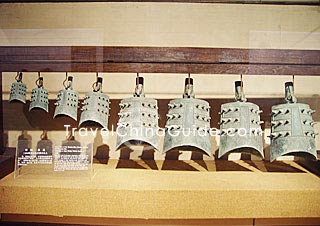 |
| Chime Bells |
Later, in the year 841 BC, Gong Hebo was elected by other vassals to deal with state affairs. From that time on, China began to have a definite way of counting the years. The country fell into a decline when the fatuous King You was on the throne. At that time, once the signal fire was ignited, it showed that other tribes attacked the city, and all the vassals around would come to help. However the king ignited the fire to send the wrong message in order to make his concubine happy. She smiled when she saw the vassals were tricked. The king's behavior enraged the queen's father, Shen Hou, because King You decided to depose the queen and kill the prince. Shen Hou assaulted the king and the Western Dynasty perished with the failure of King You.
Economy
The agriculture in the Western Zhou developed into a higher level than that in the Shang Dynasty. Not only were tools now made of bronze, the ways of furrowing were advanced. Fields were usually divided into three parts with one of these left unplanted each year to allow it to regenerate. The primary products were of diverse kinds including millet, wheat, rice and some fruits.
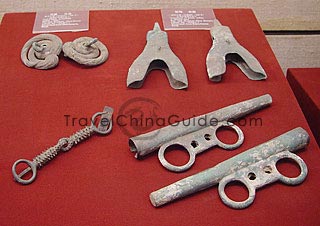
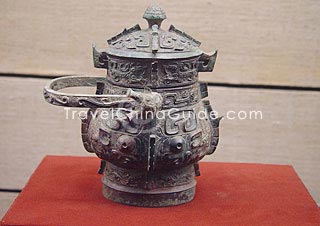
Because of the existence of slaves, the handicraft industry developed quickly. The production of bronze wares was done on a large scale. In textiles and architecture, there were also great progresses. During the late period of the Western Zhou, people began to grasp the skill of metallurgy.
|
|
Culture and Arts
The Zhou emperors paid much attention to etiquette. In sacrificial ceremonies, funerals, wedding ceremonies and other important events, there were strict regulations for the people to abide by. In order to change the extravagant customs which prevailed in the late period of the Shang, no one was allowed to be drunk. So that is why some drinking goblets commonly seen during the Shang Dynasty disappeared in the Western Zhou.
The prediction method used during the Shang Dynasty was still popular in the Western Zhou Dynasty. As for the characters, they were widely used and were carved not only on animal bones but also on bronze ware.
In astronomy, specialists appeared to observe celestial phenomena and make records. All of these developments showed that there were great advancements in science.
Emperors of the Western Zhou
| Order | Name | Notes | Reign Time (years) |
|---|---|---|---|
| 1 | Wenwang (Ji Chang) | With the assistance of Jiang Ziya, he developed the Zhou that laid the foundation for overthrowing the Shang Dynasty. | 1097 BC - 1046 BC |
| 2 | Wuwang (Ji Fa) | The son of Wenwang; He defeated the Shang Dynasty in 1046 BC and established the Western Zhou Dynasty. | 1046 BC - 1043 BC |
| 3 | Chengwang (Ji Song) | The son of Wuwang; he established the capital city of Luoyi (near Luoyang in Henan Province). | 1042 BC - 1021 BC |
| 4 | Kangwang (Ji Zhao) | The son of Chengwang; Under his reign, the Zhou Dynasty prospered. | 1020 BC- 996 BC |
| 5 | Zhaowang (Ji Xia) | The son of Kangwang; the Zhou Dynasty began to decline during his rule. | 995 BC - 977 BC |
| 6 | Muwang (Ji Man) | The son of Zhaowang; His reign time is the longest among all the emperors in the Western Dynasty. | 976 BC - 922 BC |
| 7 | Gongwang (Ji Yihu) | The son of Muwang | 922 BC - 900 BC |
| 8 | Yiwang (Ji Jian) | The son of Gongwang. The Zhou Dynasty fell into a decline in his reign. | 899 BC - 892 BC |
| 9 | Xiaowang (Ji Pifang) | The son of Muwang and the younger sister of Zhou Gongwang | 891 BC - 886 BC |
| 10 | Yiwang (Ji Xie) | The son of Yiwang (899 BC - 892 BC) | 885 BC - 878 BC |
| 11 | Liwang (Ji Hu) | The son of Yiwang (885 BC - 878 BC); He was a tyrant that abused the people and was defeated in many wars. After the people's rebellion in 841 BC, he was exiled. | 877 BC - 841 BC |
| 12 | Gong Bohe | He was elected by other vassals to deal with the state affairs after Zhou Liwang was exiled. | 841 BC - 828 BC |
| 13 | Xuanwang (Ji Jing) | The son of Liwang; He carried out a series of effective innovations and succeeded. | 827 BC - 782 BC |
| 14 | Youwang (Ji Gongsheng) | The son of Xuanwang; he made fun of his marquess in order to make his concubine smile, known as Tricking the Marquess with Beacon Fires. The Western Zhou Dynasty was lost at last in his reign. | 781 BC - 771 BC |