Chalk Wall & Water-Stealing Holes
Chalk Wall (Fen Bi Tang)
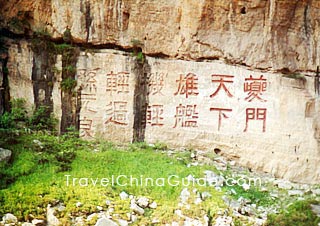 |
| Word Carvings on the Chalk Wall |
The word carvings on the Chalk Wall date back from Song Dynasty. The largest word inscribed is two yards, and the smallest is only the size of a finger. When the cruise ship passes the mouth of Qutang Gorge, the words 'Kui Men' and 'Qu Tang' can be seen. These four words are written by celebrities of the Qing Dynasty (1644 - 1911) in li script (official script). Among the inscriptions, there is a large tablet of four yards high and eight yards wide. Over 980 characters are carved on the tablet. It is the work of Zhao Gongshuo, a calligraphist from the Southern Song Dynasty. The achievements and virtues of Emperor Gaozong and Emperor Xiaozong are described in the words.
Due to the Three Gorges Dam Project, part of the carvings on the wall has been moved to a higher place to avoid the rising water. Therefore, visitors can still admire the legacy of the wall.
Water-Stealing Holes (Tou Shui Kong)
On the northern cliff at the western end of Qutang Gorge, there are stone holes positioned in a series up the cliff. They are the so-called Water-Stealing Holes.
People say that the holes were cut into the cliff by Zhang Xianzhong, leader of a peasant uprising in the Ming Dynasty (1368-1644), and his army. In order to oppose the dark rule of the Ming Dynasty, Zhang Xianzhong led his army to occupy the Area of Kui Gate as it was often a place of battle. He overcame and occupied Baidi City. When the Emperor Chong Zhen heard the news that Zhang Xianzhong had taken Kui Gate, he sent forces to shut off the source of water supply to the mountain, giving Zhang Xianzhong's army the choice - surrender or thirst to death.
As it was sunny and rainless at the time, it was difficult to get water on the mountain. Zhang Xianzhong and his army, in order to reach the riverside to obtain water, chiseled holes in the cliff and inserted wooden pegs or steps to climb down every night. These are the Water-Stealing Holes.
Now, they have been submerged under the water due to the Three Gorges Dam Project. Visitors can no longer marvel at these holes.