Memorabilia along the silk road
Famous Travelers:
Zhang Qian
Ban Chao
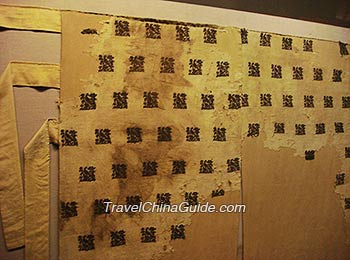
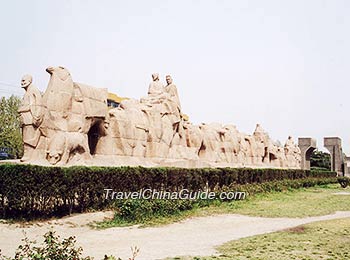
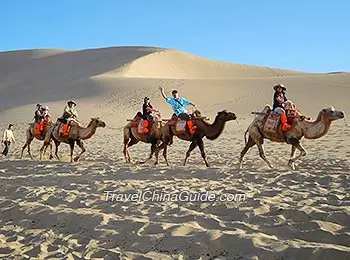
Named in the middle of the 19th century by the German scholar, Baron Ferdinand von Richthofen, the Silk Road, which is regarded as the greatest East-West trade route, was first traveled by Zhang Qian when he was sent on a diplomatic mission to the Western Regions in the Han dynasty (206 BC-AD 220). The Silk Road was the information super highway of its age, serving as the conduit not only for goods but also for the transmission of knowledge and ideas between east and west.
The Rise of the Silk Road
The Silk Road originated in the 2nd century BC from a desire for military and political purpose instead of for trade. In order to seek allies to fight against Xiongnu's repeated invasion, a court official named Zhang Qian was sent by Han Wudi to the Western Regions. However, on the way to the Western Regions, the Xiongnu captured Zhang and detained him for ten years. Escaped from Xiongnu's detention, Zhang Qian continued his journey to the Central Asia. While at that time, the local rulers were satisfied with their status and refused to ally with Han Empire. Although the mission failed in its original purpose, the information Zhang Qian conveyed to China about Central Asia, and vice versa, made people in each area desire goods produced in the other. Silk that was favored by Persians and Romans, inaugurated the trade along the Silk Road.
While when the Silk Road was first established, silk was not the chief commodity. Han dynasty made very little profit from it until the Romans were fanatic about silk that the large profits came in. The Roams love silk so much that they even exchanged silk for its weight in gold. During the Tang dynasty, thirty percent of the trade on the Silk Road was comprised of silk.
Prosperous as it was, the operation of the Silk Road always be influenced by the political developments. A stable state could ensure the smooth trade on this road, while the troublous one would hurt. When Zhang Qian opened this road, the Han dynasty and the empire of Parthia in Persia just achieved their golden ages, which give a favorite financial support to the smooth development of this route.
The Height of the Silk Road
The fall of the Han dynasty in the early 3rd century once caused Silk Road trade to decline. However, the rise of the Tang dynasty in the 7th century revived this commerce and by the mid 8th century, the route reached its height.
The prosperity of this road should owe to many reasons. Based on the breakdown of earlier dynasties, the Tang dynasty especially thought well of the internal stability and economic development. Many favorable policies were carried out to stimulate and encourage the trade between the east and west, leading to the enlargement of the market and quick development of the trade on this road.
At the same time, with the spreading of various religions in the world range, more and more missionaries reached to the east in succession by this road. With the Silk Road acting as an information superhighway, the exchange of ideas grew to a larger scale than ever before. And as a result, the Tang dynasty fortunately experienced the best flourishing period of the Silk Road.
The Decline of the Silk Road
The fall of the Tang in the early 10th century gave a deathblow to the trade on the Silk Road. The trade on the road declined sharply till in the 13th century, when the conquests of the Mongols ushered in an era of frequent and extended contacts between East and West. This increased contact created a demand for Asian goods in Europe, a demand that eventually inspired the search for a sea route to Asia.
The discovery of a sea route from Europe to Asia in the late 15th century dealt a damaging blow to the Silk Road trade again. With less cost, harassment and danger, many goods and materials that the Silk Road could not transfer were conveyed through the sea route. Besides, the Persians had mastered the art of sericulture and the import of the silk from the East was reduced.
Since then, the prosperous Silk Road was on its downhill. The bustling streets, wealthy cities and solid ramparts now were submerged in the vast desert, and today, people can only trace their splendid history in the endless ruined and dilapidated remains.
Travelers' Voices on History of Silk Road
1.
Jun. 17,2009 02:10 Reply
Ms.manas(in) said:
plz tell me developments in silk route
Jun. 17,2009 21:36
Mr.haha replied:
The Silk Road was opened up by Zhang Qian in Western Han Dynasty.It was prospered in Han Dynasty and generally decline after the fall of the Han Dynasty.
2.
Jun. 3,2009 19:08 Reply
Ms.BEAGLOVER(USA) said:
I need FActs about the silk road ASAP! i AM DOING A REPORT ON IT AND I NEED TO "how many years after the founding of the HAn Dynasty was the Silk road established and what was imported and exported"? PLEASE HELP i'M DESPERSATE!!!=(
Jun. 3,2009 22:05
Mr.Zhen replied:
The Silk Road was generally established in 115BC after the second visits' of Zhang Qian to the west. The Western Han Dynasty was built in 206BC, so it was less than 100 years later that the Silk Road was built.
3.
May. 25,2009 13:04 Reply
Mr.eyyhhyuet(y5) said:
how long is it?!??!????!!????
May. 27,2009 01:02
Mr.Jim replied:
The Silk Road measures over 7,000 km, and half of which was in China.
May. 27,2009 10:09
Mr.peerson(......usa......) replied:
it musered like 2000 miles.
Jun. 3,2009 21:03
Ms.mary(USA) replied:
it was actually over 7,000 MILES
4.
May. 15,2009 16:28 Reply
Ms.chinchilla(Guatemala) said:
I'm doing a report on the Silk Road and different spices on it, could anyone give me some useful facts about it? I'm in 6th grade and I have tried lots of various websites, but to see that none of it's what I need!:( PLEASSSSSSSE HELP ME! DESPER8!!
May. 17,2009 20:27
Mr.Jeremy(China) replied:
Many different types of spices were traded along the Silk Road, including frankincense, myrrh, chinnamon, clove, pepper, elemi, camphor, benzoin and spikenard.
May. 27,2009 09:46
Mr.mystery(vvvvv) replied:
not only spices were traded on the silk road, but also ivery, gold, salt, and many other things. they traded to many different countries, expecially europe.
Jun. 3,2009 19:05
Ms.beaglelover(usa) replied:
HI Mr. Chincilla I am also in the 6th grade and @ this time I am also doing a research report on the Silk Road! So if you need any info just ask me I am half way done with it! Maybe you can give me some answers too! I need to know why The Silk Road was so expensive?I don't know if you also have these types of ?'s in mind, but I would LOVE some answers! THX =)
5.
Jun. 1,2009 04:08 Reply
Mr.Rakesh(India) said:
Plz tell me recent developments of silk route india-china
Jun. 2,2009 01:46
Mr.LEO replied:
The merchants of China and India still do trade at the site of ancient Silk Road trade route. Renqinggang border trade market, located 16km to the northeast of Naiduila Mountain, is a modern trade market. It opens from 10:00 to 18:00 between Monday and Thursday from June 1 to September 30. The textiles, teas, barley, cigarette, alcohol, rice, vegetable oil and herbs are traded in the market.
6.
Jun. 1,2009 15:20 Reply
Mr.nick(USA) said:
does any1 know how indian merchants benefited from the silk road?
Jun. 2,2009 01:26
Ms.Emily(India) replied:
The Indian merchants brought emerald, colored glaze, precious stones and spices to trade with Chinese merchants along the Southwest Silk Road.
7.
May. 29,2009 12:39 Reply
Ms.hatfield(ohio) said:
they silk road was a good way a travel
8.
May. 27,2009 23:21 Reply
Mr.{helper}(usa) said:
A good fiction book based on the silk road is "The Dragon and the Eagle" it is very interesting. Anouther story book (fiction/non-fiction) Is "Animals Marco Polo Saw". These will help since they are from Mr. {helper}
9.
Apr. 22,2009 08:01 Reply
Ms.kara(usa) said:
who actually disovered silk..??
Apr. 22,2009 21:06
Mr.Adam(China) replied:
It is said that Luozu, the wife of the Emperor Xuanyuan promoted the technology of raising silkworms and weaving silks.
May. 27,2009 10:07
Mr.person(.......usa.....) replied:
the person was luozu, the emporors wife who was drinking tea under a tree and a silk worn fell into her cup. she then unrafeled the cacoon and got fine, thin peices of silk. she ordered her servants then to make her husband a cloke out of this silk and they ever seince then unraveled the silk worms cacoons.
10.
Mar. 4,2009 15:32 Reply
Ms.Ally Valentovich(U.S.A) said:
well good website but what was traded on the silk road??!!
Mar. 5,2009 02:41
Mr.egg(China) replied:
Silk, chinas, teas and seeds
Mar. 7,2009 14:47
Ms.boots(USA) replied:
There were lots of things traded on the silk road. I recently went to the libary and found plenty of books that that stated the things traded on the silk road
Mar. 8,2009 11:48
Mr.Lin(USA) replied:
To China: horses, metals, precious stones, ivory, and glass.
From China: silk, porcelain, furs, spices, jade, gems, and new inventions such as paper and gunpowder.
Mar. 9,2009 08:25
Ms.Ashley Vazquez(U.S.A) replied:
anything they had they sold clohtes,food ,and live stock.
Mar. 24,2009 13:17
Mr.Vrack(Timbuktu) replied:
Gun powder wasnt invented back then this is around b.c. not the 1700
Mar. 26,2009 19:41
Mr.tang(coachella) replied:
to mr.vrack-
gunpowder WAS invented back that far and the tang dynasty was the founder. they also investned items such as paper, fireworks, and lancers, which were alson traded on the silk road
May. 15,2009 16:33
Ms.chinchilla(Guatemala) replied:
Hello, Ms. Ally, these are my anwers: silks,spices,food,stories,recipes,animals,ideas,inventions,clothing, and religeons. Hope this helps!