
Home /
Silk Road
| |
| |
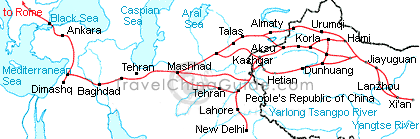

It is now included in the World Heritage List of UNESCO. 33 historical sites are along the road in total and 22 of them distribute in Shaanxi, Henan, Gansu and Xinjiang of China.
A brief introduction about this route includes its basic information, chronology, renowned attractions along the road, and other interesting knowledge.
The road is not only an ancient international trade route, but also a splendid cultural bridge liking the cultures of China, Central Asia, India, Persia, Arabia, Turkey, Greece, and Italy. The Four Great Inventions of China and religions of the West were introduced into their counterparts.
From the time Zhang Qian pioneered the world-famous Silk Road during the Han Dynasty, until the collapse of the Yuan Dynasty, it enjoyed a history of about 1,600 years.
This ancient road begins at Chang'an (now Xi'an), then by way of the Hexi Corridor, and it reaches Dunhuang, where it divides into three, the Southern Route, Central Route and Northern Route. The three routes spread all over the Xinjiang Uygur Autonomous Region, and then they extend as far as Pakistan, India and even Rome.
Other Routes
The scenery and sights along the Silk Road are spectacular and intriguing. There are well-known Mogao Caves (Mogao Grottoes) in Dunhuang, the bustling Sunday Bazaar in Kashgar and exotic customs in Xinjiang Uygur Autonomous Region and more …
There are all kinds of tour plans for traveling the world-famous road. TravelChinaGuide provides many tour lines for visitors to experience the adventures of this ancient trade road.
|
|
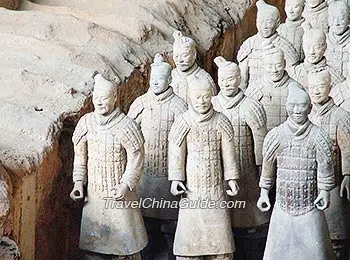
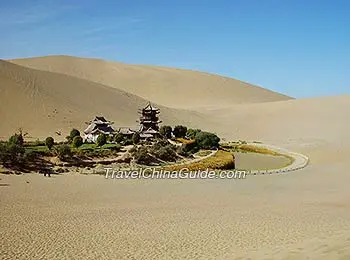
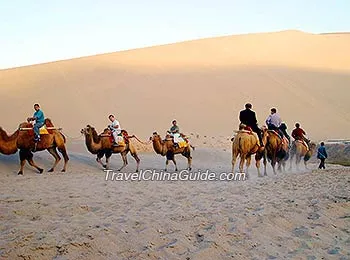
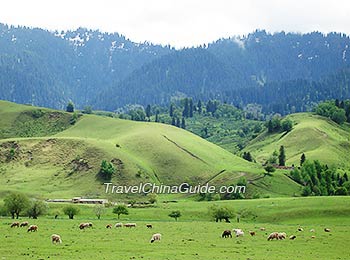
The pictures show the stunning scenery of this time-honored trade route. They display not only the beauty of places of historical places, but also the natural wonders.
|
|
- Last updated on Apr. 06, 2024 by Catherine He -
Questions & Answers on Silk Road
Asked by hi from USA | Apr. 03, 2024 07:13 Reply
Reply
ReplyAbout the silk road
On average how many people tended to die in a caravan on a one way trip.
Answers (1)
Answered by Keith | Apr. 06, 2024 20:17 0
0 0Reply
00ReplyI didn't find the number. But Zhang Qian leading his group of over 100 people who opened the way went back to ancient China with only 2 people, and one was his wife.
Asked by Sandra from SINGAPORE | Feb. 17, 2024 00:37Reply
ReplyUrumiqi
how to travel from Urumqi to Korla
Answers (1)
Answered by Jessica | Feb. 17, 2024 17:3700Reply
00ReplyThere are high speed trains departing from Urumqi to Korla now and it takes about 4 hours. A ticket for a second class seat costs around CNY 108.
Asked by whitney from USA | Feb. 15, 2024 11:21Reply
ReplyWas it worth it for the traders to risk their lives on silk road?
Answers (1)
Answered by Hailey | Feb. 17, 2024 17:4100Reply
00ReplyWell, I think yes and it is not so easy to have business at any time.
Asked by A Tiu from CANADA | Feb. 06, 2024 11:58Reply
Replywhich railway station (name of station) does the D train from zhangye west to dunhuang stop.
Answers (1)
Answered by Hailey | Feb. 06, 2024 23:2800Reply
00ReplyIt is Dunhuang Railway Station.
Asked by Sandra from USA | Jan. 29, 2024 19:59Reply
ReplyCompatibility
I’m a snake born on June 16th 1965 , I was married to a dragon born on Aug 3rd 1964. We were married and thinking about reconciliation. Should I move forward?
Answers (1)
Answered by Diana | Jan. 29, 2024 22:4100Reply
00ReplyYour love compatibility is not bad according to the Chinese zodiac and just follow your heart.