China Silk
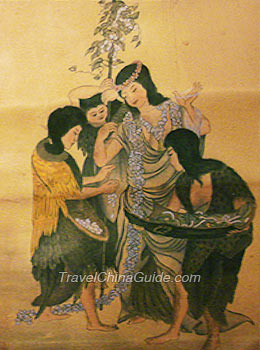 |
| Empress Leizu, the inventor of sericulture |
History
The Warring States Period, the beginning of feudalist society in Chinese history, witnessed a prosperous time. The development of productivity popularized silk and it was no longer a luxury just for aristocrats. The pattern, weaving, embroidery and dyeing skills were all improved as they were influenced by the free ideology of the time, while the silk designs had sense of a free and bold air about them.
The silk products excavated from Mawangdui Han Tomb are proof of the advanced skill and artistry of silk at this time.
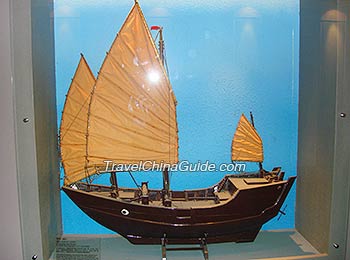
Silk production peaked during the Han Dynasty when the manufactured goods were transported as far away as Rome from Chang'an (today's Xian). The overland trade route was to become famously known as the Silk Road. However, there was also a Marine Silk Road extending from Xuwen, Guangdong or Hepu, Guangxi to Vietnam. An outward bound voyage lasting five months would arrive in Vietnam; it would take another four months to reach Thailand; while a further twenty days would carry the merchants on to Burma. Two months later they would arrive in India and Sri Lanka, from where the silk would be eventually transported to Rome via the Mediterranean. After such a long journey, the price of silk was equivalent to that of gold. Legendary as it seems, tender silk connected China to the rest of the world.
|
|
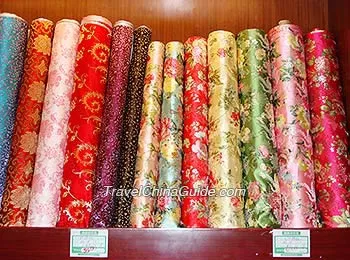
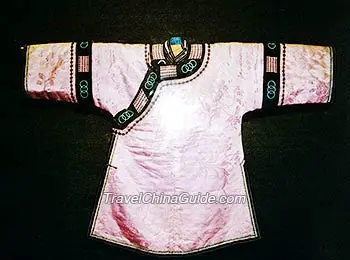
The Marine Silk Road took supremacy over the land Silk Road following the Song Dynasty extending the trade to Southeast Asia which became fully developed in the Yuan Dynasty. Besides Chinese exports, foreign businessmen also came to China to buy silk and china wares.
During the Ming and Qing Dynasties silk was transported to Europe and America from Manila and this meant that China dominated the world's silk market until 1908.
Chinese characters including the component "silk" have the intonation of silk or its implication of fine and deep. The richness of color, texture, strength and beauty of silk make it the means to imply something is fine and impeccable. A woman's raven hair is referred to as 'black silk' ; tender feelings are 'feelings of silk' and the Chinese word for a lingering and emotive feeling contains the component of "silk", and even a flavor can be silky and smooth.
|
|

Tips on Buying Silk
Function of Silk
First, it brings the pleasant sensation. Composed of azelon, the real silk has a good biocompatibility. The smooth surface makes the smallest friction coefficient of all types of ribers.
Second, it has a good permeability and hygroscopicity. It contains 18 sorts of amino acid. It is regarded as the "Queen of Fiber" due to its good permeability and light absorbing ability.
Third, it has excellent qualities of acoustic absorption, dust absorption and strongly heat-resistant.Fourth, it has the function of anti-ultraviolet radiation. The fibroin in it can well absorb the ultraviolet radiation. But after absorbing the ultraviolet radiation, the chemical changes will make it yellowing from day lighting.
|
|
Identification of Real Silk
The most common methods to identify real silk are handling, eye observation, inflammation and chemical coloring.
The methods of Handling and Eye Observation:
Observe the length and uniformity of fiber: silk is slim and long; cotton fiber is short; fleece is longer and more curled than cotton fiber; the long chemical fiver is long, and the short chemical fiber is short and trim.
Observe the handling and strength of fiver: the handling of silk is moderate; terylene, nylon yarn and viscose feel very similar to silk; The flax and cotton are hard and the fleece is soft.
Observe from the appearance: silk fiber has special sheen, bright but not harsh glare; chemical fiber does not have this property.
By Inflammation, burn the fiber and observe the changes to determine its kind.
| Fiber | Touch the Flame | Away from the Flame | Smell When Burns | Feature of the Leftovers |
| Silk | Curl, melt, flame up | Burn slowly, extinguish sometimes | Hair burning | Crisp, loose and black granule |
| Cotton | Flame up instantly | Inflame instantly | Paper burning | Soft, fine, grayish black downy leftovers |
| Flax | Flame up instantly | Inflame instantly | Paper burning | Soft, fine, hoar downy leftovers |
| Fleece | Curl, melt, flame up | Burn slowly, extinguish sometimes | Hair burning | Crisp, loose and black hard coke |
| Azelon | Burn slowly with noise | Extinguish | Hair burning | Crisp, loose and black beadlike |
Washing and Maintenance of Real Silk
 F (30C). The silk would be softer and smoother if soaked in the water with several drops of vinegar before washing.
2. Neither alkaline detergents nor soap should be used to wash your silk clothes. Neutral detergents would be the best.
3. It should be dried in a well-ventilated place and should avoid the direct sunlight.
4. Don’t hang the silk products onto sharp or metal hook to avoid unintentional damage.
5. If hygroscopic agent is put together with the silk products, it would enjoy a better preservation. Or just put away them in a dry environment.
6. A lining cloth is necessary when ironing the silk clothes. The ironing temperature should be no higher than 212
F/100C (100C is the best).