Maijishan Grottoes
Located 45 kilometers (about 28 miles) southeast of Tianshui City in Gansu Province, Maiji Mountain rises up abruptly 142 meters (about 466 feet) from the landscape. The people named the mountain 'Maiji' because it resembles a stack of wheat straw (mai meaning wheat, and ji meaning stack). On the sheer cliff that marks the southwest side of Maiji Mountain, people have labored for centuries carving niches and caves, giving rise to what is known today as the Maijishan Grottoes. Also known as Maijishan Caves or Maiji Caves, it was included on the World Heritage List on June 22, 2014.
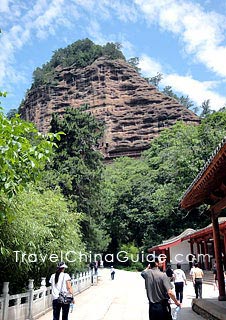 |
| Maiji Mountain, Gansu |
If you want to gain the most complete understanding of Chinese sculpture art in the shortest amount of time, the Maijishan Grottoes are your best choice. Why is that?
1. Carved into a 142-meter-high (466-foot) cliff, the statues have been remarkably well preserved.
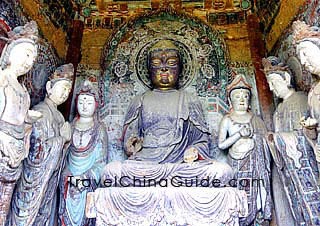
Rarely can one find caves and statues carved over sheer cliffs in China, and this is one of the most distinguishing features of Maijishan Grottoes. Inside the caves are clay statues, whose heights vary from 20 centimeters (about 8 inches) to 15 meters (over 49 feet). Besides 194 Buddhist caves and niches, containing more than 7,200 clay statues, there are also murals of over 1,300 square meters (about 1,555 square yards) in the Maijishan Grottoes as well. These statues are works of art that reflect ancient craftsmanship and dedication to the Buddhist ideal. Being carved on the cliff, these caves are connected by plank roads that hang precariously along the face of the cliff. Visitors can only reach each cave by using these plank roads, which offers a breathtaking experience.
|
|
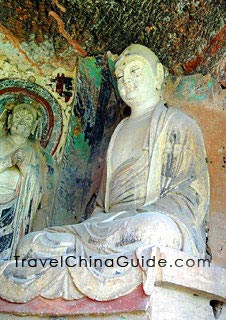

2. Continuous construction over time has preserved sculpture art from different dynasties.
Another curious feature of the statues is their trend toward secularization, that is, a move toward depicting the icons as man rather than God. Except for statues built in the early period, almost all Buddhist statues look affable and accessible. They were no longer gods standing high in the heaven, but rather became more like common people.
|
|
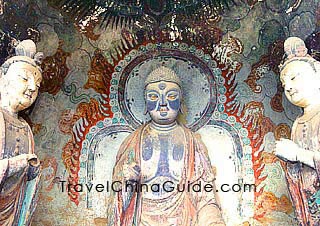
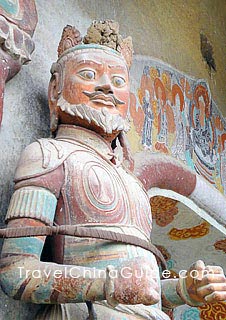
3. Known as the “Oriental Sculpture Gallery”
There are other places of interest near Maiji Mountain as well, Xianren Cliff, Shimen Mountain, Quxi and Maiji Arboretum, all offer fine panoramic views of mountains, rivers and plants in Northwest China.
 |
| Maiji Caves, Lanzhou |
How to get to Maijishan Grottoes from Lanzhou?
2. Take a normal train from Lanzhou Railway Station to Tianshui Railway Station and it takes4 - 5 hours. Then, take bus 34 to Maijishan Tourist Center, which takes about 1 hour.
| Entrance Fee | CNY 80 Free for children under 1.2m (3.9 feet). Note: Some caves with higher protection levels require an extra fee. |
|---|---|
| Opening Hours | Apr. - Oct.: 8:30 - 17:30 Nov. - Mar.: 9:00 - 17:00 |