20 Inscriptions of Longmen Grottoes
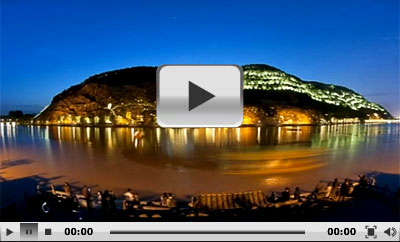
13 kilometers (8.1 miles) south from Luoyang lies the famous Longmen Grottoes. On Longmen Mountain and Xiangshan Mountain stretching along the two banks of the Yi River, there are 1,352 caves in the cliff excavated from the Northern Wei Dynasty (386 - 534) to the Northern Song Dynasty (960 - 1127). 2,345 niches, over 100,000 statues, and 2,800 tablets with inscriptions were carved and kept in these caves. Among all the engraved tablets, the Twenty Inscriptions of Longmen Grottoes are the archetypes of Northern Wei calligraphy and the most precious relics of Longmen Grottoes.
19 of the 20 inscriptions are inside the Guyang Cave, and one in the Cixiang Kiln, the No. 660 Cave outside the Old Dragon Cave. The 20 inscriptions are all poems engraved on the stone tablets for special statues. They are even more famous than the delicate sculptures. They were made at the request of some royal families, officials and eminent monks during the Northern Wei Dynasty to sing the praises of Emperor Xiaowen or pray for their deceased family members. The 20 inscriptions not only record these important historical facts, but also are excellent calligraphy examples of the Northern Wei style. The calligraphy in the Northern Wei Dynasty featured characters with a compact structure. The main parts of the characters are at the bottom instead of being equally distributed. Another feature of the inscriptions is that there are some characters intentionally written incorrectly by adding or cutting strokes.
Most of the 20 inscriptions are set in niches together with specific statues on the north wall of the Guyang Cave. Here is an introduction to the main ones:
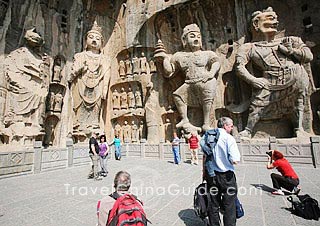
Inscription for Statue of Maitreya Making for Niu Jue
Inscription for Buddha Statues Made by Yifu for Her Husband
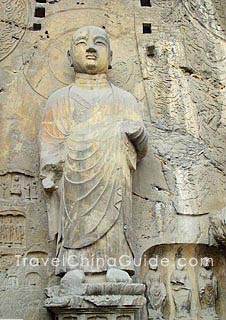
Inscription for Passed Father Shiping
Inscription for Emperor Xiaowen Made by General Yang Dayan
Inscription for Buddha Statue Making for Grandson Bao
Inscription for Buddha Statue Making for Zheng Changyou’s Family Members
Besides the above, there are also other outstanding works, including Inscription for Buddha Statue Made by Sun Qiusheng, Inscription for Statue Made by North Sea Prince Yuan Xiang, Inscription for Statue Made by Xie Boda, Inscription for Sakyamuni Statue Made by Wei Lingcang, etc. Recommended Tours including the visit of Longmen Grottoes:
Spotlights of Luoyang: 3 days to visit Shaolin Temple & White Horse Temple, etc
One- Day Express Train to Luoyang: Express train tour to visit Shaolin Temple and Longmen Caves
Ancient Capitals Xi'an & Luoyang: 5-day tour to visit the popular attractions of these two ancient cities
 Reply
ReplyThanks,
Dr. Ron Kantor
 0
0 0Reply00ReplyReply
Can you confirm its closing time. ( 6.00 pm, 6.30 pm or 9.00 pm).
Thank you.
10ReplyFebruary 1 to March 31: 08:00 - 18:00
April 1 to October 7: 08:00 - 18:30
October 8 to October 31: 08:00 - 18:00
November 1 to November 31: 08:00 - 17:00
In addition, ticketing stops one hour before the closing time. The scenic area is cleared one hour after the closing time.:)
Reply01ReplyReplyI was thinking of doing the day tour to the Longmen Grottoes and the Shaolin Temple from Xi'an by the high speed train.
Is it really possible to see both of these attractions and go too and from xian in the one day? My contact in China said they did not think this was possible, as it is simply to much travel time between cities and sites.
Could you help and give me a break down of your itinerary for what you would do to achieve this? Like how long you would leave for each attraction and what transport and how long it takes by that transport to reach each attraction and back.
Really want to see both attractions - but need to know if it is really possible or if it is best to just pick one.
Xi'an - Luoyang - Longmen Grottoes - Shaolin Temple/Show - Back to Luoyang? - Xi'an
Thankyou!!
02ReplyReplyam planning to visit longmen and shaolin temple in one day , and i need to know how much time it takes for both of them to see everythng , please recomend for me :)
01Reply