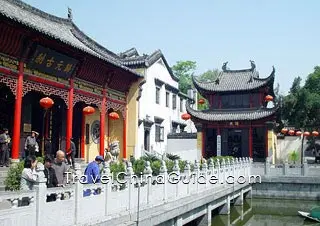
Covering an area of about 46,900 square meters (approx. 55,812 square yards), Guiyuan Buddhist Temple is situated in the west section of Hanyang district in Wuhan City. Being one of the four best temples in Wuhan, the temple, which was originally established in 1658 in the Qing Dynasty (1644-1911), was initially built on the site of Wuzhangpu Kuiyuan in the Ming Dynasty (1368-1644). The word 'Guiyuan' originates from a sutra, meaning to surpass the circumscription of existence and extinguishment, to return to purity and tranquility.
Though it is a construction of a Buddhist temple, it is also in a garden style. The distribution is compact, and the design is delicate. The temple is even interspersed by kiosks and parterres.
There are five courtyards in Guiyuan Temple: the eastern courtyard, the western courtyard, the southern courtyard, the northern courtyard, and the middle courtyard. Its distribution is in the shape of a cassock. Initially, the temple was not completed, but was extended in the next several decades to reach the present scale.
 | | Wuhan Guiyuan Temple | | |
Eastern Courtyard in Guiyuan Buddhist Temple
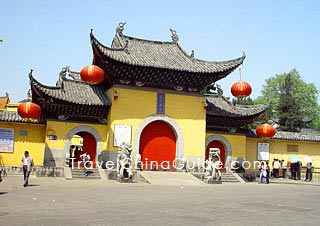
The eastern courtyard is the entrance of the temple, in which a large apricot coloured door opens towards the east, indicating the importance of forming kind relationships and saving all human beings from sufferings. On the lintel of the door, a tablet is hanging with the name of the temple written on it.
Northern Courtyard in Guiyuan Buddhist Temple
Upon arrival, you can see the northern courtyard to your right, in which the Amitabha, Kwan-yin Bodhisattva, and Dashizhi Bodhisattva are worshipped. Collectively they are called the 'three western saints'. The Wenshu Bodhisattva and Puxian Bodhisattva are also worshipped. The Sutra Collection Pavilion in the courtyard has a rich collection of cultural relics of Buddhism, figures of Buddha, religious paraphernalia, stone carvings, paintings, calligraphies, and books from abroad.
Southern Courtyard in Guiyuan Buddhist Temple
In the southern courtyard, the most famous hall is the Lohan Hall. It is also one of the five best Lohan halls in China. The 500 Lohans here are vivid and lively just like real people. They are all identical in size, and each is no more than 25 kilogram's in weight. What is most amazing is that one can never find two Lohans with the same appearance or expression. They are all totally different from each other. Counting Lohans in the courtyard forms an interesting custom in Wuhan. It is said that one can know the disasters and fortunes in the present year by counting the Lohans. The method is like this: counting from the discretional Lohan in the direction according to one's first step into the hall until he has counted the numbers of his age. When he reaches the last Lohan, the expression of it will tell him all.
 | | Grand Hall | | 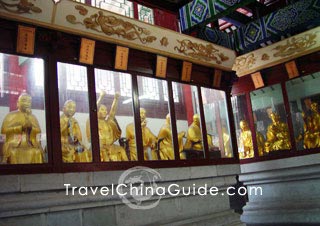 | | Statues of Eighteen Arhats | |
Middle Courtyard in Guiyuan Buddhist Temple
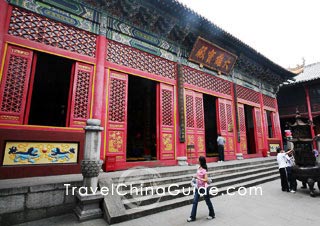
In the centre of the middle courtyard, there is the Daxiong Baodian. The statue of Sakyamuni in this hall is the biggest Buddhism figure in the Guiyuan Temple. A lion that is said to be the image of Sakyamuni in pre-existence lies to the north of the statue. Behind the statue, some other figures are worshipped.
Now the temple attracts people from both home and abroad to admire its wonderful architecture, delicate yet perfect statues, and the large collection of precious items.
How to get to Guiyuan Buddhist Temple
1. Take
Metro Line 4/
Line 6 to Zhongjiacun and then walk southwest for 10 minutes to the temple.
2. Take bus 26, 42, 79, 413, 531, 535, 541, 553, 585, 607, 608, 629, 637, 705, 707, 708, 710, 711, 740, 803, Trolleybus 5 or 7 to Hanyang Dadao Hanyang Huochezhan, and then walk south for 15 minutes to get there.
 You May Like Top 10 Things to Do in Wuhan
- Last updated on Jul. 24, 2026 by Sherry Xia -