Wuhan Travel Guide
Wuhan Facts
Chinese Name: 武汉 (wǔ hàn )
Population: 12,000,000
Area: 8,596.15 square kilometers (3,318.99 square miles)
Location: in the west of Hubei Province, central China
Administrative Division: 13 districts (Jiang' an, Jianghan, Qiaokou, Hanyang, Wuchang, Qingshan, Hongshan, Caidian, Jiangxia, Huangbei, Xinzhou, Dongxihu, Hannan); 1 county (Suixian); 1 county-level city (Guangshui)
Area Code: 027
Zip Code: 430000
GDP (2019): CNY 1,622.321 billion (USD 235.153 billion)
China’s Main Industrial & Transport Center
Wuhan, the capital city of Hubei Province in central China, is situated on Jianghan Plain, a river-crossed fertile land created by the Hanjiang River joining the Yangtze River. This is a routine port for a Yangtze River cruise. Divided by the Yangtze, Wuhan is known as the 'Three Towns of Wuhan' with Hankou and Hanyang on the west bank, and Wuchang on the east.
Being an important industrial base in China, Wuhan has developed a complete industrial system of iron and steel, automobile, optoelectronics, chemical industry, metallurgy, textile, shipbuilding, manufacturing, and medicine. This city is also China’s main transport hub as its high-speed rail network radiates most cities of China and flights to the world. It takes about 5 hours to Beijing, Shanghai, Chongqing, Shenzhen and Hong Kong by train while there are 40 direct overseas routes to four continents. Moreover, Wuhan is an important science and education City in China. The number of colleges and universities ranks third in China.
Beautiful cherry blossom, wonderful lake and river views and abundant snacks all add unique charm to Wuhan. In March, cherry blossoms in full bloom in Wuhan University and Mo Mountain attract tourists from all over the country. And the picturesque East Lake and night scenery of Yangtze River will make you intoxicated. All kinds of breakfasts in Hubu Alley are particularly attractive. A bowl of Hot and Dry Noodles is an indispensable delicacy in the life of Wuhan people.
In the Qing Dynasty (1644 - 1911), Hankou became one of the four best-known towns in the country. For centuries, Wuhan has been the center of trade and transportation in central China. Today it is an important hub in central China and a feature of Yangtze River cruises for sightseers and businessmen traveling from Sichuan to Shanghai or Hong Kong.
The uprising voice of the Revolution of 1911 was heard here firstly. The revolution which aimed to overthrow the autocratic monarchy of the Qing Dynasty (1636 - 1912) and establish the Republican government is one of the great events in modern China.
|
|
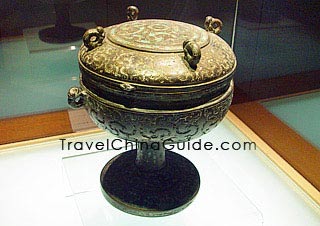
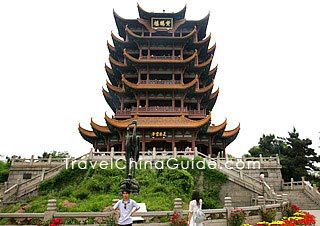
Wuhan is the place to find both history and natural wonders. Hubei Provincial Museum and Yellow Crane Tower are two places to appreciate ancient Chinese history and culture. In the museum, chimes excavated from tombs reveal the incredible achievements of ancient people in music, acoustics and metallurgy. The classic poems and inscriptions on the tower, (although unrecognizable to most Westerners) can inspire your spirit as you pretend to be a poet with a bird's-eye view of the river from the tower window. In addition, the famous Villa of Chairman Mao Zedong on the scenic bank of East Lake, Wuchang, is an ideal place for Westerns to learn more about him. Travelers going to Wuhan can also visit these attractions:
 Hubei Cuisine Featured Snacks Western Style Food
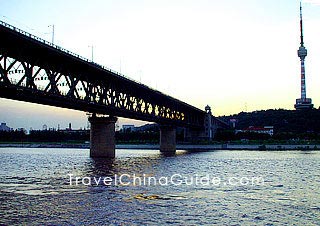 |
| Yangtze River Bridge |
Wuhan is also a city with impressive nightlife. Today people have more entertainment choices than ever before. Instead of watching TV at home, locals go to the cinema with friends, or spend the evening at disco parlors, karaoke rooms, bars and pubs and other interesting places.
240-hour Visa-free Transit has been implemented at Tianhe International Airport. Passport holders from 54 eligible countries, such as USA, Russia, United Kingdom, France, Japan, South Korea and Singapore, can enjoy up to 240 hours free transit in 24 provinces when they take an international transfer at 60 open ports in China including Wuhan Airport. See more Top 10 Things to Do in Wuhan Recommended Tour Itineraries of Wuhan:
Hiking Adventure
Golf Vacation
 Further Reading
9 China Famous Cities for Study Tour
China Population by City: List of 50 Most Populated Cities