The Guge Kingdom in Tibet experienced a brief period of ascendancy which lasted for about 700 years. Today two of its remaining glories have been left behind. One is its political center,
the Ruins of Guge Kingdom, and the other is its religious center, the sublime Tholing Monastery.
History
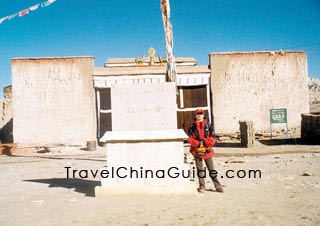
Tholing means 'hovering in the sky forever' in Tibetan, and this indicates the imposing position occupied by the monastery. The Tholing Monastery is located in Zanda County, in the Ngari Region of western Tibet. Built by the second king of the Guge Kingdom in 996, it was the oldest Buddhist temple in the region. During its heyday, it was the main centre for the translation of Buddhist scriptures and the holding of religious ceremonies. The kingdom's dominant function in introducing Buddhism to the heart of Tibet also contributed much to this temple. In the middle of the 11th century, the high lama from India Atisha lived and gave sermons there. Then in the year 1076 a religious ceremony to memorize the nirvana of this master was held there during the peak period of this glorious monastery. In subsequent years, the Tholing Monastery weathered several vicissitudes and was finally recognized as a cultural relic of national importance under the protection of the state at its 1,000th anniversary.
The Tholing Monastery incorporates the craftwork of the architecture and Buddhist statues of neighboring India, Nepal and Ladakh (the present area of Kashmir), imitating the style of the archetypal Tibetan temple - the
Samye Monastery. The groups of buildings here include halls, monks' residences and pagodas, among which the most worth seeing are the Jiasha Hall, Red Hall, White Hall and the 108 Pagodas.
Jiasha Hall
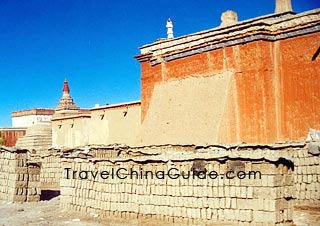
The Jiasha Hall is the main building and serves as the symbol of Tholing Monastery. From above, it looks like the Chinese character ya '亚'. The central hall symbolizes the highest mountain in Buddhism - Mount Meru. The surrounding small halls represent the four continents while the pagodas in the four corners stand for the Heavenly Kings guarding the sutras. The statue of Tathagata Buddha is enshrined in the central hall, and the murals remaining in the other small halls are extremely beautiful. Their style and taste echo the artistry of the Ruins of Guge Kingdom.
Red Hall
The Red Hall was the assembly place for the monks. The most impressive remains here are also the murals which depict many stories. The mural of the Sixteen Vajra Dancers on the porticos is especially lovely.
White Hall
The White Hall is where the statue of Sakyamuni stands. There used to be 14 other sculptures, however only their pedestals remain now. In the murals here, you can find pictures of the king, Atisha and other high lamas.
108 Pagodas
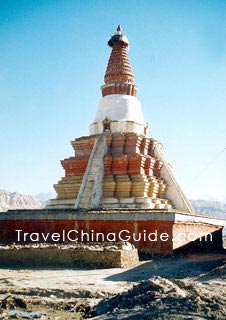
Another sight worth visiting is the group of pagodas beside the Xiangquan River. They are all made of earth and arranged in an orderly line hundreds of meters long. There are 108 pagodas in all, hence the name '108 Pagodas'. At sunset the reflection of the sun's rays from the yellow pagodas makes for a beautiful and breathtaking scene.
How to get to Tholing Monastery
The Tholing Monastery lies not far from Zanda County. You can walk north from there.
- Last updated on Apr. 08, 2021 -
 Tholing Monastery Pictures