Ruins of Guge Kingdom
 |
 Ruins of Guge Kingdom Pictures Ruins of Guge Kingdom Pictures |
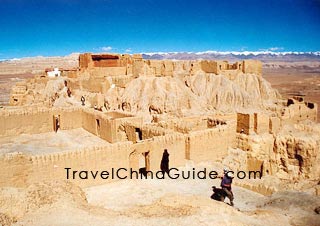
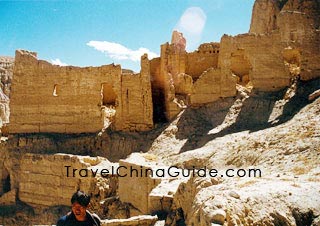
Established in about the 10th century, it was founded by one branch of descendants of a nearby crumbled Kingdom. It was ruled by about 16 kings with armies of tens of thousands of soldiers during the over 700 years in which it flourished.
Then in the 1660s, conflicts resulting from power disputes within the imperial family emerged which engendered restlessness in society and induced civil uprisings. To win power in the disordered state, the brother of the king asked the ruler of the neighboring country Ladakh (the present Kashmir) to send his army to help. This army overthrew and conquered the kingdom. Only years later was power returned to Tibet. During its lifetime the Guge Kingdom played an important part in the economic and cultural development of Tibet. It advocated Buddhism, and many versions of this religion were created here and their teachings were spread from here into the heart of Tibet. It also served as a major center for Tibet's foreign trade.
 |  |
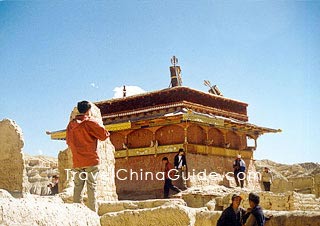 |
| The Red Temple, Ruins of Guge Kingdom |
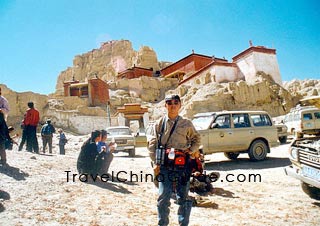
Perhaps the most interesting aspects of Ruins of Guge Kingdom are the five temples and palaces - the White Temple, Red Temple, Samsara Temple, Imperial Palace, and Assembly Palace. Many inscriptions, statues and murals are displayed inside these. The most complete and valuable artifacts remaining are the murals, which are mainly pictures of Sakyamuni, the king, queen, prince and other royal servants. Beside, in the sanctuary pictures of the cultivation of male and female Esoteric Buddhas can be found. The margins are painted with dozens of nude Dakinis. The colors and lines of the murals can be compared with those of the Mogao Caves in Dunhuang City, Gansu Province. Most of the statues here are golden and silver Buddhist statues, among these the Silver Eyes of Guge is of the highest achievement.
How to get to Ruins of Guge Kingdom
The Ruins of Guge Kingdom lie 18 km. (11.18 mi.) from Zanda County. Visitors can get there by taxi or motorbike .
| Entrance Fee | CNY 50 |
|---|---|
| Opening Hours | 8:00 - 19:00 |
- Last updated on Aug. 15, 2025 by Demi Li -