Iron Gate Pass
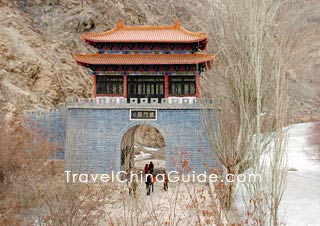 |
| Iron Gate Pass, Korla, Bayingolin |
Iron Gate Pass is a part of an arduous section of the Silk Road which one needed to travel to reach Tarim Basin located in Xinjiang, the largest interior basin in China. The Tiemen Pass lies in Tieguan Gorge which has been a strategic location since ancient times. A famous poet named Cen Sen in the Tang Dynasty (618-907) once wrote a poem depicting the steepness of the pass. In his poem the gate is a place where people worry seriously about how to pass through, and where persons are rarely seen. Looking upwards, you can only see the cliff; looking downwards, the torrential water rushes with waves churning in Kongque River.
Many tourists come to visit the Iron Gate Pass because they are attracted by a famous love story. The story is set in ancient times and tells of love between a princess and the son of a minister. They fell in love but the King, the father of the princess, and the King's evil advisor were opposed to their love. Pressure from the King and persecution by the advisor resulted in a tragedy. The princess and the young man suffered so much that together they ultimately leaped to their death into Kongque River. In order to commemorate the two youngsters who sacrificed their life for love and freedom, a tumulus where they are buried together was built on the Gongzhu Ling opposite the Iron Gate Pass.
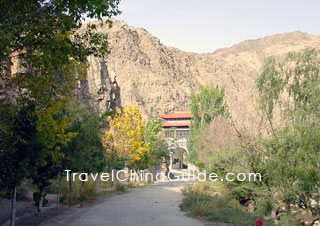 | 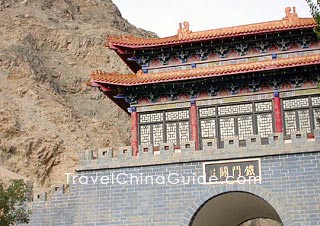 |
Nowadays, the Iron Gate is no longer a place where persons are rarely seen. It was rebuilt in 1989 according to the ancient descriptions. As a result of the efforts of architects, sculptors, and artists, the Iron Gate Pass has become an example of excellent architecture which attracts some 300,000 tourists every year. Mountain climbing enthusiasts will find it a good place to climb. Standing on top of the gate, they can have a panoramic view of the famous Iron Gate Pass.
Passing though the gate tower and moving forward, you will see the Kongque River where a hydropower station was built by later generations. It provides enough electric power for various regions. Roaming along the river, you can find all kinds of blooming flowers, and well-arranged pavilions. The beautiful natural scenery will be a feast for the eyes.
The best seasons to go are early summer and early autumn. After visiting the pass, you can have a picnic in the woods, go boating or rafting in the reservoir, or experience the idyllic life in the local farmyards.
How to get to Iron Gate Pass:
Or take a taxi from downtown Korla. Taxi fare is approximate CNY 40 for a round trip.
| Admission Fee: | CNY 8 |
| Opening Hours: | 08:00-20:00 |
| Recommended Time for a Visit: | 3 – 4 hours |
 Nearby Attraction
 Bosten Lake
- Last updated on Aug. 15, 2025 by Demi Li -