Tang Dynasty
Viewing the Chinese history record, you will find the Tang Dynasty was the most glistening historic period in China's history. Founded in 618 and ending in 907, the state, under the ruling of the Tang Emperors, became the most powerful and prosperous country in the world. Particularly, in this glorious period, the economy, politics, culture and military strength reached an unparalleled advanced level.
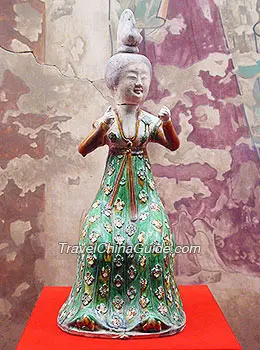 |
| Tang Tri-colored Glazed Pottery |
Establishment
At the end of Sui Dynasty (581 - 618), the whole country fell into chaos due to the tyranny of Emperor Yang; rebellions roused by peasants were everywhere. Resenting Emperor Yang's ruling, the chief officer of Taiyuan - Li Yuan, who was also known as Tangguo Gong (a vassal in Sui Court) raised an army in Taiyuan from May 617. In November of the same year, Li Yuan's army captured the capital city Chang'an (currently Xian) and put a new monarch, Yang You, on the throne as Emperor Gong. Meanwhile, Li Yuan proclaimed himself Da Chengxiang (prime minister) and Tang Wang (King of Tang). In 618 after Emperor Yang was killed by his chancellor, Yuwen Huaji, Li Yuan seized the chance to proclaim himself emperor and changed the state title into Tang, still with Chang'an as the capital city.
Glorious Period
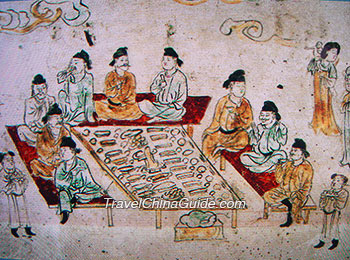
The first glorious period was from 627 to 649 when the Tang Dynasty was just set up and its national strength was recovering from the previous weak condition. Under Emperor Taizong Li Shimin's wise governing, the national strength and social development reached an unparalleled prosperity - economy and commerce flourished, the social order was stable, corruption never existed in the court and the national boundaries were even open to foreign countries.
|
|
In 705, a coup broke out which brought one of the former emperors, Li Xian, to the throne as Emperor Zhongzong. However, Emperor Zhongzong's ruling was manipulated by his wife, Empress Wei. In 710, plotting to be the second woman emperor, Empress Wei along with Princess Anle poisoned Zhongzong. At that time, Li Longji (son of Li Dan) launched a coup with the assistance of his parental aunt Princess Taiping, killing Empress Wei and Princess Anle. After that, Li Dan was crowned as Emperor Ruizong.
The second glorious period was during Emperor Xuanzong's reign. In 712, Emperor Ruizong abdicated and Li Longji was enthroned as Emperor Xuanzong. Under his ruling, the national economy, politics and culture all developed rapidly and the social development entered a new heyday. In that period, Chang'an City was the largest and the most prosperous metropolis in the world. Since the title of Xuanzong's reign was Kaiyuan, that period was called the Heyday of Kaiyuan, in which the dynasty reached its summit of prosperity.
|
|

Decline and Ruin
In his old age, Emperor Xuanzong was complacent and indifferent to state affairs. Hopelessly, he indulged himself in the beauty of his concubine Yang Yuhuan. Besides, he also appointed some wicked chancellors who corrupted the political order. Meanwhile, troops on the frontiers gradually gathered together and formed a powerful military force. In 755, An Lushan aligned with Shi Siming and launched a rebellion, called the An Shi Rebellion which lasted for eight years and heavily knocked the Tang regime. From then on, the national strength was weakened daily by separatist forces in local areas. Because of the incompetence of the emperors the dominance of the eunuchs and power struggles between chancellors became increasingly intense. Hence the Tang Dynasty declined from generation to generation. In 859, a large-scale peasant uprising launched by Huang Chao again severely attacked the Tang regime. In 907, the last Tang emperor, Emperor Ai was forced to abdicate by Chancellor Zhu Quanzhong, who afterwards changed the state title into Liang, finally putting the ever powerful and mighty dynasty to an end.