Empress Wu Zetian of Tang Dynasty
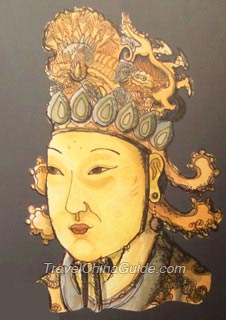 |
| Portrait of Empress Wu Zetian |
Wu Zetian was born in 624 in Wenshui county, Shanxi Province. Her father Wu Shihuo was one of the meritorious chancellors of the Tang Dynasty. When she was young, she read many books and received a good education from her father. At the age of 14, she was selected to be Emperor Taizong's Cai Ren (a kind of Tang concubine) because of her beauty and intelligence. During that period, her literary talents impressed Emperor Taizong who permitted her to assist as a secretary. This enlarged Wu's insight and knowledge of state affairs. It was also then that Wu began to attract the attention of Prince Li Zhi who later became Emperor Gaozong. In 649 when Emperor Taizong died, Wu was sent to Ganye Temple to be a nun. After Emperor Gaozong ascended the throne, his adoration of Wu remained. Just at that time, Empress Wang and concubine Xiao Shufei were struggling for the emperor's favor. During this time Wu Zetian was recalled to the palace and given the title Zhao Yi (a kind of Tang concubine). Ambitious Wu was not satisfied with this title. In order to get the position of empress, she killed her baby daughter with her own hands and imputed it to Empress Wang. In this way, she made Emperor Gaozong depose Empress Wang. In 655, Wu Zetian successfully became the empress, launching her political career.
After Wu Zetian became empress, many of the state affairs were up to her for final decision since Emperor Gaozong was weak-minded. In that period of time, Wu managed to remove a group of political enemies thus clearing away all the obstacles in her political career. Beginning in 660 when Emperor Gaozong caught an eye disease, Wu began to grasp all the real power in the guise of assisting the Emperor in dealing with state affairs. In 674, Emperor Gaozong changed his title into Tian Huang (Emperor of Heaven) while Empress Wu Zetian changed her title into Tian Hou (Empress of Heaven). Meanwhile, people in the street called them Er Sheng (two gods). In 683, Emperor Gaozong died. Successively, she put her two sons, Li Xian3 and Li Dan, onto the throne as Emperor Zhongzong and Emperor Ruizong. Actually, the real power always remained in Wu's hands. In 690, Wu deposed Emperor Ruizong and proclaimed herself Emperor Zetian. By changing the state title into Zhou, she realized her long-cherished imperial dream.
|
|
As emperor, Wu Zetian's reign was regarded as an indispensable link between Emperor Taizong's Zhen Guan Reign and the Emperor Xuanzong's Heyday of Kaiyuan. Wu Zetian was a bold reformer of the educational and personnel selection systems. She developed and improved the Keju Educational System, which originated in the Sui Dynasty (581 - 618). She also appointed many talented people, regardless of their family status. Second, she attached great importance to agricultural production. By rewarding those local officials who developed agriculture well in their administrative areas and punishing those who imposed too much tax on peasants, Wu's measures greatly improved agriculture production. Additionally, she paid close attention to military defense and foreign relations, including setting up a military administration in the northwest area where the Silk Road was reopened after a period of interruption. Overall, in Wu Zetian's reign, a powerful centralized regime was formed, with a prosperous national economy and stable social order. Nevertheless, she also had many faults. For example, she appointed many cruel officials whose behavior disturbed the normal order of the court and brought much hardship to the common people. What's more, Wu's personally killing her sons (Li Hong and Li Xian2) and her baby daughter only to achieve her political aims incurred much historical condemnation.
Like many emperors in history, Wu Zetian became increasingly obsessed with pursuing longevity in her later years. After 697, she began to embrace Taoism, a religion that believes one can transcend the boundaries of life and death and achieve immortality through spiritual cultivation. It is said that she even sent an envoy to Song Mountain, considered the center of heaven and earth, to drop a golden slip, praying to the Taoist deities for blessings and longevity. However, the quest for immortality could not alter the course of her life.
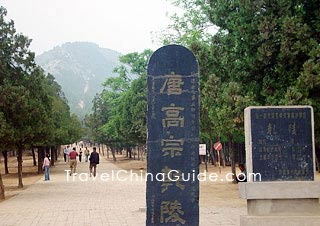
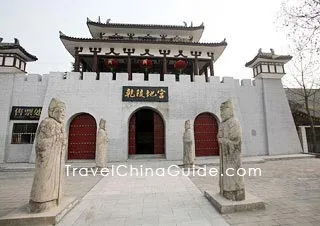
After 15 years of ruling, Wu Zetian was severely ill at the beginning of the year 705. Under pressure from many chancellors, Wu finally agreed to yield the throne to her son Li Xian3, who resumed the throne as Emperor Zhongzong. In November of the same year, the female emperor of the times passed away. Later, she was buried with her husband, Emperor Gaozong, in Qian County of Shaanxi Province, in a joint tomb known as the Qianling Tomb.
Recommended Tours

- Last updated on Jan. 22, 2026 by Sule Su -