Tie-dyeing in Zhoucheng
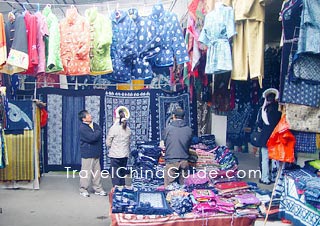 |
Souvenirs made of tie-dyeing cloth Zhoucheng Tie-Dyeing Pictures Zhoucheng Tie-Dyeing Pictures Zhoucheng Tie-Dyeing Video Zhoucheng Tie-Dyeing Video |
Tie-dyeing is a technology of printing flower patterns on cloth. As the name suggests, the process is divided into "tie" and "dye". Tie refers to making the cloth into certain shapes by pinching, creasing and flanging it according to the flower patterns. They are then sew or tie tightly together to make a bunch of knots. The aim of tying the knots is to dye the untied part while retaining the original color of the knotted parts. The tighter the knots are tied, the better the effect of the color printing will be achieved.
The dyeing process involves first soaking the 'knots' into clear water, followed by immersing them in the dye vat for a period of time before taking them out to dry. After drying, they are again put back in the dye vat and the process is repeated until a satisfactory color is achieved. Once dried, stitches are taken out of the knots and the cloth is smoothen out to reveal that part of the cloth which was sewn and form beautiful flower patterns and the dye crease marks.
|
|
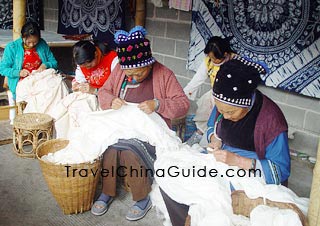
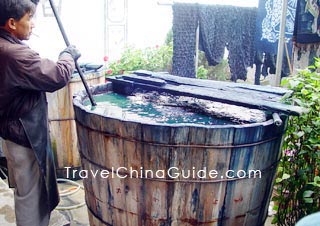
The tie-dyeing products in Zhoucheng Village are well sought after, both at home and abroad. Do drop by and witness for yourself the process of this historical craftsmanship. Who knows, you will return home with some cheap and beautiful crafted cloths.
 You may like: Top 10 Things to Do in Dali
- Last updated on Jul. 18, 2022 -
Questions & Answers on Tie-dyeing in Zhoucheng
Asked by Phyllis Weberman from USA | Dec. 28, 2014 10:22 Reply
Reply
ReplyBuy and ship Bai Tablecloth
Need a , tablecloth that is 2.5meters by 1.3 meters (about 98inchx50inch) Can this size be created, ordered and paid for and mailed out to USA? If so, suggest where I can view patterns.
Thank you,
Phyllis Weberman
Thank you,
Phyllis Weberman
Answers (1)
Answered by Julie from SINGAPORE | Dec. 29, 2014 03:39 0
0 0Reply
00ReplyIt should be fine to make a tablecloth in such a size. I just know there are several famous tie-dyeing workshops there, but don't have their contact. If you have any Chinese friend, I suggest you ask him or her to contact directly.
Asked by Mrs.Michelle Chin from MALAYSIA | Apr. 15, 2011 12:12Reply
ReplyDear Andrew,
we will arrive at Kunming on 6 June 2011 afternoon , we plan to go to Dali on 7 June 2011 and then bus to Zhoucheng. Can you quote to us the transportation from Kunming to Dali ? by air or by road ? , hotel booking at Zhoucheng ? we plan to leave Kunming on 11 June 2011 . do we have enough time to visit Lijiang ?
Thank you
Michelle
we will arrive at Kunming on 6 June 2011 afternoon , we plan to go to Dali on 7 June 2011 and then bus to Zhoucheng. Can you quote to us the transportation from Kunming to Dali ? by air or by road ? , hotel booking at Zhoucheng ? we plan to leave Kunming on 11 June 2011 . do we have enough time to visit Lijiang ?
Thank you
Michelle
Answers (1)
Answered by Mr.Frank | Apr. 16, 2011 00:5200Reply
00ReplyYou can either take a bus or a train from Kunming to Dali. It takes about 7 hours by train and the ticket is around CNY100 for a hard sleeper and CNY130 for a soft sleeper. If you take a bus , it takes about 5 hours and costs about CNY80.
Asked by Ms.Michelle Chin from MALAYSIA | Apr. 04, 2011 04:20Reply
ReplyHello !
If we fly from Malaysia to Kunming, how to get to Zhoucheng the Tie dye factory ? how far from kunming City. how about Dali ? how far from kunming by road.
I need to order Tie Dye table cloth and bed sheet , do you quote whole sales prices ? I did order this products from canton fair 4 years ago but now I can not find any supplier from canton fair making Tie Dye? so we thinking of go to the source area.
Thank you
Michelle
If we fly from Malaysia to Kunming, how to get to Zhoucheng the Tie dye factory ? how far from kunming City. how about Dali ? how far from kunming by road.
I need to order Tie Dye table cloth and bed sheet , do you quote whole sales prices ? I did order this products from canton fair 4 years ago but now I can not find any supplier from canton fair making Tie Dye? so we thinking of go to the source area.
Thank you
Michelle
Answers (1)
Answered by Mr.Andrew | Apr. 06, 2011 23:0802Reply
02ReplyZhoucheng is in Dali, so you have to go to Dali first. The you can shift to bus from Dali Xiaguan bus station to get there. Many villagers in Zhoucheng have tie dye workshop, they are the suppliers.