Ningbo Attractions
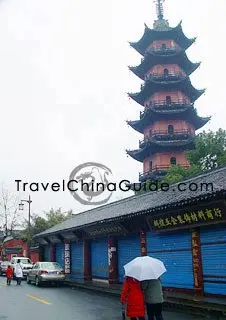 |
| Tianfeng Pagoda |
 Baoguo Temple Tianfeng Pagoda Tianyi Pavilion Yandang Mountain Hangzhou Bay Bridge Xikou-Tengtou Tourist Area
Ningbo, with its beautiful natural scenery and wealth of historical attractions throughout its 7000-year history, draws tourists from all over the world. Culture Relics
Ningbo is the birthplace of the Hemudu Civilization. The Hemudu Site is one of the earliest Neolithic Age sites discovered in China. It is situated in the Yuyao Town, just 20 kilometers (12 miles) from the city proper. The site covers an area of 40,000 square meters (9.8 acres), and contains four different layers, each representing a different cultural age - the deepest layer of which goes back around 7000 years. Over 7000 artifacts have been unearthed from the site. These include a number of implements and tools made from bones, jade, wood and clay. The remains of buildings, animals and even cultivated rice have also been discovered in the area.
Thousands of years' history left Ningbo with abundant cultural relics which reveal the great importance of this city in Chinese history, especially in terms of Buddhism. The Asoka Temple is one of the most prominent of the city's cultural relics. It is one of the 'Five Mountains' of Buddhism in China - the 'Five Mountains' referring to the five official temples with the highest status in Chinese history.The temple is famed for the dagoba which houses the Buddhist relics of Sakyamuni, the founder of Buddhism. (Dagoba is similar to pagoda yet it usually refers to which houses the relics of the eminent monk.)
Ningbo is also home to a number of other prestigious temples: one of those is the Baoguo Temple ,a wooden-structured building first erected during the Northern Song Dynasty (960-1127).
Another local Buddhist sanctuary is Tiantong Temple, which lies at the foot of Taibai Mountain. It covers an area of almost 60,000 square meters, one of the largest of its kind in China. It contains over 720 uniquely structured buildings,each subtlety decorated and finely designed.
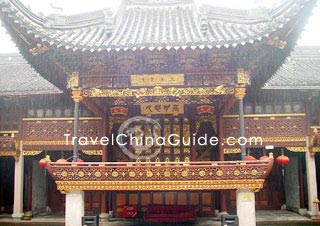 |
| Tianyi Pavilion |
The city's Tianyi Pavilion and Tianfeng Pagoda are also worth visiting. Tianyi Pavilion was built during the years 1561-1566. Today, it houses a collection of around 300,000 volumes. Most of them are block printed editions and hand copied books from the Ming Dynasty (1368-1644). The pavilion itself is also surrounded by an elaborate landscape garden. Tianfeng Pagoda, located in the city center, is a seven-storey tower with another seven stories underground. It is renowned for its long history, architectural value and ancient artifacts. Natural Sceneries
The region is blessed with the beautiful natural scenery of the Siming and Tiantai Mountains. The Tianhe Scenic Area lies in the mid-section of Tiantai Mountain, and is actually made up of three separate scenic areas: Big Pine Creek Canyon, Double Peak Forest Park and the On-Water Visiting Area. Big Pine Creek Canyon stretches for 20 kilometers (12 miles), and is known as the 'No.1 Canyon in east Zhejiang Province'. The canyon contains numerous peaks, rock formations and waterfalls.
7 kilometers (4 miles) to the southeast of the city centre, Dongqian Lake adds much charm to the cityscape. It is four times larger than the West Lake and is the largest fresh water lake in Zhejiang Province. Surrounded by green mountains, the lake with its serpentine bank is one of the city's most attractive locations. There isn't tourist infrastructure like West Lake Hangzhou, but the Xiayu Temple is a jewel. Take care: the public buses (from train station) to there needs 2 hours, stops 50 times and it's a fighting to get on them by departure of the Lake.
Another great place for relaxing is the Nanxi Hot Spring southeast of the city. Various hot springs and a peaceful environment provide comfort and enjoyment to those that choose to visit. There is also the Ningbo Zoo. To go there always the same buses problem, but the place is great. Situated in a green park you can stay there the whole journey to enjoy nature and a lot of animals.
Tip: To go somewhere have the chinese name writing on a paper, because nobody will understand you if you tell the name of the place where you wanna go in english. Top 10 Things to Do in Ningbo
 Reply
Reply 0
0 0Reply00Reply
Thank you very much for your reply. By the way what is the name of the station where I can get to take the subway line 2?
00Reply00ReplyThank you
Reply20Reply20ReplyThank you for your reply. Do you have their email address that I can write to them. I cannot speak nor can I read mandarin , Thank you.
20ReplyOr you can try to dail the hotline and see whether if they have English service. :)
00ReplySorry for the late reply. I appreciate the information given by you. Thank you very much.
sllim
Reply00ReplyReply00Reply00ReplyReplyI'm in NB right now and is planning to go to places by the first week of October since it's a holiday/no work the entire week. I've been searching for famous attractions but I'm looking for more. I've heard about something like ocean park here in NB. Where's that? How about Harborland. Is it suitable for Kids below 3 years old? Also, is there an entrance fee or tickets for Children below 3 years old?
This may sound stupid, but are there libraries here in Ningbo that displays books in english?
P.S, I've been here in NB for 5 months now and I've been to Moon Lake, Tianyi Square, Fuming Park and that park they called Switzerland.
Thank you!
20ReplyAs for the Harborland at Mt. Fenghuang, it is suitable for kids below 3 years old. The entrance fee is CNY160 for adult and kid under 1.2m can travel for free. As for kids between 1.2m and 1.5m, they get 50% discount.
10Reply01ReplyThank you for that very quick response though I'm not sure if what you meant by 1.2 and/or 1.5m is 1 year and 2 months? If so, 1.2-1.5m get 50% discount, how about 2 years and 7 months old? They get to pay the 160 rmb ticket?
thanks again!
00Reply00ReplyThank you. I was asking about age so I thought m was month/s. lol! Thank you for your help! It's very much appreciated. I'm excited to wander around Ningbo specially now that summer's almost over! :))