West Lake (Xi Hu)
Misty rain tricks the hill.
Plainly or gaily decked out like Xi Zi,
West Lake is always alluring.'
These are the words composed by the famous Song Dynasty poet Su Dongpo (960-1127). In this poem, he compared the West Lake to Xi Zi, one of the four beauties in ancient China. These poetic sentiments depict the charm of the lake which has always been a beautiful and romantic spot since ancient times.
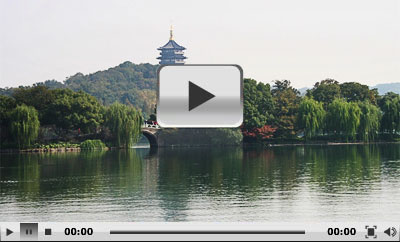
Measuring 3.2 kilometers (2 miles) in length, 2.8 kilometers (1.7 miles) in width, and 2.3 meters (7.5 feet) in average depth, the lake spreads itself in an area totaling 6.5 square kilometers (2.5 square miles). Embraced by mountains on three sides, the West Lake knits itself into the North Inner Lake, the Yuehu Lake, the West Inner Lake, the South Lake and the West Outer Lake by the fabric of the Bai Causeway, the Su Causeway and the Yang Causeway. Between the North Inner Lake and the West Outer Lake lies the largest natural island called the Solitary Hill. In addition, three man-made islands stand in the West Outer Lake: the Lesser Paradise Island, the Mid-lake Pavilion, and the Ruangong Islet; and two famous pagodas by the lake: the Leifeng Pagoda to the south and the Baochu Pagoda to the north.
 |
| West Lake at Dusk |
Nowadays, West Lake is one of the top ten scenic areas in China, getting listed as a World Cultural Heritage Site by UNESCO in 2011. It is famous for the romantic legends and intoxicating scenery.
Legend of West Lake
 |
Top Ten Scenes at West Lake Scenic Area
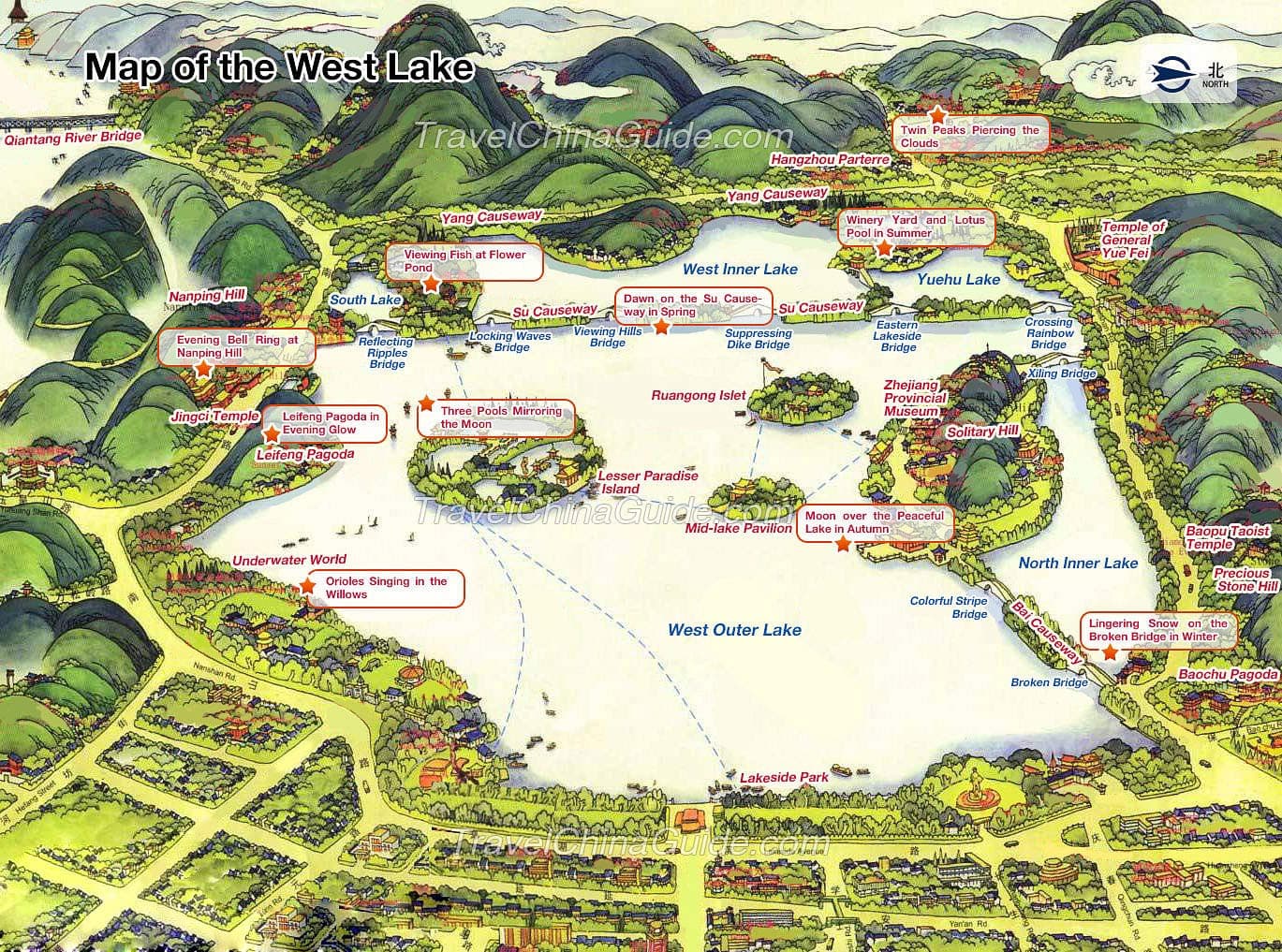 |
| Map of West Lake (Click to enlarge) |
There are many beautiful landscapes in the lake area, and the following are the most famous Top Ten Scenes.
Dawn on the Su Causeway in Spring
As the No. 1 of ten scenes of the West Lake, the Dawn on the Su Causeway in Spring is intoxicating and delighting. With a length of 2.8 kilometers (1.7 miles), the Su Causeway was constructed under the guidance of the great poet Su Dongpo in the Song Dynasty (960-1279). There are six bridges along the causeway, including the Crossing Rainbow Bridge, the Eastern Lakeside Bridge, the Suppressing Dike Bridge, the Viewing Hills Bridge, the Locking Waves Bridge, and the Reflecting Ripples Bridge. There is a willow or a peach tree every certain distance. In spring, the green willow buds and the pink peach blossoms will take the breath of tourists away, hence the fame.
 |
| Su Causeway in Autumn |
Winery Yard and Lotus Pool in Summer
The Winery Yard and Lotus Pool in Summer in the northwest of the lake is a time-honored scenic spot. It is said that there used to be a winery surrounded by lotus flowers in the Southern Song Dynasty (1127-1279) there. The fragrance of the lotus flowers and the aroma of wine waft coherently through the summer air, hence the name of the scenic spot. Presently, the scenic spot comes in five parts, including the Yuehu Lake, the Bamboo Garden, the Lakeside Woods, the Winery Yard, and the Lotus Pool. With a variety of lotus flowers dancing around, a culture of imperial wine back to the Southern Song Dynasty unfolding for you and a sight of southern-China garden coming your way, what an enjoyably unforgettable experience you have!
|
|


Moon over the Peaceful Lake in Autumn
West Lake has been an ideal place to appreciate the glorious full moon since ancient times. The Moon over the Peaceful Lake in Autumn is to the west of the Bai Causeway by the West Outer Lake. It consists of the Imperial Stele Pavilion, an octagonal pavilion, a platform over the lake, and some other buildings. The broad platform is a perfect spot to admire the full moon. In addition, there is a Xiling Calligraphy and Painting Gallery. Tourists can enjoy the beautiful moonlight, and feel the atmosphere of traditional Chinese culture.
Lingering Snow on the Broken Bridge in Winter
The Lingering Snow on the Broken Bridge in Winter scenic spot is at the foot of the Precious Stone Hill to the east end of the Bai Causeway. Built in 1921, the single-span Broken Bridge is 8.8 meters (9.6 yards) long, and 8.4 meters (9.4 yards) wide. When seen from the Baoshi Mountain after snow, the bridge seems as if it were broken because the snow in the middle part has melted while the snow at the ends is still lingering. The remaining white snow is glistening in the sunshine. It is fabulous!
Orioles Singing in the Willows
The Orioles Singing in the Willows Scene is located at the Qingbo Gate to the southeast of the Outer West Lake. It was the largest imperial garden called the Landscape Gathering Garden in the Southern Song Dynasty. Along the nearby dike are willows of various species. At the center of the garden is the Orioles House. Near the Orioles is a gigantic bird cage called the 'Birds' Paradise'. In March, tourists can appreciate the flying willow branches while listening to the warbling of orioles. It is intoxicating!
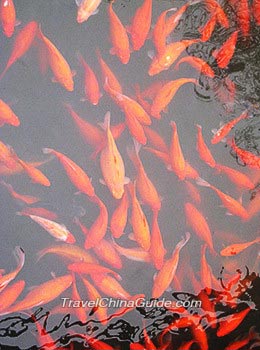
Located at the Red Carp Pond to the south of the Su Causeway, the Viewing Fish at Flower Harbor Scenic Spot is a large park of over 20 hectares (49 acres). It is made up of five scenic spots: flower harbor, the red carp pond, the peony garden, the great lawn, and groves. The whole park is surrounded by the flower harbor, a sightseeing river way that connects the West Inner Lake with the South Lake. The red carp pond at the center of the park is swarming with red carp. Tourists can lean on the rails of a zigzag bridge to appreciate them. To the west of the red carp pond are exuberant groves and the Peony Garden centering on the Peony Pavilion. When these peonies are in full blossom, the gentle breeze blows the petals onto the surface of the lake, forming an amazing scene. To the north of the red carp pond is a large lawn interspersed with arbors for tourists to have a rest. For centuries, the Viewing Fish at Flower Pond has provided natural beauty and cultural connotations for emperors and poets who have expressed their admiration through poems, calligraphy, and drawings.
|
|

Leifeng Pagoda in Evening Glow
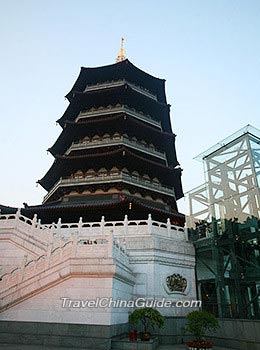 |
| Leifeng Pagoda |
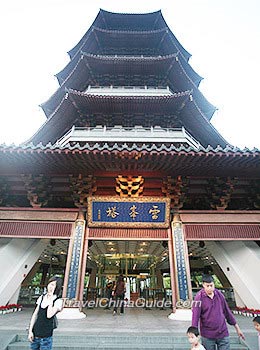
The Leigfeng Pagoda in Evening Glow scene is located at the top of the Evening Glow Mountain to the south of the West Outer Lake. At dusk, the evening glow and the spectacular Leifeng Pagoda are reflected in the rippling lake. It looks very beautiful! The Leifeng Pagoda was constructed by the king of the Wuyue Kingdom to celebrate the pregnancy of his concubine during the Five Dynasties and Ten Sates Period (907-960). It was damaged and renovated several times later. Standing on the pagoda over 70 meters (230 feet) in height, tourists can enjoy the panoramic view of the lake.
Twin Peaks Piercing the Clouds refers to South Peak and North Peak. The South Peak is 256.9 meters (843 feet) in height, and the North Peak is 355 meters (1,165 feet). They face each other across a distance of about 5 kilometers (3.1 miles). The natural scenery is exceptionally beautiful, especially when it is cloudy or after a rainfall. At that time, only the two tops of the peaks can be seen in the thick fog. It looks as if the fog is being pierced by the two peaks, thus the name 'Two Peaks Piercing the Clouds'.
Long ago Buddhist temples and pagodas were constructed on the tops of the two peaks, making the place a great attraction and listed as one of the ten famous scenic sites of the lake during the Southern Song Dynasty. Over the years the temples and pagodas were abandoned and fell into disrepair. During the Qing Dynasty (1644-1911) Emperor Kangxi renamed the area Twin Peaks Piercing the Clouds when he traveled to the lake and erected a pavilion at the Hongchun Bridge on the Lingyin Road.
Evening Bell Ringing at Nanping Hill
The Nanping Hill to the south of the West Outer Lake is less than 100 meters (328 feet) high, but it is more than 1,000 meters (1,094 yards) long. The Jingci Temple at the foot of the Nanping Hill was constructed by the king of the Wuyue Kingdom in 954 during the Five Dynasties and Ten States Period. The famous Xingjiao Temple also at the hill foot was built in the fifth year (972) of the Kaibao Period in the Northern Song Dynasty (960-1127). The bells ring at dawn and drums beat at dust in the temples. The rocks and caves in the Nanping Hill vibrate in resonance with the incoming sound-waves. The beautiful sounds can be repeated again and again.
Three Pools Mirroring the Moon
 |
| Our Guests at Three Pools Mirroring the Moon |
The Three Pools Mirroring the Moon Scene is located to the south of the Lesser Paradise Island. 'Three Pools' refer to the three stone towers and their surrounding water area. The three towers were erected during the Tianqi Period (1621-1627) in the Ming Dynasty. They stand at the vertexes of a regular triangle, 62 meters (68 yards) away from one another. They have a height of 2.5 meters (8.2 feet), with 2 meters (6.6 feet) above the surface of the water in usual time. The towers are made up of a stone pedestal, an empty sphere, a round cover, a small hexagonal pavilion, and a pear-shaped top. There are six holes evenly distributed around the sphere. At full moon night, candles are lit in the sphere, and the holes are covered with thin paper. The holes, along with the full moon in the sky, are reflected in the water. It seems as if there were so many moons. That is quite unique! Additionally, the Three Pools Mirroring the Moon can be found on the CNY 1 note.
Apart from the top ten scenes, the lake is surrounded by many attractions worth visiting, including the Tomb of General Yue Fei, Tomb of Su Xiaoxiao, the Six Harmonies Pagoda, the Baochu Pagoda, Zhejiang Provincial Museum, the Underwater World, and Hangzhou Zoo. China Sightseeing Tours to Top 6 Attractions on CNY Banknotes
Music Fountain of West Lake
The Music Fountain in the Third Park to the east of the lake is very amazing. It is a feast to both eyes and ears. It starts at 19:30 daily and normally lasts 20 minutes.
Show: Enduring Memories of Hangzhou
 Enduring Memories of Hangzhou Ticket Booking
Ticket Prices
| Class | Fare |
|---|---|
| Ordinary Seats | CNY 360; CNY 310 for children between 1.2-1.5m (3.9-4.9 ft). |
| VIP Seats (first five rows) | CNY 420; CNY 370 for children between 1.2-1.5m. |
| Distinguished Seats | CNY 980 |
Entrance Fee
| Attractions | Opening Hours | Ticket Price |
|---|---|---|
| West Lake | All day long | Free of Charge |
| Leifeng Pagoda | Mar. 16 - Apr.: 08:00 - 19:00 May - Oct.: 08:00 - 20:00 Nov. - Mar. 15: 08:00 - 17:30 Ticket selling stops half an hour before closing. | CNY 40; CNY 20 for minors aged 6-18 and seniors over 70 Free for children less than 1.2 meters or 6 years old. |
| Lingyin Temple | 06:30 - 17:30 | CNY 30 CNY 15 for minors aged 6-18 and seniors aged 60-69 Free for children less than 1.2 meters or 6 years old. |
| Three Pools Mirroring the Moon | 8:00- 17:00 | CNY 55 (including the boat ticket) |
| Temple of General Yue Fei | 07:30 - 17:30 | CNY 25 CNY 12.5 for seniors aged 60-69. Free for minors under 18 and seniors over 70. |
To visit Lingyin Temple, tourists also need to buy tickets for Leifeng Pagoda as the temple inside Leifeng Pagoda Scenic Area.Transportation
How to get to West Lake:By Metro:
Take metro line 1 to Longxiangqiao. Upon arrival, walk westward to reach the Lakeside Park (Music Fountain) or northward to Broken Bridge or Bai Causeway.
Or take the same metro to Ding'an Road. Upon arrival, walk westward to lakeside Nanshan Mountain area or southward to Wushan Mountain area.
By Bus:
1. Take bus 4, 315, 315, 1314, West Lake Metro Shuttle Bus Line 4, West Lake Inner Ring Loop Line to Jingsi, close to the south gate of Leifeng Pagoda.
2. Take bus 7, 27, 277, Wuling Square - Lingyin Special Line, West Lake Shuttle Bus Line 7, West Lake Outer Ring Loop Line to Yuefen, close the south gate of Temple of Yue Fei.
3. Take bus 7, 16, 26, 27, 78, 101, 277, WE 1314, West Lake Shuttle Bus Line 7, West Lake Outer Ring Loop Line to Shaoniangong (Children's Palace), close to the leisure boat wharf.
4. Take bus 4, 87, 510, 1314 to Sudi (Su Causeway).
Hangzhou Bus/ Metro Search
How to tour around the West Lake
By Battery Car
| Running Time | Jun. - Aug.: 8:30 to 18:00 Sep. - May: 9:00 to 17:00 |
|---|---|
| Duration | 70 minutes |
| Ticket Fare | CNY 40 |
| Running Route | Yongjinmen- Park of Orioles Singing in the Willows- Roman Square- Tang Yun Gallery- Changqiao Park- Leifeng Pagoda- Su Causeway- Crossing Rainbow Bridge (Temple of General Yue Fei)- Tomb of Wu Song- Xiling Bridge- Moon over the Peaceful Lake Scenic Spot- Children’s Palace (Broken Bridge)- the New Lakeside Scenic Area- Yongjimen |
By Sightseeing Boat
West Lake Cruise
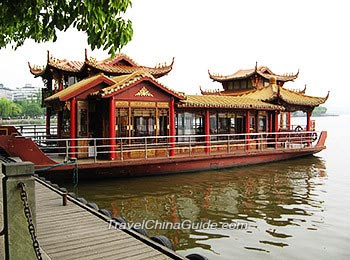 |
| Gorgeous Old Style Cruise Boat |
By Bike
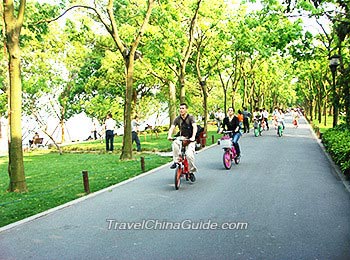
Public Bike: Tourists can apply for a Z Card at the IC Card Service Center located at the nearby Longxiangqiao Subway Station (Entrance/ Exit C1) at CNY 300 (including CNY 200 deposit fee). Then, they can rent a public bike at any stop around the lake by swiping the card. Riding the bike for less than one hour is free of charge; riding it for more than one hour and less than two hours will be charged CNY 1; riding it for more than two hours and less than three hours will be charged CNY 2; riding it for more than three hours will be charged CNY 3 per hour. After sightseeing, return the bike to any of the bike stop and the Z Card at Longxiangqiao Subway Station to get the deposit and balance back.See details of Hangzhou Transportation Smart Card Note: Appreciating the lake by bike is one of the most enjoyable ways. The only inconvenience is that there may be no place to store it and that one always needs to keep an eye on it during sightseeing.
|
|
Recommended Sightseeing Routes
On Foot:
1. To visit the Broken Bridge: Bai Causeway- Xiling Bridge (about 1 hour)
2. To enjoy the Su Causeway: Crossing Rainbow Bridge- Eastern Lakeside Bridge- Suppressing Dike Bridge- Viewing Hills Bridge-Locking Waves Bridge- Reflecting Ripples Bridge (about 2 hours)
3. To Wander the Beishan Street: Youth Activity Center- Beishan Street- Temple of General Yue Fei (about 1.5 hours) By Boat: Lesser Paradise Island (Three Pools Mirroring the Moon)- Inner West Lake- Yang Causeway- Winery Yard and Lotus Pool (1.5 to 3 hours) By Bike: Broken Bridge- Bai Causeway- Su Causeway- Leifeng Pagoda- Qingbo Gate (Orioles Singing in the Willows)- Broken Bridge (about one day)
Hangzhou Tours Top 10 Things to Do in Hangzhou 12 Best Places to Visit in Hangzhou