Viewing Fish at Flower Harbor
As one of top ten attractions at West Lake, Viewing Fish at Flower Harbor features the flower harbor plus red carps, peony flowers, a big lawn and dense woods. With a total area of 20 hectares (49 acres), it is located on a peninsula between West Inner Lake and South Lake in the southwest part of West Lake, and is sandwiched in between the Yang Causeway and Su Causeway.
 |
The history of Viewing Fish at Flower Harbor can be dated to the Southern Song Dynasty (1127-1279). Back then, the government official Lu Yunsheng built a private garden at the foot of Flower Hill (Huajia Hill). He dug a pond, and raised various fish in it. The garden was first called Lu Garden, and then became known as Flower Harbor. Later, Ma Yuan, a great painter of the Southern Song Dynasty, depicted the scene when he created the Ten Paintings of West Lake. From then on, the beautiful scene has been known as 'Viewing Fish at Flower Harbor'.
The best site to start a visit to Viewing Fish at Flower Harbor is at Su Causeway. Upon arriving there, you can reach the harbor in a few minutes' walk. The Flower Harbor was dredged to blend perfectly with the rice fields and ponds. It is a river course which connects West Inner Lake with South Lake. The harbor surrounds the Viewing Fish at Flower Harbor Park.
After entering the park, you will first see the Imperial Stele Pavilion. The stele was constructed in 1699, and renovated in 1869. On the front of the stele is the inscription 'Viewing Fish at Flower Harbor' handwritten by Emperor Kangxi of the Qing Dynasty (1644-1911). There is an interesting anecdote about the inscription. The traditional Chinese character 'fish' has four dots at the bottom. But Emperor Kangxi only wrote three. Four dots in Chinese mean fire, over which fish are cooked; while three dots mean water, in which fish can live happily. It shows the best wishes of the emperor for the fish as well as his people. The back of the stele is engraved with a poem which reads 'At Flower Harbor at the foot of Flower Hill, petals fall down onto fish.' It is a beautiful image, isn't it?
|
|

Walk on, and you will be attracted by the Great Lawn surrounded with tall cedars and exuberant magnolia trees. A Chinese larch was planted in the western part of the lawn in memory of Premier Zhou Enlai. Standing on the lawn, people can see Su Causeway from a distance.
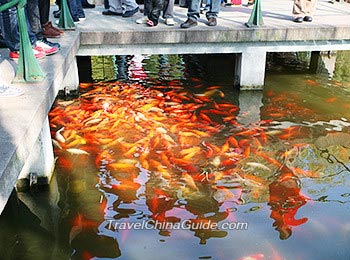
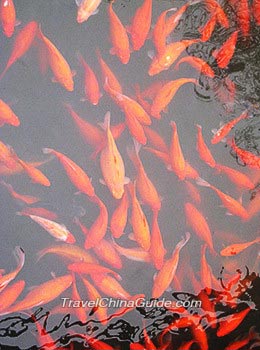
Keep moving and you will reach Red Carp Pond, the highlight of the park at its very center. Leaning on the railings of the zigzag bridge, you can see thousands of red carp swimming in the pond. If you throw food into the water or clap your hands, a swarm of red carp will gather rapidly, and redden the pond in seconds. Some of the fish open their mouths wide to wait for food. Others catch the food immediately when it falls into water, and some will eagerly jump out of the water for food. That is very spectacular and interesting!
To the west of Red Carp Pond is the Peony Garden, which covers a total area of 1 hectare (2.5 acres). The crisscrossing pebble paths divide the garden into eighteen sections. More than one-hundred species of peony flowers are planted here, along with green pines, vibrant cypresses, red maples, and plum blossom trees. There is an octagonal double-eave Peony Pavilion in the garden. The tablet of the pavilion was written by the famous writer Mao Dun. The pavilion is a perfect spot to enjoy the beautiful scenery of the entire park. You can admire the exuberant lawn to the north, the lush trees to the east, green Nanping Hill to the south, and the clear West Inner Lake and South Lake.
To the west of the Peony Garden is the Dense Woods Area. It is planted with evergreen trees. Trails wind through the woods. Sitting among the woods, people can breathe in the fresh air and have a good rest in peace and tranquility.
How to get to Viewing Fish at Flower Harbor Scenic Spot
1. Take bus 4, 31, 51, 52, 87, 314, 315, 334, 822, jy6, y2 or y10 and get off at Sudi (Su Causeway) Station. Then, enter the park through the south gate.
2. Take bus 51, 52, 194, 197, 318, or y2 to Yuhuwan Station, and enter the park through the west gate.
By boat:
Take the West Lake Cruise Boat. Get off at Su Causeway, and enter the park through the east gate.
| Entrance Fee | Free of charge |
|---|---|
| Opening Hours | All day long |
- Last updated on Jul. 24, 2026 by Sherry Xia -