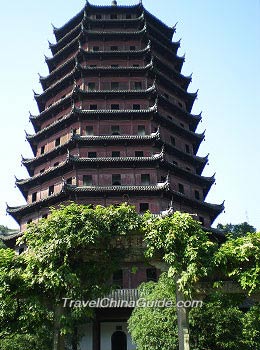
Six Harmonies Pagoda is a representative ancient pavilion-style tower in China, located on Yuelun Mountain to the south of the West Lake and facing Qiantang River. It is one of the three renowned pagodas in Hangzhou, together with another two around the West Lake, Baochu Pagoda and Leifeng Pagoda. Because of the height advantage and special location, Liuhe Pagoda is one of the best places to view the splendid Qiantang River Tide. In addition, there is an Ancient China Pagodas Garden near the tower, displaying miniatures of famous pagodas around the country.
Ingeniously Designed Constructional Work
Six Harmonies Pagoda is an octagonal building with a height of 59.89 meters (196.49 feet). Seen from the outside, the pagoda has 13 storeys and there are 104 iron bells hung at every corner of the eaves. Because of this magnificent appearance, locals consider it a brave general standing on the bank of Qiantang River. However, if you step into the pagoda, you will find only seven floors inside. A spiral staircase was built inside the tower, leading to the top floor. Each floor of the pagoda consists of four parts: exterior wall, a ring-shaped corridor, interior wall, and a small chamber. The chambers are used to enshrine Buddha figures. Looking through windows on exterior walls, visitors can overlook beautiful scenery of wide Qiantang River and grand Qiantang River Bridge, against distant green mountains. There are a lot of exquisite brick-carvings inside the tower with various themes, including pomegranates, lotuses, phoenixes, peacocks, lions, and kylins.
Best Site to View the Qiantang River Tide
Hailed as the great wonder of the world, Qiantang River Tide is the masterpiece of the nature. Located on the northern bank of the river, Six Harmonies Pagoda has been considered the best place to view the spectacular since the Southern Song Dynasty (420 – 589 AD). This scene is even more magnificent around Mid-Autumn Festival. Annually, regions around Liuhe Pagoda are very crowded during that period. Seeing from the top of the pagoda, the great sight of the turbulent tides of Qiantang River may take your breath away.
Ancient China Pagodas Garden
Tourists can have a thorough visit of China's ancient towers of different styles in the garden. With an area of 6,689 square meters (8,000 square yards), there are about 100 miniatures of renowned old pagodas of the country in a ratio of 1:10, including Wooden Pagoda in Yingxian County of Shanxi Province, White Dagoba of Beihai Park in Beijing, Songyue Pagoda of Henan Province, and Big Wild Goose Pagoda and Small Wild Goose Pagoda of Xi'an.
How to get to Six Harmonies Pagoda
1. Take bus 4, 287, 318, 334 or 354 to Liuhe Ta (Six Harmonies Pagoda) Station.
2. Take bus 190, 202, 280, 308, 595a, 595b or 597, and get off at Zhijianglu Liuheta Station.
Hangzhou Bus / Metro Search
| Ticket Fare | Entrance Ticket | CNY 20 |
| CNY10 for children between 1.2 and 1.5 meters (3.9 and 4.9 feet) high |
| Free of charge for children less than 1.2 meters in height |
| Climbing the Pagoda: CNY 10 |
| Opening Hours | 6:30 – 17:30 |
- Last updated on Aug. 18, 2025 by Demi Li -
 Six Harmonies Pagoda Photos


 12 Best Places to Visit in Hangzhou