 |
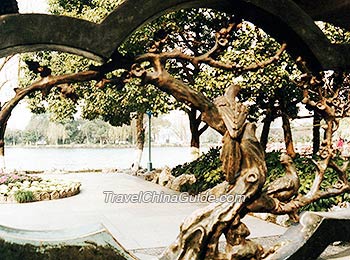
| A big plum tree on Solitary Hill |
Hangzhou Solitary Hill, situated at the northwestern corner of West Lake, is 38 meters (about 125 feet) above sea-level, and covers an area of 300 mu (nearly 50 acres). It is the lowest summit, compared to other hills around West Lake, but it is also the biggest island in the lake, and the only natural island as well.
Solitary Hill got this name because it is surrounded by water, standing solitarily in West Lake. It can also be called Solitary Island, for it is a lonely island rather than a hill. Its other name: Plum Blossom Island, originates from the flourishing plum blossom planted on the hill.
Are you eager to know the story of 'Plum wife and crane son'? Lin Bu, also called Lin Hejing, was a real hermit and a talented poet in the Northern Song Dynasty (960-1127). Besides composing poems and paintings, he spent all his spare time planting plum trees and raising cranes. He didn't get married all his life, and as a result, people took plum blossom as his wife and considered cranes his children. The place he lived in seclusion was called Solitary Hill (Gu Shan).
Solitary Hill boasts of beautiful landscapes. It is bordered by Bai Causeway on the east, Xi Ling Bridge on the west, the Outer West Lake on the south, and the Inner West Lake on the north. Autumn Moon over the Calm Lake, one of the ten scenes of the West Lake, is formed on the boundary of Solitary Hill and Bai Causeway. It is an ideal place to enjoy the beauty of West Lake.
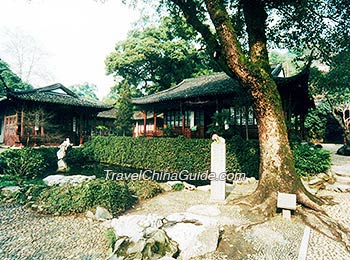 | | Old houses in tree shadow | | 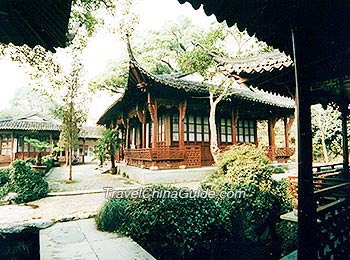 | | Antique architectures on the hill | |
In addition, there are a lot of cultural relics in the Solitary Hill scenic area. At the south foot lies Zhejiang Museum, Wen Lan Pavilion (attracting many literati), and Zhongshan Park is in the middle of the hill. The park was rebuilt on the site of an imperial garden of the Qing Dynasty, and was opened in 1927 to commemorate Sun Yat-sen, the great leader of the Xinhai Revolution in 1911. At the west foot is Fang He Pavilion, which is related to Lin Bu and his story 'Plum wife and crane son'; together with the pavilion is the Tomb of Qiu Jin, a great female revolutionist at the end of the Qing Dynasty. On the top of Solitary Hill, there is Xi Ling Seal Society, dedicated to the study of seals. This area also includes Cypress Hall, Bamboo Pavilion and Si Zhao Pavilion.
The best time to visit the hill is winter or early spring, since you can enjoy the plum blossom as well as the usual sights.
How to get to Solitary Hill
Take bus no. Y10 to get off at Xileng Bridge Station or Zhejiang Provincial Museum Station.
| Entrance Fee | Free |
| Opening Hours | All day |
Recommended Nearby Attractions
1.
Zhejiang Provincial Museum2. Memorial Hall of Yu Quyuan
3. Tomb of Qiu Jin
- Last updated on Jul. 24, 2026 by Sherry Xia -