Jiumenkou Great Wall
About nine miles (15 kilometers) from Shanhaiguan Pass, the grand Great Wall runs from southern lofty mountains to the bank of Jiujiang River, then spans the river and forces its way up to the northern mountains. This section is Jiumenkou, known as the "Great Wall over Water". Owing to the strategic location, many battles took place there. Nowadays, it has been developed into a scenic area characterized by the Jiumenkou Pass and the Mind Dynasty Tunnel.
 |
| Jiumenkou Great Wall |
Basic Facts of Jiumenkou Great Wall
 It was first constructed in the Northern Qi Dynasty (479- 502). The remaining section was built in 1381 of the Ming Dynasty (1368- 1644), and restored several times after.
 It is 1,863 yards (1,704 meters) long, with 12 watch towers, two sentry posts, two beacon towers, and ditches, forming a complete military defense system.
The section over the Jiujiang River is about 110 yards (100 meters).
Many historical relics have been excavated there, such as porcelain bowls, vats, and cannons. These relics tell you the life of soldiers on guard.
In November, 2002, it was listed as a World Cultural Heritage Site as a unique section over the water.
Jiumenkou Pass: Nine-Arch Great Wall Bridge
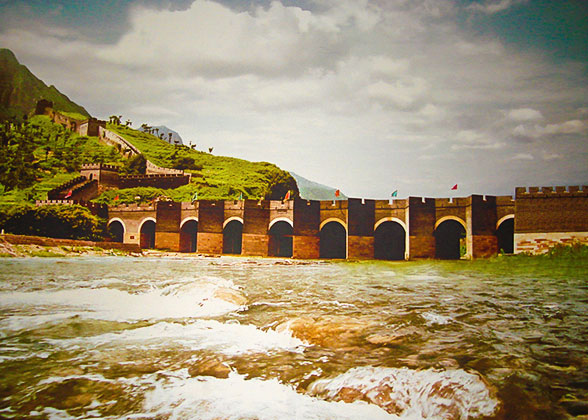 |
| Nine Water Gates at Jiumenkou |
Secret Tunnel of the Ming Dynasty
Beside the bridge and the tunnel, you can go to the Rare Bird Garden at the foot of the mountain. You can see various species of rare birds, and enjoy the interesting bird shows. For instance, you can see a little parrot walking on a steel wire. Also, you can see the Ci En Temple or Ancient Tombs nearby.
 |
| The view outside the arrow window |
How to Tour Jiumenkou Great Wall
Start hiking from the entrance, you will reach the Nine-Arch Bridge over the sparkling Jiujiang River first. During the high flow period, you can go boating on the river, and enjoy the scenery on both banks. Afterwards, you can hike along the winding Great Wall that crawls on the mountain ridges. The southern section is steep, and the watchtowers are densely distributed. In contrast, the northern section slopes gently, and is more suitable for children and senior citizens. Standing atop, you can enjoy the pastoral scenery, including the vast fields and orchards. After hiking, you need to climb down along the same route.
Then, you can go to the Rare Bird Garden and then pay a visit to the Secret Tunnel. It is pretty cool inside the tunnel.
In summer and autumn, there are many people selling fresh local fruit, such as pears, jujube, and kiwi fruit at the entrance of the scenic area. They are not expensive and you may have a try!
| Opening Hours | 8:00- 16:00 |
|---|---|
| Admission Fee | CNY 90 (with the Rare Bird Garden and Secret Tunnel included) |