

Great Wall in Gansu
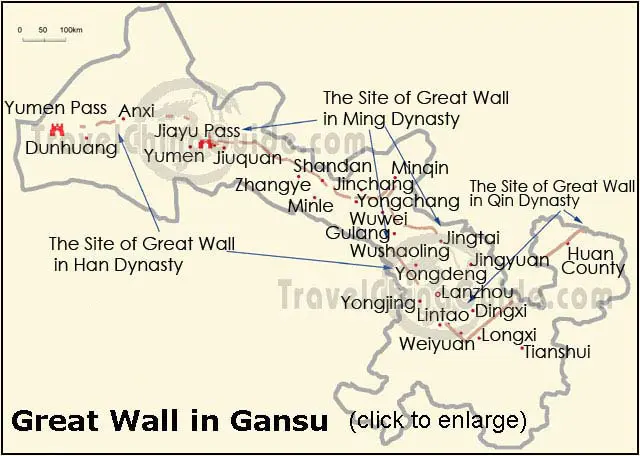
Gansu is where the Great Wall of China ends in the west. Located in northwest Gobi or desert, Great Wall in Gansu was mainly built with rammed earth, red willow, reeds, or sand. This makes it look different from other brick or stone sections as you may think. The most famous sections here include Jiayuguan Pass, Yangguan, and Yumenguan, all in earth yellow.
Basic Facts of Gansu Great Wall
 The Great Wall in Gansu is mainly the relic of five dynasties: Warring States (475 – 221 BC), Qin Dynasty (221 – 207 BC), Han Dynasty (020 BC – 220 AD), Northern Liang Dynasty (502 – 557), and Ming Dynasty (1368 – 1644). Of these, sections of Qin, Han, and Ming comprise the largest proportion.
Gansu houses the longest Ming Dynasty Great Wall, measuring about 1,080 miles (1,738 kilometers), covering one fifth of the total length of the Ming sections. Sections of the Warring States Period are 370 miles (595 kilometers) long, and the Han Great Wall is 1,370 miles (2,205 kilometers) in length.
In some regions, which are not suitable to construct ramparts, dense beacon towers were built to defend against enemies. In total, 1,334 beacon towers have been discovered in Gansu.
The construction work follows the principle of using local materials. The clever ancient people built the wall by ramming earth so as to be as solid as stone. This dense earth made the body of the wall difficult to deform and split. Jiayuguan Pass is a typical example built in this way. In the desert, people created the wall by laying branches of local red willow, reeds and sand layer upon layer. Yumenguan Pass and Yangguan Pass are relics of this kind.
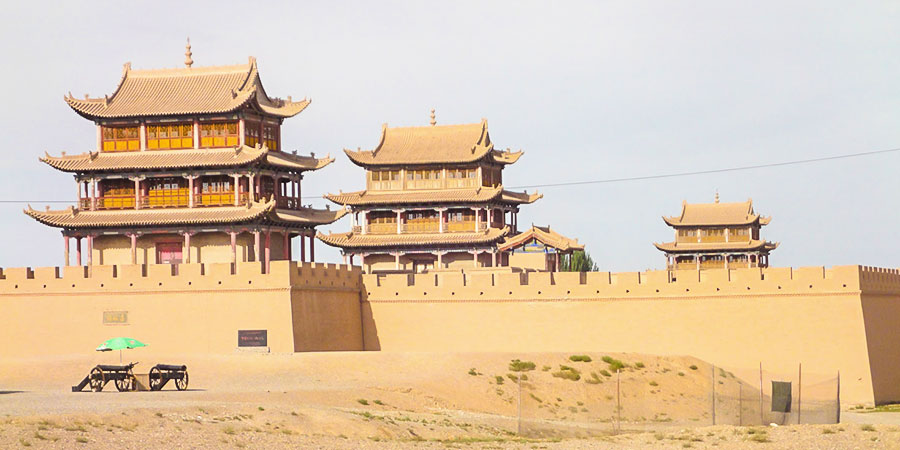 |
| Jiayuguan Pass |

Jiayuguan Pass, four miles (six kilometers) west of Jiayuguan City, is the west end of the Ming Dynasty Great Wall, dividing the central plain with the western regions. It was constructed with the most integrated defensive system: an inner city, an outer city, and a moat. Besides functioning as a frontier military fortress, it was also an important traffic hub along the Silk Road, the oldest worldwide trading route. Standing among vast desert and surrounded by rolling mountains, Jiayuguan Pass looks like a dignified general guarding the grand land.
Five miles (eight kilometers) north of Jiayuguan Pass, this section is like a rope ladder thrown down from the top of the mountain and hanging among the cliffs. Ascending about 400 stairs to the top, you will have a bird's-eye-view of the endless desert.
 |
| The Overhanging Great Wall |
The Silk Road separated into two branches at Dunhuang. The northern route would pass Yumenguan (Jade Gate Pass in English), through which Hetian jade of the Western China was taken into the central plain. After the fading of the Silk Road, Yumen Pass was also abandoned. The old site of the pass is a record of the once prosperous worldwide trading route.
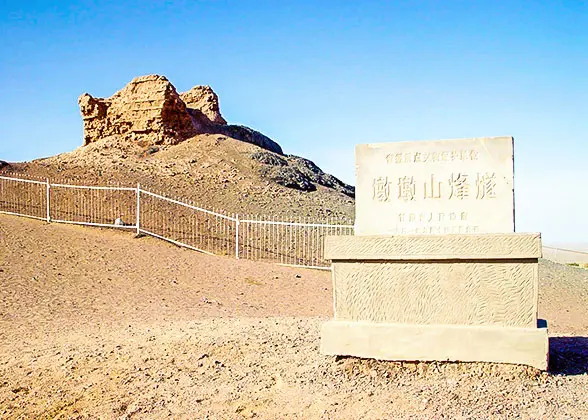 |
| Yangguan Pass |
The southern route of the Silk Road started from Yangguan Pass. Old poems portrayed many separation scenes around Yangguan Pass, making it a symbol of separation and sadness. However, it is now not only a site to reflect on the past, but also, as the second Grape Valley in China (the first being in Turpan, Xinjiang), for visitors to taste this sweet fruit.
Three miles (five kilometers) west of Yumenguan, this site is the best preserved section from the Han Dynasty. At one time it was the site of a bloody battlefield. It also played an important role in cross-border trading. Thousands of years of wind and sun have erased its original appearance. The dilapidated ramparts are now just mounds, resembling an aged soldier telling visitors about its past glory.
Juyan Fortress used to be an important frontier city located at the present border of Gansu and Inner Mongolia. You can find traces of different periods there, with the earliest site dating back to the Bronze Age. Here, you can also find 13 city sites of different ages, six burial areas, 118 beacon towers of the Han Dynasty, and temple sites built during the time from the Western Xia Dynasty (1038 – 1227) to the Yuan Dynasty (1271 – 1368).
The Rescue Work is Very Urgent
Thousands of years have not been kind to the Great Wall in Gansu. What remained after the Warring States and Han Dynasty is less than half of the original length. Of the 1,060-mile (1,705-kilometer) Ming section only around 620 miles (998 kilometers) remain.
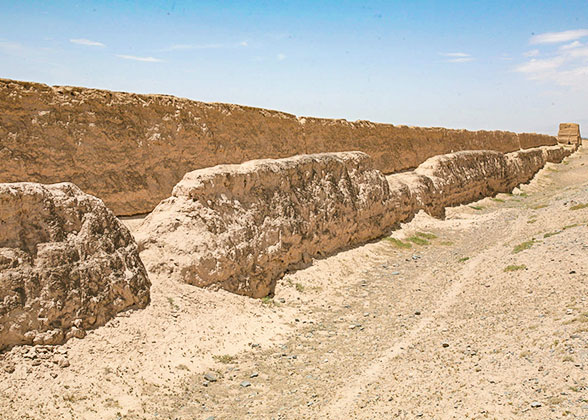 |
| Shandan Ruins |
The remaining parts continue to dwindle day by day because of natural disasters and human destruction. TravelChinaGuide has sent survey groups to Shandan County, Gansu Province in 2002 and 2009 to investigate the damage of the local sections. Thousands of years of natural erosion has made most parts look like mounds, and some are even beyond recognition. Due to the dry climate, it is very hard to find grass in the desert. Peasants even allow livestock to dig grass roots at the foot of the ramparts. Some even shovel bricks from the ramparts to build their own houses. Sections in other regions also suffer the same pain.
If people don't take immediate action, the remaining parts will finally disappear together with their glorious historical memories.
See More: TCG Survey Group to Great Wall in Shandan County Further Reading: Gansu Travel Guide