Yumenguan Great Wall
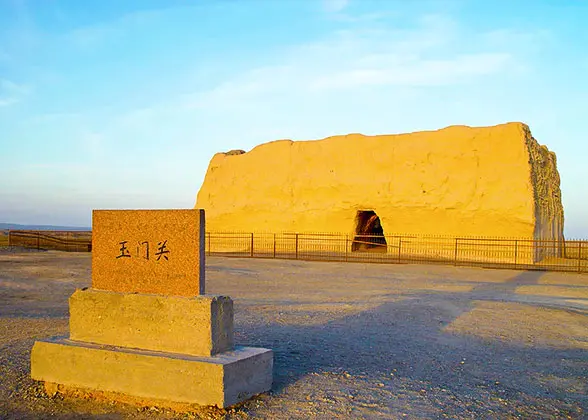
Standing alone among the vast desert, Yumenguan, also known as Small Square Castle, has lost its splendor as an invincible military fortress. You may hardly believe this dilapidated rammed-earth site was once a fierce battlefield and prosperous trading gateway with merchants and camels streaming in and out.
 |
| Yumenguan Great Wall |
Basic Facts of Yumenguan Great Wall
 It was a crucial pass along the western border built in the Han Dynasty (206 BC – 220 AD), located at the west end of Hexi Corridor, the gateway to the western regions from central China.
As a huge and complete ancient defensive system, Yumenguan Pass of Great Wall, in a broad sense, refers to a pass-centered strip-shaped region of 25 miles (40 kilometers) long and 550 yards (503 meters) wide, including two castles, 20 beacon towers, and 17 ramparts sites.
Stood along the northern branch of the Silk Road, the oldest international trading route of the world, Hetian jade of Yutian (today's Hetian County, Xinjiang) was transported into the central plain through the pass in old times, hence the name Yumenguan (Jade Gate Pass).
 |
 Yumenguan Pass Photos Yumenguan Pass Photos |
The pass was built from rammed yellow earth and has two gates, the west gate and the north gate, with the latter one being the main entrance. There used to be several offices inside and a staircase at the southeast corner leading to the top. However, these sites cannot be traced at present because of thousands of years of disrepair.
The remaining castle covers an area of 757 square yards (633 square meters), measuring 26.7 yards (24.4 meters) long, 28.9 yards (26.4 meters) wide and 30 feet (nine meters) high.
Yumen Pass became a World Heritage Site on June 22nd, 2014.
Guarding the Western Frontier
In the early Han Dynasty, the western border of the country was ceaselessly invaded by Huns. Instead of fighting back, the weak state rulers preferred to marry imperial daughters to Huns' leaders to get temporary peace. When Emperor Wu rose to power, this cowardly policy was immediately abolished. He launched fierce counterattacks on a large scale, and drove Hun's troops out of the territory. In order to strengthen the stability of the western frontier, two passes, Yumenguan and Yangguan were set up along the border. From then on, these two passes, like two royal soldiers, honorably guarded the western gate for their motherland.
A Gateway of the Silk Road
 |
| Yellow rammed earth Great Wall |
Located along the northern branch of the Silk Road, Yumen Pass also served as a post station for businessmen and ambassadors. It has witnessed the prosperity of business trade along the old trading route. Silk, porcelain, and tea was transported to the western regions in an endless stream. Specialties of the west countries such as spice, fruit, music, and religious beliefs were introduced to central plain at the same time. It is said that the grapes, pomegranates, and walnuts now growing in central China were originally from the western area.
Two thousand years later, the singing of camel bells have disappeared. The cry of sellers in the markets is completely gone. Only an isolated castle remains there to remind you of its glorious past.
| Admission Fee | CNY 40 (including the entrance fee of Dunhuang Han Dynasty Great Wall and Hecang Fortress, the site of old munitions storage.) |
|---|
How to Get there from Dunhuang City
Located in the desert 60 miles (97 meters) west of Dunhuang City, Gansu Province, there is no public buses heading for the spot. You may pay CNY 400 – 500 and charter a minibus to have a one-day west-line tour of Dunhuang. Besides Yumenguan Pass, you can also visit popular spots like the Western Thousand-Buddha Cave, Han Dynasty Great Wall, Hecang Fortress, and Yardang National Geopark.
 Further Reading:
6 Best Places to See Great Wall of China