Liu Che - Emperor Wu of Western Han
Emperor Wu, or Liu Che, (156 BC-87 BC), was one of the greatest emperors of the Han Dynasty (206BC - 220AD). As the tenth son of Emperor Jing, he was chosen as prince at the age of seven and was enthroned when he was sixteen years old. At the age of 70, he died on the throne, ending his 54-year rule.
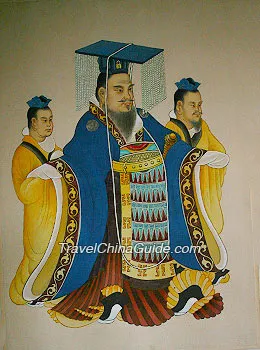 |
| Liu Che, Emperor Wu of Western Han Dynasty |
The times of Emperor Wu were among the most prosperous periods in Chinese history. At the beginning of his accession to the throne, a stable political situation and favorable national economy paved the way for splendid achievements in politics, economy, foreign affairs and culture.
As an innovative monarch, he took some effective measures in politics. He set up a special system for selecting, appointing, and assessing governmental officials. During that period, talented figures emerged in all occupations. Li Guang, as well as Wei Qing and Huo Qubing were all generals in that period, famous throughout the history of China. In addition, certain measures were carried out to strengthen the centralization of authority to weaken the power of small kingdoms.
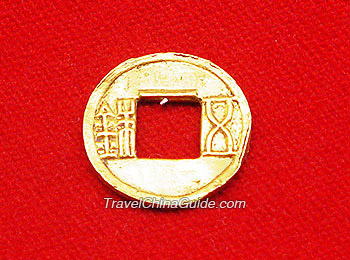 |
| Gold coin inscribed with characters "Wu Zhu", Han Dynasty |
He adopted many economic reform policies. First, the currency system was changed, establishing the wuzhu coin as the national legal currency. Second, industries such as manufacturing and the selling of salt and iron were monopolized by the national government. All these measures strengthened the financial power of central government and restrained the power of businessmen. In addition, he paid close attention to building water conservancy projects and treating the Yellow River.
As for foreign affairs, a prolonged battle was launched by Emperor Wu to drive out the Huns, an ancient tribe who trespassed on Han territory. With a powerful economy and strong military force, he defeated the Huns and safeguarded northern territory including the Hosi Corridor. At that time, China's territory was vaster than that of any previous dynasties. Meanwhile, Emperor Wu sent the envoy Zhang Qian to the western regions. As a result, an ancient Silk Road was opened up and the economic and cultural exchanges between the central plains and western regions were greatly enhanced.
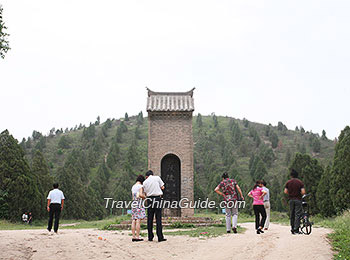 |
| Maoling Mausoleum, Tomb of Emperor Wu |
Confucianism became the mainstream Western Han ideology under Emperor Wu's reign. Emperor Wu required that all chancellors in the court learn the Confucian classics before they got a promotion. He also set up an educational system of Confucian classics. With 'unification' as its core, Confucianism helped form an important cultural spirit which joined Chinese people's hearts.
In that period, China's first historical record - The Records of the Grand Historian -- was written by Sima Qian (a famous historian in Western Han).
Although Emperor Wu was a warlike emperor, great achievements were accomplished in almost all aspects of society during his reign.