Built over a period of more than 2,500 years across over 20 dynasties, the Great Wall reflects evolving construction techniques and materials, resulting in the diverse and widely distributed ruins that survive today.
Prior to the widespread adoption of brick-making technology, the Great Wall was built primarily using locally sourced earth, stone, and sand. Sections along mountain ridges used quarried stone; those on the loess plains employed rammed earth; and in desert regions, walls were layered with reeds and sand.
Following the maturation of brick technology during the
Ming Dynasty (1368 - 1644), key segments of the
Ming Great Wall featured brick-encased rammed earth - outer layers of brick and stone surrounding a compacted earthen core. Brick kilns were erected nearby to supply building materials. To enhance structural stability, a mortar mixture of lime and glutinous rice paste was used between bricks and stones.
2. How Was the Location for the Construction of the Great Wall Selected?
The foundational principle of Great Wall siting was to make full use of the natural terrain to achieve the greatest defensive effect with the least amount of engineering work. Walls were typically built along high, open mountain ridges, offering unobstructed visibility to monitor enemy movements and elevated positions to resist attacks. At strategic points such as valleys, mountain passes, or river crossings, which were the necessary routes for ancient armies, core defense structures like passes and fortresses were built. These places had narrow terrain and were easy to defend and difficult to attack. In addition, many sections also followed river valleys, using rivers as natural moats while protecting fertile farmland within.
 | | The Great Wall in the Desert | |  | | The Great Wall by the Sea | |
More to read:
Where is the Great Wall of China located?Great Wall Terrain & Structure 3. When and Who Built the Great Wall?
During the over 2,500-year-long history of the Great Wall's construction, more than 20 states or dynasties successively built it. The existing sections of the Great Wall were mostly constructed during the Ming Dynasty.
Border garrisons formed the main workforce. During the reign of Qin Shi Huang, up to 300,000 soldiers were conscripted for construction. Laborers and convicts also comprised critical parts of the workforce.
More to read:
Who built the Great Wall of China?When was the Great Wall of China built? Stretching thousands of miles, the Great Wall represented one of antiquity’s largest and most complex engineering projects. Construction was integrated with border defense, using a regional, section-based system: the garrison responsible for an area also built and maintained its wall, with tasks assigned to individual soldiers. Major passes were constructed by concentrating labor from nearby military camps.
The greatest difficulty in the construction of the Great Wall was the transportation of building materials. More than 2,000 years ago, there were no advanced transportation tools. How were those materials transported to the top of the high mountains? Records show that the transportation of building materials for the Great Wall mainly relied on people carrying them on their backs or passing them along in a line. On relatively gentle slopes, simple tools such as wheelbarrows were used. In addition, animals like goats and donkeys were also used to transport bricks.
 | | Great Wall bricks engraved with builders' information | |  | | Sculptures of the Great Wall Defenders | |
You may like:
How much did the construction of the Great Wall of China cost? 5. The Architectural Structure of the Great Wall
The Great Wall functions as an integrated defensive system composed of the main wall and its auxiliary structures.
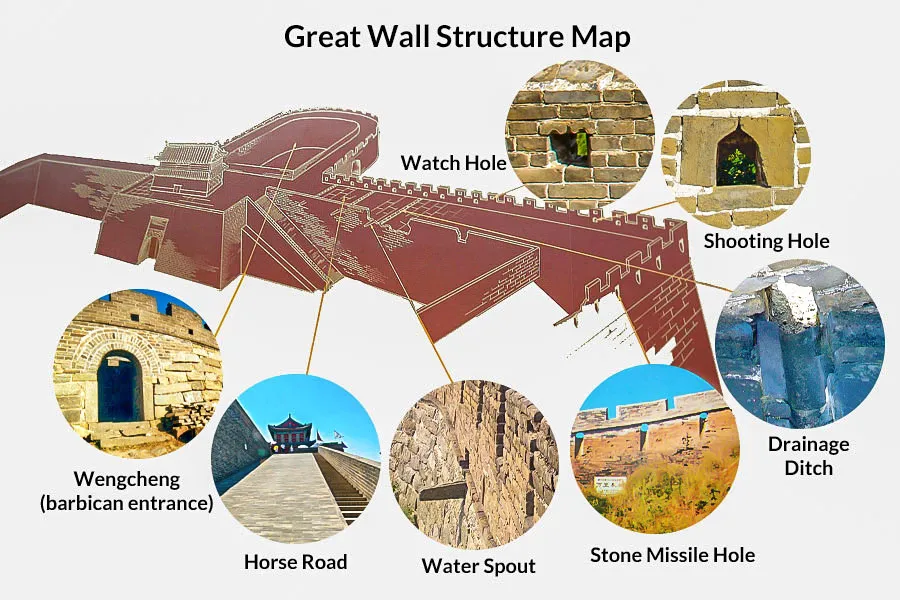
The wall of the Great Wall is its foundation. It is formed by the continuous extension of sections of the wall, which together make up the Great Wall stretching for thousands of miles. The wall is made up of a walkway at the bottom and the two sides of the wall. The side with crenellations on the outside is called the crenelated parapet wall, and the side without crenellations on the inside is called the parapet wall.
On the Great Wall, there must be openings for the passage of vehicles and horses. For security reasons, the openings on the wall cannot merely have city gates. Usually, a fortress with various military facilities is built, and this kind of fortress is called a pass - examples include
Shanhaiguan Pass and
Jiayuguan Pass.
 |
| Shanhaiguan Pass |
The city gate is a crucial part of the city's defense, and the enemy's main objective in engineering attacks is to capture the city gate. Once the city gate is breached, the enemy can pour in. To strengthen gate defenses, a small enclosed structure called a barbican was often built outside the main gate, creating a secondary defensive layer and preventing immediate breach of the interior.
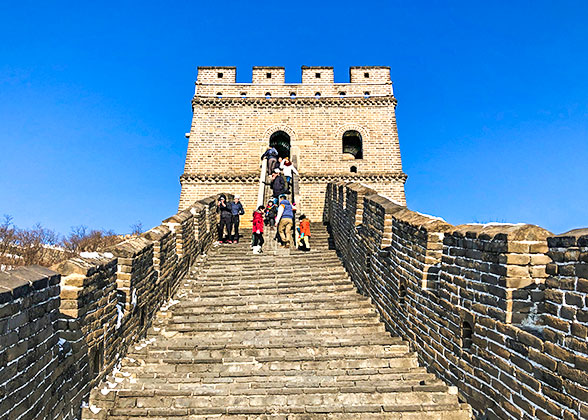
The watchtower is a tower-like structure on the Great Wall, usually with two floors. The upper floor was used for surveillance, while the lower floor housed troops, weapons, and supplies. Arrow slits are set on the watchtower, through which soldiers can look out and shoot arrows. The more arrow slits there are on a watchtower, the more active it is.
Beacon towers were elevated platforms used to send military signals via smoke and fire. Some were integrated into the wall; others stood independently as part of the ancient communication network.
 | | A Beacon Tower | | 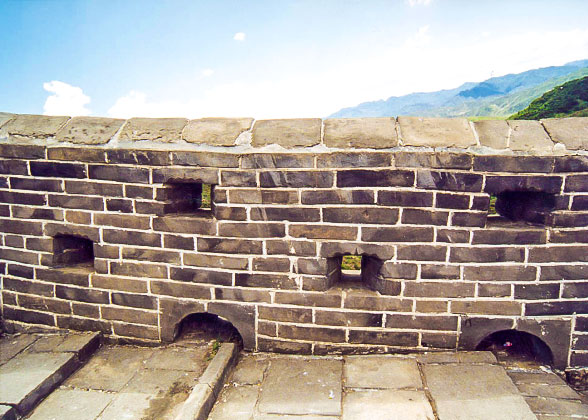 | | Battlement Wall with Shooting Holes | |
The wide, paved walkway atop the wall, known as the horse road, allowed rapid movement of soldiers, horses, and supplies.
Crenellations are the notched battlements along the outer wall. They shielded defenders while enabling observation and shooting. To expand the field of vision, crenellations are often narrower on the inside and wider on the outside, forming an angle of more than 120 degrees.
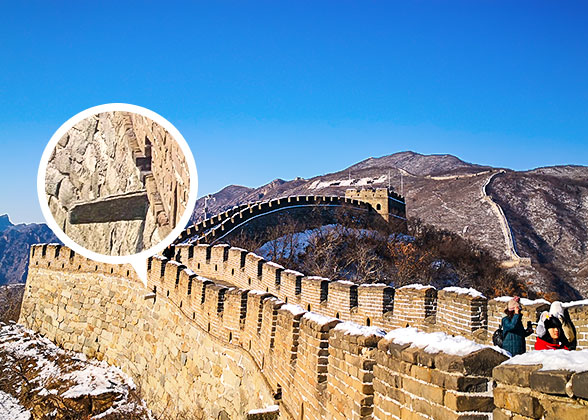
Water spouts protruding from the wall are installed outside the drainage channels of some important parts. This can prevent the wall from being eroded by the discharged water.
Where the wall crossed streams and rivers, specially built water channels, or water passes, prevented flooding and damage. A well-known example is the
Water Pass Great Wall in Beijing.
Under the Great Wall, there are many small and concealed secret doors. These doors are set up very discreetly and are hard for the enemy to spot. They are used for the passage of soldiers in case of emergency during battles.
 | | Water Spout | | 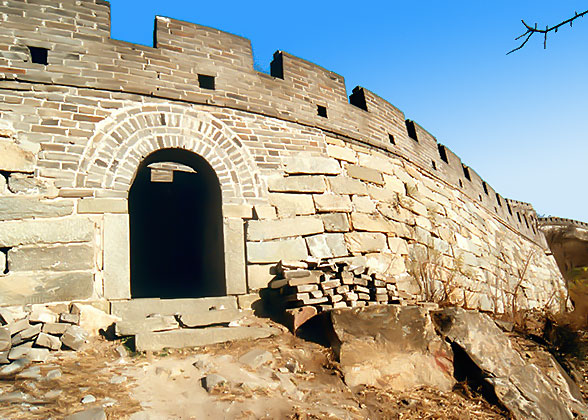 | | Secret Door | |
Small holes set into both sides of the Great Wall allowed defenders to observe and target enemies while remaining protected.
You may like:
- Last updated on May. 15, 2026 by Sherry Xia -
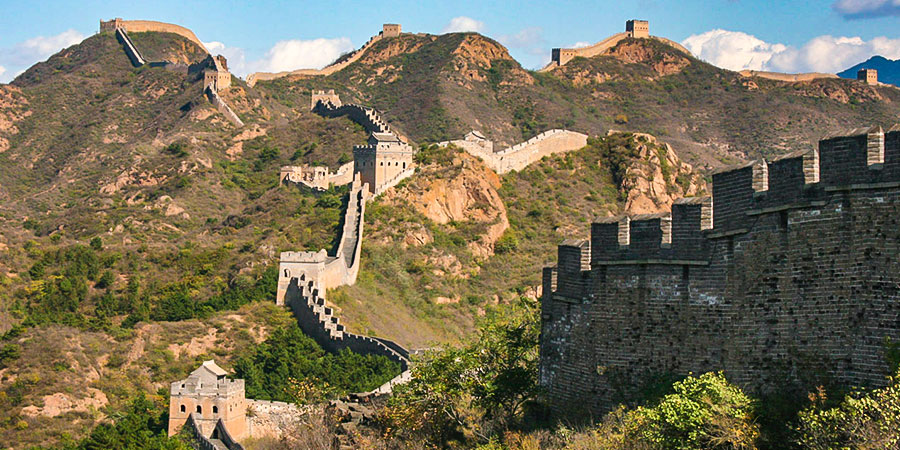
 Great Wall Construction Pictures