The construction materials of the Great Wall of China were mainly earth, wood, stones, sand, and bricks, used depending on construction era and construction site with different climate and local materials.
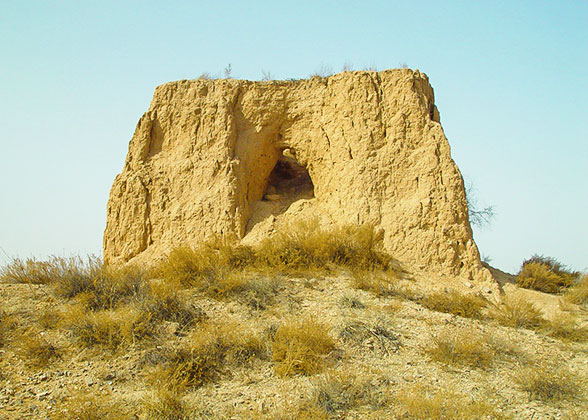 | | Great Wall Constructed with Sand and Earth | | 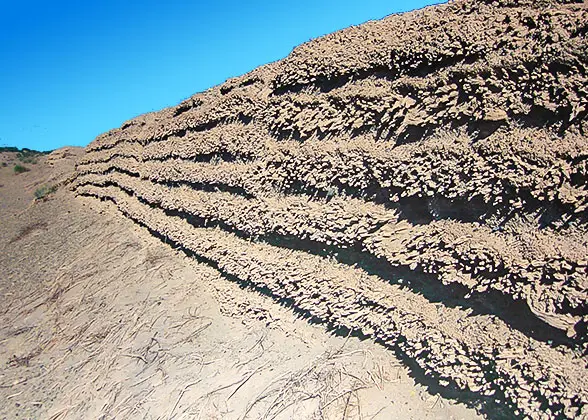 | | Great Wall Built with Sand and Branches | |
Due to the large quantity of materials required to construct the wall, the builders usually obtained materials from local sources. When building over mountain ranges, the stones of the mountain were used, while in the plains, earth rammed into solid blocks was used in construction. In the desert, even the branches of reeds and red willows were layered with sand. Wooden planks were used as the flank wall in some sections. With the development of brick-making techniques, bricks were used from the Tang Dynasty (618 – 907 AD) onwards.
Earth, Woods, Branches, Sand and Stones
– Construction Materials of Great Wall before Sui (7 Cen. BC – 618 AD)
As earthen buildings could withstand the strength of cold weapons like swords and spears, and as earth suited the low technology of productivity before the Sui Dynasty (518 – 618 AD), most Great Wall sections of that time were built by ramming earth between board frames. Some of the walls were rammed with earth, lime, sand and small stones. In the desert, some walls were rammed with reeds and red willows and sand layer by layer. At sites around Dunhuang City in Gansu Province, Yulin City in Shaanxi Province and Baotou City in Inner Mongolia, the Great Wall of Qin, Han and Zhao dynasties can be found. The Wall of Zhao was built during the Warring States Period using board frames, and the earth layers can still be clearly seen.
Some sections were built with sun-dried mud brick covered with yellow clay as protection. This kind of construction was usually used in areas with a dry climate. The Jiayuguan Pass in Gansu Province is an example of this.
Earth, Bricks and Stones
– Construction Materials of Great Wall during Tang and Song (618 – 1279 AD)
Brick-making techniques developed greatly during Tang and Song Dynasties. However, bricks were quite expensive to produce and distribute at that time, therefore construction could not use them solely. Therefore, passes and the wall around the passes were built with the bricks on the exterior and yellow mud filling the body of the wall. Some places also used stones to build the wall during that period. This kind of Great Wall was more solid than walls built with sun-dried mud brick or rammed earth.
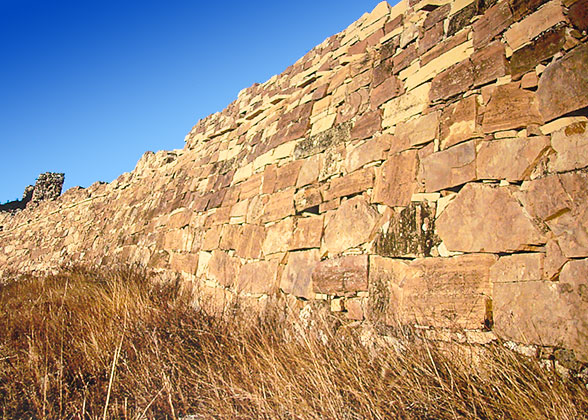 | | Great Wall Built with Stones | | 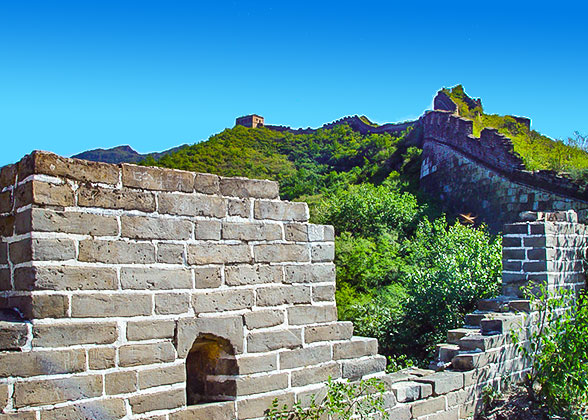 | | Great Wall Made of Bricks and Stones | |
Bricks and Stones
– Construction Materials of Great Wall of Ming (1368 – 1644 AD)
During the Ming Dynasty (1368 – 1644 AD), brick-making techniques had a great progress and both quantity and quality of production improved markedly. Since then, Great Wall sections were widely built with bricks, with lime mortar and sticky rice used to reinforce the bricks. The wall in this period not only resisted the invasions of nomadic tribes, but also protected the terrain and people from cold weapons and some firearms.
In addition, some walls were built along the mountains where there were plenty of stones available. Therefore locally available stones were used to build the wall. The stone walls were quite firm to defend against enemies and withstand natural erosion. There is a wall near Badaling section made of huge stones with lime mortar and sticky rice in its crevices to reinforce the wall.
Stone, cut in rectangular shapes was mostly used to build the foundation, inner and outer brims, and gateways of the wall. Bricks were more advanced materials than earth and stone as their small size and lightweight made them convenient to carry and thus quickened the speed of construction. Bricks are also the ideal material to bear weight. Therefore, bricks were used as the upper layers of the walls to resist attack from various weapons. For further ease of construction, different shapes of brick were also fired and made to fit into different locations.
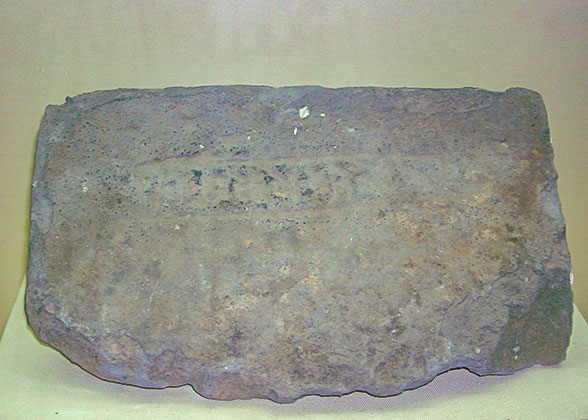 | | Stone Used in Building the Great Wall | | 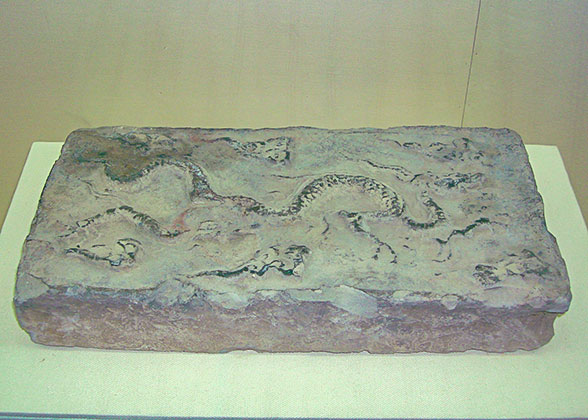 | | Great Wall Brick with Flower Patterns | |
How many bricks were used to construct the Great Wall?
There might to be approximately 3,873,000,000 individual bricks used to build the Great Wall of China, though the precise number remains unresolved. Generally speaking, most bricks of the wall measure 0.37 meters (1.2 feet) long, 0.15 meters (0.5 feet) wide and 0.09 meters (0.3 feet) thick. As a rough estimate - if all the bricks are place end to end, the bricks would loop 36 times around the equator.
- Last updated on Jan. 19, 2026 by Sherry Xia -