Jiujiang Travel Guide
Jiujiang Facts
Chinese Name: 九江 (jiǔ jiāng)
Population: 4,920,300
Area: 19,084.61 square kilometers (7,368.61 square miles)
Location: in the north of Jiangxi Province, east China
Administrative Division: 3 districts (Xunyang, Jiangxi, Chaisang); 7 counties (Wuning, Xiushui, Yongxiu, De’an, Duchang, Hukou, Pengze); 2 county-level cities (Ruichang, Lushan)
Area Code: 0792
Zip Code: 332000
GDP (2019): CNY 312.105 billion (USD 45.239 billion)
North Gate of Jiangxi Famed for Mt. Lushan
Situated near the northern border of Jiangxi Province, Jiujiang is the second-largest city next to Nanchang. Jiujiang in Chinese literally means 'nine rivers'. Owing to its location at the geographical intersection of Hunan, Hubei and Jiangxi Provinces, it is the north gate of Jiangxi which connects Jiangxi with cities along the Yangtze River and greatly contributes to opening up to other countries. Few areas of Jiangxi can rival with the charm and character of Jiujiang, from the famed Mt. Lushan and dramatic Poyang Lake to numerous historical buildings. Lushan is widely known for a poem by Sushi saying “The true face of Mt. Lushan is lost to my sight, for it is right in this mountain that I reside.” Since that, endless tourists visit Mt. Lushan to see what it really looks like. It is necessary to take 2 – 3 days to enjoy this picturesque city.
With a history of over 2,000 years, this is an attractive city boasting of grand mountains and numerous waterways. Cultural relics of Buddhism, Taoism, Islam and Confucianism can be found on nearby Mt. Lushan. The mountain also features captivating rock formations, natural springs, temples and stone inscriptions. Most of its 99 peaks rise over 1,000 meters above sea level.
Poyang Lake located south of the city is China's largest freshwater lake. It is a habitat rich in aquatic plants and is home to over 100 species of migratory birds. During the winter months visitors can see spectacular flocks of birds in flight. This scene is thought by some to resemble the 'second Great Wall of China'.
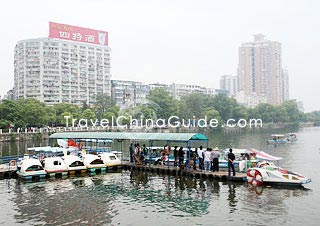
There are many historical buildings in the city. Among them are Suojiang Tower, Nengren Temple built in the 6th century, and Wave Well which is nearly 2,000 years old. Gantang Lake located downtown is historically significant as well.
How to get to Jiujiang
 Dependant on the Yangtze River, Jiujiang Port has played an important role since ancient times. Today, standing in the intersection of the Yangtze River and the Beijing-Jiulong Railway, it has well developed land and water transportation routes.
As the junction of the Beijing-Jiulong Railway, Wuhan-Jiujiang Railway, and Hefei-Jiujiang Railway, the Jiujiang Railway Station connects the city with cities in all parts of China. Everyday, trains starting from or passing by Jiujiang go to most of major cities in China.
As for road transportation, five important highways traverse the city, including the Nanchang-Jiujiang Highway, Jiujiang-Jingdezhen Highway and the No. 105 National Highway and No. 316 National Highway, forming a large network of roads. Moreover, the Jiujiang Airport offers another transportation option.
Jiujiang Lushan Airport has been officially closed on March 21, 2015, and is currently under expansion and reconstruction. It is about 33 kilometers (22 miles) away from Jiujiang City and 9.8 kilometers (6 miles) west from Lushan Mountain National Park. Currently, visitors can fly to Jiujiang by transferring at Nanchang Changbei International Airport and Wuhan Tianhe International Airport firstly, then travel to Jiujiang by train or airport intercity bus.
 When to Go: Since it is sultry and rainy in summer and cold in winter, the best time to visit the city is in late spring and autumn. However, the situation is different in Mt. Lushan, which has four distinct seasons. Therefore it is pleasant to visit anytime, depending on your preference.