Dalian Travel Guide
Dalian Facts
Chinese Name: 大连 (dà lián)
Population: 5,949,000
Area: 12,574 square kilometers (4,855 square miles)
Location: in the southwest of Liaoning Province, northeast China
Administrative Division: 7 districts (Zhongshan, Xigang, Shahekou, Ganjingzi, Lushunkou, Jinzhou, Changhai); 1 county (Changhai); 2 county-level cities (Wafangdian, Zhuanghe)
Area Code: 0411
Zip Code: 116000
GDP (2019): CNY 736.39billion (USD 106.74 billion)
A Beautiful Coastal City with Amazing Early-20th-century Architecture
Dalian city is located in the southwest of Liaoning and borders the Yellow Sea to the east, the Bohai Sea to the west, Anshan to the north, Yingkou to the northwest and Dandong to the northeast. It is an important port, trade, industry and tourism city.
Dalian is more like a coastal city in the southern China as it does not have a freezing temperature of -30 ℃ (-22 ℉) in winter and the summer heat here is not so hot thanks to the soft sea wind. It also boasts long coastlines, fantastic sea views, sun-kissed beaches, holiday resorts and coastal parks. A variety of exotic streets and countless century-old European buildings in Zhongshan Square add more charm to Dalian. The old trams still running on the street slowly pass through the city, connecting numerous landmark squares, but also symbolizing the brand of an era. The best time to visit Dalian is from May to September. Fishing and tasting the best fresh seafood from September to October is the most satisfying thing to do. 240-hour Visa-free Transit policy has been implemented in Liaoning for citizens from 54 countries and regions including USA, UK, Australia, Canada, France, Germany, Italy, Denmark, Netherlands, Spain, etc., and Dalian Zhoushuizi Airport is one of the eligible 60 entry / exit ports.
The impression Dalian gives to the world is of a city of lawns, squares, fountains and gardens. This is all thanks to the former mayor of the city, Bo Xilai, who initiated a 'Green Storm' - a widespread environmental campaign which brought numerous green squares, forest parks and seaside scenic spots to the city. People say it is 'A City Built in Gardens'. Running from downtown there is a 40-kilometer (25-mile) road known as Binhai Lu winding along the coastline, northeast to southwest. This coastal area is a paradise for beach vacationers. The famous scenic spots of Bangchuidao Scenic Area, Tiger Beach Ocean Park, Jinshitan Scenic Area, Dalian Forest Zoo and Xinghai Square are scattered around this region. In addition to the stunning cliffs and scenic parks, numerous places along the coastline are good for beach resort visitors and water sports lovers. Meanwhile, you can sample the authentic Dalian-style seafood in a fisherman's house at an incredibly low price. Besides, there is a large entertainment park - Discoveryland Theme Park, inside Jinshitan Scenic Area, where you can feel the excitement of adventures.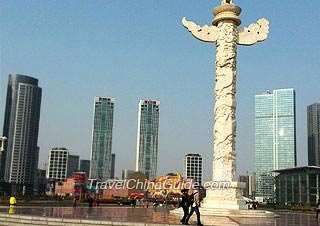
Zhongshan District, originally the colonial residential area of the Russians and containing Nicholas Square, (Zhongshan Square) is a bustling downtown area of the city. The square (Zhongshan Square) has ten avenues radiating from it and is one of the most famous squares in the city. Renmin Square, originally called Stalin Square and marked out to be the administrative center of the Russian colonists, now houses the government's financial institutions in Euro-style buildings. The old tramlines built by Japanese colonists and left behind through the ages tell the history of the city. Other Scenic Spots: Xinghai Park, Bingyu Valley Scenic Area Read More: 7 Best Dalian Beaches, Top 10 Things to Do in Dalian
Recommended Tours
Golf Vacation: 8 Days Golf Vacation of Dalian - Dandong - Shenyang
Hiking Adventures: Information about hiking in the city for your reference
As the provincial transportation hub, Dalian equips with well-developed public transportation system. This city is easily approached because of its convenient air routes, railways and long-distance bus routes extending major cities in China. Besides, Dalian city buses, metro system, ships, trams and taxis make the sightseeing within the city more easily.
History: Dalian, compared to ancient capital cities such as Beijing, Xian, Nanjing or Luoyang, is a young city with only a 100-year history. Situated at the tip of China's Liaodong Peninsular, it is a trading and financial center in northeastern Asia and has gained the name the 'Hong Kong of Northern China'. The old name was first used by an official in his memorial to Emperor Guangxu in the Qing Dynasty (1644-1911) referring to the present Dalian Gulf. In the early 20th century, the gulf area developed quickly and expanded into a city of significant size and importance. After the Opium War in 1840, the area was plunged into warfare. At the end of the 1800s, Japanese and Russian invaders successively set their feet on the Chinese mainland here. In 1894, Japan invaded the Peninsular and in 1897 Russian troops occupied Lushun Port (Port Arthur) and imposed upon the Qing government an unfair contract, in which they ceded Lushun as a colony to Russia. Seven years later, Lushun was again transferred to Japanese rule, when the Russians lost in the Japanese-Russian War. From then on the city suffered from the colonial rule of Russia and Japan for decades. It was as recently as 1955 that the Chinese government took over sovereignty of Lushun and the hardest times in this city's history ended. Local Highlights: Both the Russian and Japanese colonists dreamed of establishing a city of their own on this land in those colonial periods. A group of Russian architects fascinated with French culture came to the city with their construction blueprint of Paris and built all sorts of elegant squares with artistic sculptures, lush lawns and western-style fountains. These formed the architectural basis of the present city - taking squares as the center and radiating outwards. Today, the stylish women troopers patrolling the squares have become a feature of the city. Local Foods: Surrounded by the Yellow Sea and inland Bohai Sea, this city has rich marine resources. The seafood here is equal to its southern counterpart in Guangdong Province and there are numerous restaurants in the city providing a wide variety of top-quality seafood at very reasonable prices. Nightlife: Numerous bathing places and beaches in the city are popular venues for the locals to relax from everyday work and stress. Young people, like those in many other metropolitan cities in China are trend pursuers who spend their evenings in bars and pubs throughout the city. Festivals: There are two things that have earned the city a great reputation. One is Football and the other is Fashion. Given the name of 'Oriental Brazil', it hosts many Chinese football matches and has the most successful football teams in China. The enthusiastic fans in the football club of the four-star Wanda International Hotel tell everyone how much the Chinese like this game.
Another carnival event in the city is Dalian International Fashion Festival, during which thousands of dazzling celebrities, designers, pop stars and clothing merchants from both home and abroad get together to present an In-Fashion feast to the world. Consequently, the city stirs shopping lovers' blood with all sorts of skyscraper shopping malls and markets.If you are lucky enough to come to the city around September, a sea of world-class fashion brands will delight you. Dining Shopping Further Reading:
Top 10 China Main Cities for Nature Lovers