Bargaining in China
Preparation
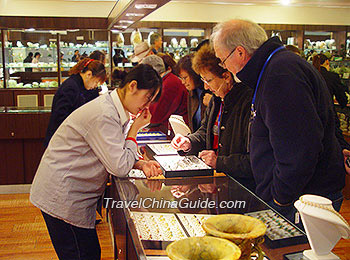 |
| Shopping in a jade shop |
Practice
In bargaing with the seller, stay relaxed but always polite. Be patient and unflappable to facilitate the bargaining process. There are some skills that can be used in the course of bargaining:
1. Cut down considerably from the asking price. The shopkeeper often charges higher prices than the actual value of the goods. Try to reduce the price to half of the asking price, and then spend some time on further negotiation.Generally, the basic rules and conditions of bargaining in different shopping areas are different, so you should know them first in order to make comparisons. Then you can bargain and arrive at a good price that will enhance your shopping experience.
 |
| Bargaining when shopping |
3. Try to find and point out as many flaws as possible in the product. The seller will always describe its excellence and will avoid talking about blemishes; but no product is completely perfect, and you should learn to identify all the flaws in order to gain bargaining leverage. In response, the seller may reduce his asking price.
4. Take some time when choosing and comparing the goods before you propose the price you wish. In this situation, the seller may compromise with you.
5. Pretend to walk away. Generally, this skill works quite well in most shopping places. If the price proposed by the seller is still unacceptable and outside your budget, you can use the walk away technique. Usually, you will be called back again, and the price you offer may be accepted by the shopkeeper.
 |
| Xiushui Market, Beijing |
7. Try to wear plain clothes without jewelry. If your clothes and ornaments make you appear to be rich, the price proposed by the seller will accordingly be a little higher. But this is not a must and should not prevent you from being be yourself.
8. Speaking a little Chinese may be very helpful. To overcome the language obstacles when communicating with the Chinese shopkeeper, you will benefit from learning some everyday Chinese phrases about shopping like 'Ni Hao' (Hello!), 'Duo Shao Qian?' (How much?) as well as 'Pian Yi Dian?' (Can you give me this for cheaper?). Do not worry about speaking Chinese fluently. A calculator or a paper and pen held in the seller's hand may ease the communication of prices between you.
End
Make sure that you get the things you buy at prices you are satisfied with, and that the products are flawless and the ones you prefer. It is possible that you will take pleasure in practicing the exciting art of bargaining.