24 Solar Terms
Solar Terms is a calendar of twenty-four periods and climate to govern agricultural arrangements in ancient China and functions even now. Each solar term has about 15 days and it is decided by the position of the sun in the sky.
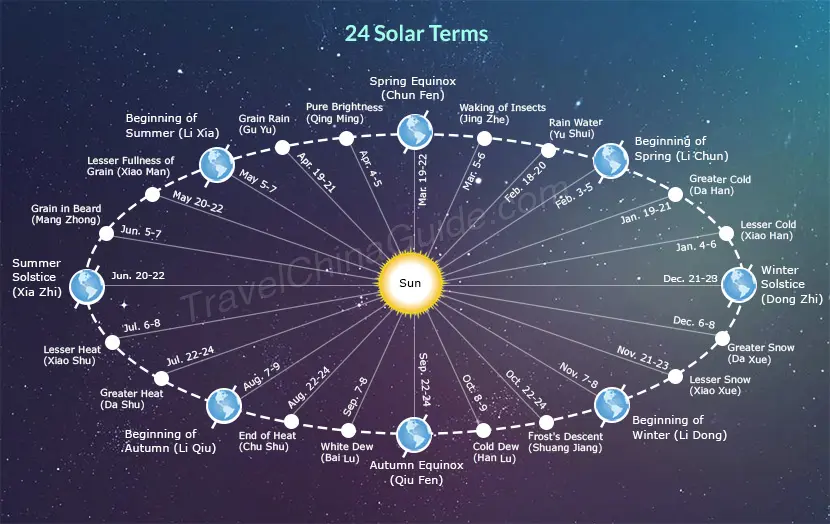 |
How Does it Work?
These twenty-four solar terms each suggest the position of the sun every time it travels15 degrees on the ecliptic longitude. A cycle is that earth revolves around the sun for one time. It begins from the Beginning of Spring (Li Chun) and ends at Greater Cold (Da Han). In each month there are often two solar terms; the first one is generally named 'Jie Qi' and the other one 'Zhong Qi'. Their dates are mirrored by the Gregorian calendar, so we find that during the first half of a year 'Jie Qi' is around the 6th day of a solar month, 'Zhong Qi' around the 21st; in the second half of a year, 'Jie Qi' is around the 8th and 'Zhong Qi' around the 23rd.
24 Solar Terms in 2024
| Solar Terms | Date | Meaning |
|---|---|---|
| Lesser Cold (Xiao Han) | Jan. 6th | It is rather cold. |
| Greater Cold (Da Han) | Jan. 20th | The coldest moment of a year. |
| The Beginning of Spring (Li Chun) | Feb. 4th | Spring begins. |
| Rain Water (Yu Shui) | Feb. 19th | It begins to rain. |
| The Waking of Insects (Jing Zhe) | Mar. 5th | Hibernating animals come to sense. |
| The Spring Equinox (Chun Fen) | Mar. 20th | Day and night are equally long. |
| Pure Brightness (Qing Ming) | Apr. 4th | It is warm and bright. |
| Grain Rain (Gu Yu) | Apr. 19th | Rainfall is helpful to grain. |
| The Beginning of Summer (Li Xia) | May 5th | Summer begins. |
| Lesser Fullness of Grain (Xiao Man) | May 20th | Kernels plump. |
| Grain in Beard (Mang Zhong) | Jun. 5th | Wheat grows ripe. |
| The Summer Solstice (Xia Zhi) | Jun. 21st | It has the longest daytime and the shortest night of the year. |
| Lesser Heat (Xiao Shu) | Jul. 6th | Torridity comes. |
| Greater Heat (Da Shu) | Jul. 22nd | The hottest moment of a year |
| The Beginning of Autumn (Li Qiu) | Aug. 7th | Autumn begins. |
| The End of Heat (Chu Shu) | Aug. 22nd | Heat hides. |
| White Dew (Bai Lu) | Sep. 7th | Dew curdles. |
| The Autumn Equinox (Qiu Fen) | Sep. 22nd | The mid of autumn |
| Cold Dew (Han Lu) | Oct. 8th | Dew is very cold. |
| Frost's Descent (Shuang Jiang) | Oct. 23rd | Frost descends. |
| The Beginning of Winter (Li Dong) | Nov. 7th | Winter begins. |
| Lesser Snow (Xiao Xue) | Nov. 22nd | It begins to snow. |
| Greater Snow (Da Xue) | Dec. 6th | It snows heavily. |
| The Winter Solstice (Dong Zhi) | Dec. 21st | The shortest daytime and the longest night of a year |
* Please select a date according to the Gregorian calendar and search for the corresponding Chinese calendar information.
Meanings of 24 Solar Terms
These solar terms have meaningful titles. Some of them reflect the change of seasons such as the Beginning of Spring, the Beginning of Summer, the Beginning of Autumn, and the Beginning of Winter; some embody the phenomena of climate like the Waking of Insects (Jing Zhe), Pure Brightness (Qing Ming), Lesser Fullness of Grain (Xiao Man) and Grain in Beard (Mang Zhong); and some indicate the change of climate like Rain Water (Yu Shui), Grain Rain (Gu Yu), Lesser Heat (Xiao Shu), Greater Heat (Da Shu), and so on.
History and Origin
During the Shang Dynasty (17th century BC - 1046 BC), ancient people have decided 4 solar terms: The Spring Equinox (Chun Fen), The Summer Solstice (Xia Zhi), The Autumn Equinox (Qiu Fen), The Winter Solstice (Dong Zhi) by observing the shadow at noon. When the shadow is shortest in a year, it is Summer Solstice, the longest is Winter Solstice and the moderate is Spring Equinox or Autumn Equinox. In Zhou Dynasty (11th century BC - 221BC), eight solar terms were used. In 104 BC, the astronomical positions of 24 solar terms were decided.
 Reply
ReplyCan you please suggest a book title IN ENGLISH that explains the solar terms and how to apply them in daily life -- like eating practices, 5 element factors, etc? A website recommendation or two would be appreciated too, but in English, please ;) A Taoist author or perspective would be even better. Thanks!
 0
0 0ReplyReply00ReplyReply00Reply