Chinese Calendar
Chinese Solar Date:
Chinese calendar, a lunisolar calendar, is formed on the movement of the moon and the sun. It is also called the Lunar calendar, Yin calendar, Xia calendar or the old Chinese calendar. Each Chinese calendar year has a zodiac sign, 12 or 13 months and each month has 29 or 30 days. If there are 12 months, there will be 354 or 355 days in a year; if 13 months, there will be 383 or 384 days. Although China has adopted the Gregorian calendar for official and business occasions, the traditional Chinese calendar is widely used to define 24 solar terms, traditional holidays and helps to choose a lucky day before important activities such as wedding, moving into a new house.
How Does the Chinese Lunar Calendar Work
Each time the moon moves into a line with the earth and the sun, a new month begins and this is called 'Chu Yi' or 'Shuo Ri', meaning the first day of a lunar month. When the full moon appears, it is the middle of the month. The time of a full moon circle is a little more than 29 days, so one month has 29 days or 30 days.
There are 12 – 13months in a lunar year. The month with its first day nearest the Beginning of Spring (the first solar term) is the first lunar month, and on that day the Spring Festival is held and this varies between January 20th and February 20th.
Leap Month
Just as the Gregorian calendar has a leap year in order to compensate for the fact that the earth does not travel around the sun in exactly 365 days, the Chinese calendar is adjusted so as to ensure that it bears a proper relationship with the apparent movement of the sun between the northern and southern tropics. People in ancient times concluded that there is a 19 year cycle. And within this cycle, certain days will equate with the lunar day. For example, in 1963, 1982, and 2001, May 28th coincided with the sixth day of the fourth month in lunar year.
To decide when a leap month needs to be added to bring the lunar calendar in accordance to the earth's movement around the sun, the 24 solar terms are considered. Most months will have more than one solar term but in those instances where a month has only one, it will be repeated with 29 or 30 days the same as a normal month which means there are 13 months in some years. This phenomenon can occur every two or three years.
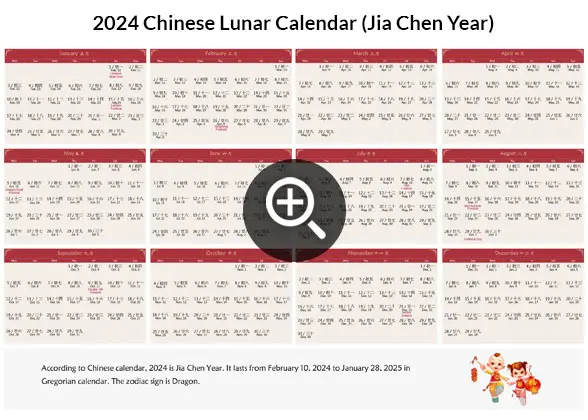 |
| 2026 Chinese Lunar Calendar PDF Download |
Differences between Chinese Calendar and Gregorian Calendar
Chinese calendar is lunisolar calendar which is calculated according to the movement of the moon and the sun. Gregorian calendar is calculated by the movement of sun; when the earth goes around the sun for one circle, it is one year. Generally speaking, lunar calendar is 20 – 50 days later than Gregorian calendar.
Chinese Lunar Calendar 2026 & 2027
According to Chinese calendar, 2026 is Bing Wu Year. It lasts from February 17, 2026 to February 5, 2027 in Gregorian calendar. The zodiac sign is Horse. 2027 is Ding Wei Year and it lasts from February 6, 2027 to January 25, 2028 in Gregorian Calendar. The zodiac sign is Sheep.
Chinese Calendar Year 2026 - 2037
| Year | Chinese Calendar Year | Chinese Pinyin | Zodiac Sign | Date in Gregorian Calendar |
|---|---|---|---|---|
| 2026 | 丙午年 | bing wu nian | Horse | Feb. 17, 2026 – Feb. 05, 2027 |
| 2027 | 丁未年 | ding wei nian | Sheep | Feb. 06, 2027 – Feb. 25, 2028 |
| 2028 | 戊申年 | wu shen nian | Monkey | Jan. 26, 2028 – Feb. 12, 2029 |
| 2029 | 己酉年 | ji you nian | Rooster | Feb. 13, 2029 – Feb. 02, 2030 |
| 2030 | 庚戌年 | geng xu nian | Dog | Feb. 03, 2030 – Jan. 22, 2031 |
| 2031 | 辛亥年 | xin hai nian | Pig | Jan. 23, 2031 - Feb. 10, 2032 |
| 2032 | 壬子年 | ren zi nian | Rat | Feb. 11, 2032 - Jan. 30, 2033 |
| 2033 | 癸丑年 | gui chou nian | Ox | Feb. 3, 2033 - Feb, 4, 2034 |
| 2034 | 甲寅年 | jia yin nian | Tiger | Feb. 19, 2034 - Feb. 7, 2035 |
| 2035 | 乙卯年 | yi mao nian | Rabbit | Feb. 8, 2035 - Jan. 27, 2036 |
| 2036 | 丙辰年 | bing chen nian | Dragon | Jan. 8, 2036 - Feb. 14, 2037 |
| 2037 | 丁巳年 | ding si nian | Snake | Feb. 15, 2037 - Feb. 3, 2038 |
What are the Uses of Chinese Calendar?
All traditional Chinese festivals are decided according to the lunar calendar. For example, Spring Festival is the first day of a lunar year, Dragon Boat Festival is on May 5th and Mid-Autumn Festival is on August 15th in lunar calendar.
A zodiac year is from the first day to the last day of a lunar year. Every lunar year has a representative zodiac. And it has a 12-year cycle with the order as Rat, Ox, Tiger, Rabbit, Dragon, Snake, Horse, Sheep, Monkey, Rooster, Dog, Pig.
After observing the sun’s movement, ancients have found the longest day and the shortest day of a year, respectively Summer Solstice and Winter Solstice. Using these two annual events, a Chinese calendar year was divided into 24 equal parts, each forming a solar term. 24 solar terms show people’s understanding of four seasons, climate and the agriculture. For instance, the Beginning of Spring (Li Chun) symbolizes the coming of spring; Grain in Beard (Mang Zhong) means it is time to harvest wheat and Greater Cold (Da Han) signifies the coldest time of a year. See more Customs Concerning the 24 Solar Terms
Choose a Lucky Date
In daily life, Chinese people usually choose a lucky day in Chinese calendar before important activities such as marriage proposal, wedding, praying for pregnancy, and traveling.
Based on Chinese lunar calendar, Heavenly Stems and Earthly Branches is developed which is used to calculate years. The 10 heavenly stems are Jia, Yi, Bing, Ding, Wu, Ji, Geng, Xin, Ren, Gui and the 12 earthly branches are Zi, Chou, Yin, Mao, Chen, Si, Wu, Wei, Shen, You, Xu, Hai. Every lunar year has a name combined by 1 heavenly stem and 1 earthly branch. For example, 2024 is Jia Chen year and 2025 is Yi Si year. When every lunar new year comes, the heavenly stems and earthly branches turn to next one and combine a new name. And it has a 60-year cycle.
Ancient Chinese believed the universe was composed of five elements, namely metal, wood, water, fire and earth. Chinese like to find out their element using their birth date in lunar calendar and predict their life horoscope, like what career they are suitable for and what kind of people they are supposed to marry.
Over 4,000 Years’ History of Chinese Lunar Calendar
The lunar calendar has a very long history going back to the Xia (21st century BC - 16th century BC) and Shang Dynasty (16th century BC - 11th century BC). Roughly speaking, it has existed for more than 4,000 years. It is based on a unique combination of astronomy and geography through observation and exploration.
Following its creation in the Xia Dynasty, succeeding reigns continued to use the calendar but modified it from time to time. The Han Dynasty (202 BC - 220 AD) rulers instituted the Taichu calendar, while during Tang Dynasty (618 - 907 AD) the Huangji calendar was introduced and it was adopted by Japan, Korea and Vietnam.