Lucky Numbers in China
Numbers have always played a significant role in Chinese culture. People in China traditionally associate fortune with lucky numbers. Thus, there came a system of lucky numbers on their own way. It is undeniable that numbers differ from auspicious and ominous. So, Chinese take lucky numbers combination into important consideration in daily life, such as in occasions when they buy residences, choose telephone numbers, select a date of a wedding ceremony, and pick an identification number for their vehicle. They believe lucky numbers can bring them good luck.
What Are the Lucky Numbers in China?
Number 8
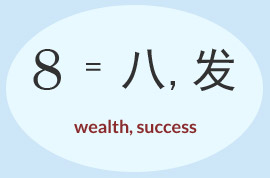
In China, it is customary to regard even numbers as being more auspicious than odd ones. So, gifts are given in even numbers for the celebration of all occasions. No. 8 has long been regarded as the luckiest number in Chinese culture. With pronunciation of 'Ba' in Chinese, no. 8 sounds similar to the word 'Fa', which means to make a fortune. It contains meanings of prosperity, success and high social status too, so all business men favor it very much. Moreover, in some areas of China, people prefer to pay much more money for a telephone number with 8 in it. They also favor residences on the eighth floor of buildings. In 1990s, a vehicle identification number with 8 was once auctioned off for 5 million Hong Kong dollars.
Number 2
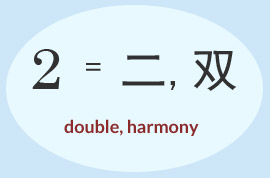
As the no. 2 usually suggests germination and harmony, decorations in China are invariably set out in pairs, such as a pair of red candles, a pair of pillows, and couplets hung on two sides of the door.
Number 6
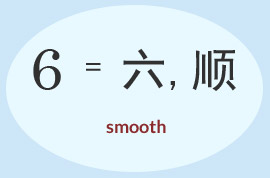
No. 6, pronounced as 'Liu', conveys indirectly its homophony's meaning – Do everything smoothly.
Number 3
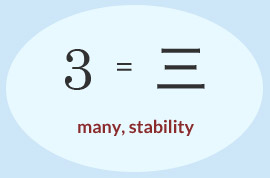
For odd numbers, no. 3 indicates multiples. In Buddhist culture, it represents Buddha, Dharma and Bonze, so people toll the bell three times to worship Buddha and pray for the removal of calamities with 3 sticks of incense.
Number 7
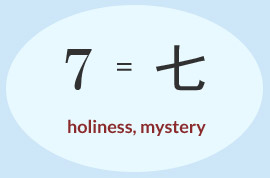
Whilst no.7 implies holiness and mystery in Buddhism, it is lucky as well. So, there are seven-storied Stupas everywhere.
Number 9
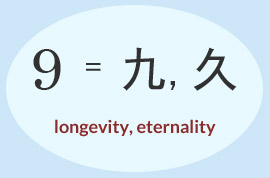
No. 9 in Chinese culture means longevity and eternality. Thus, there were 9,999 rooms within the Forbidden City in Beijing. It is also a tradition between lovers to send 99, or 999 roses, which carry the best wishes for 'everlasting love'.
Chinese Lucky Numbers Combination
1988
19 sounds like “forever” in Chinese, and 8 means “make a fortune”.
1366
The pronunciation of 13 is similar to “a lifetime”, 6 in Chinese represents smooth.
1314 & 3344
The pronunciation sounds like “a whole life” and “forever” in Chinese. They are often used by lovers to express their forever love to each other.
366, 666, 888 & 1666
These are the lucky number for Chinese New Year, or specifically the quantity of cash Chinese usually put in the Red Envelope. It is a blessing from the elders to the younger generation, which hopes that they will have a smooth journey in life.
Chinese Zodiac Lucky Numbers
| Chinese Zodiac | Lucky Numbers |
| Rat | 2, 3 |
| Ox | 1, 9 |
| Tiger | 1, 3, 4 |
| Rabbit | 3, 4, 9 |
| Dragon | 1, 6, 7 |
| Snake | 2, 8, 9 |
| Horse | 2, 3, 7 |
| Sheep | 3, 4, 9 |
| Monkey | 1, 7, 8 |
| Rooster | 5, 7, 8 |
| Dog | 3, 4, 9 |
| Pig | 2, 5, 8 |
 See more about Chinese Zodiac
What Numbers Do Chinese not Like? - Unlucky Numbers in China, 4 & 14
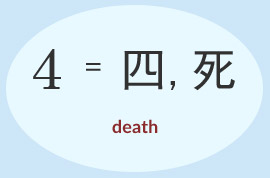
No. 4 is the exception to the even number rule. Why is the number 4 bad luck in Chinese? Because it sounds like “Si”, death in Chinese. Just like some westerners hate no. 13, Chinese avoid number 4 and no.14 when they choose phone numbers, room numbers or select date of ceremonies.
Beside the notions above, each number has their unique meaning and significance. There is no exception to this in modern or ancient times, in culture of China or elsewhere around all over the world. Every person is a universe onto himself, but as the analysis for astrological signs in Western culture, Chinese do follow their own tradition to generalize person's character by analyzing their lucky numbers.
 See detailed description of different numbers: