Dai Nationality
The Dai ethnic minority, which numbers 1,158,989, is distributed throughout the Dai Autonomous Region and the Dehong Dai-Jingpo Autonomous Prefecture in Xishuangbanna in the southern part of Yunnan Province. In the past, they were called 'Baiyue', meaning a vast living area. Therefore, they have established a close relationship with ethnic groups like the Zhuang, Dong, Shui, Bouyei and Li, who are said to be the descendants of the Dai people.
 Language:
Their language belongs to the Zhuang-Dai branch of the Zhuang-Dong group of Sino-Tibetan languages. The written language was derived from Devanagari and differs from region to region.
Religion:
Their religion is Southern Buddhism, which was adopted in the 6th to 8th century and had a profound influence on their politics, economy, culture and arts. Religious activities are so common that most 8 to 10-year-old boys, in particular in Xishuangbanna, are sent to temples where they learn sutras for one to five years. They then leave the temple and spend their lives as secularized monks.
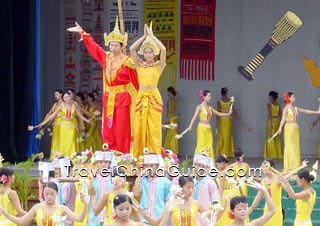 |
| Performance of Dai People |
Resources:Thanks to the area's favorable climate, agriculture and horticulture developed very early. An abundance of rice won for Xishuangbanna the title 'barn of south Yunnan'; local tea, bamboo, and sugar cane are also of high quality. According to historical records, Pu'er Tea was presented to the emperor as tribute as early as the Ming Dynasty (1368 - 1644). Now this region has become an important producer of rubber.
Other resources are also abundant. There are wild apples, bananas and Chinese gooseberries, rare animals like gibbons and peacocks, and minerals like gold, silver, iron, and crystal.
Arts:
They are quite good at singing and dancing. Their achievements in music are well-known among all the ethnic groups. Their folk and traditional musical instruments include the elephant-foot drum, bronze gong, clarinet, and hulusi.
Xishuangbanna is the home of the peacock, which the Dai people revere as a symbol of good fortune, happiness, beauty and kindness. Thus the Peacock Dance is their most popular folk dance. Performers in clothes with peacock patterns imitate peacocks with lively, flexible and graceful movements in a dance that is a popular part of the Water-splashing Festival.
The Elephant-foot drum dance is another well known dance for men. This unique instrument is made of carved mango or ceiba trunk covered with cowhide, and looks just like an elephant foot. The drum can be long, medium-sized, or short. The dance done with a long drum appears very graceful, with the medium-sized one, it is vigorous with broad, sweeping movements; and with the short one, flexible and bright.
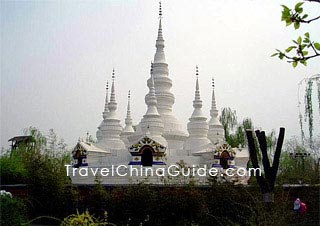 |
| Architecture of Dai Nationality |
Architecture:The architecture of the Dai region is distinctive, known especially for the Dai-style temples, bamboo bridges and houses. The temples combine the styles of South Asian and Chinese culture and can be shaped like pavilions, thrones, bells, and so on. Bamboo houses are designed based on local conditions. Made entirely of bamboo, the houses have two floors - downstairs for livestock and upstairs for people - a clean, light and well - ventilated design.
Food:
They love glutinous rice and hot and sour dishes. A favorite dish is bamboo rice, made by putting clean rice into a bamboo tube, adding water and soaking for 7 or 8 hours. Finally, the mouth of tube is covered with a banana leaf and the whole thing is roasted for about 12 minutes. The resulting soft, delicate rice emits a delicious bamboo fragrance and is a choice offering for guests.
Festivals:
Their important festivals are the Water-splashing Festival, the Door-closing Festival and the Door-opening Festival, all of which are related to Buddhism. The Water-splashing Festival is the New Year of the Dai ethnic minority. On the 24th to 26th day of the sixth month of the Dai calendar, people engage in traditional activities such as water-splashing and dragon-boating, hoping to pacify evil spirits and ensure a good harvest in the coming year.
The Door-closing and Door-opening Festivals are the two longest and grandest periods--one in mid-September and the other in mid-June. People worship Buddha by sacrificing food, flowers, sutra, clothes and other wealth. They also take advantage of the holidays to preach Buddhist teachings and have a good time.
The Huajie Festival (Flower Street Festival) is held on the seventh day of the first lunar month to say farewell to the past year and to greet the new one. On that morning, men and women, old and young, wear flowery new clothes and bathe in the hot spring. Unmarried young people also sing to each other in an attempt to find their future better half. More Ethnic Groups in Yunnan Area:
Yi Bai Hani Zhuang Lahu Wa Jingpo Primi Achang Dulong
Further Reading:
Yunnan People
 Reply
ReplyAre the Dai and the Thai of thailand related?
If so, to what extend? like languages and culture?
 2
2 1Reply
I am also curious about this question. I have searched on the internet and it says that they are with the same origin but different branches.
11Reply00Reply00ReplyThe ethnic name Dai, Tai, Tai, Tay, Thai, Hlai come from the same origin. Another older ethnic name is Lao (Rau in Zhuang language). The exonym called by non-Tai people is "Siam" which the word Shan and Assam (Ahom) derived from.