Zhuang Nationality
 Population and Distribution:
 With a population of about 16,178,811, Zhuang ethnic group is the largest minority group in China with a long history and glorious culture. Over 90 percent of the population live in Guangxi Zhuang Autonomous Region. The rest reside in Yunnan, Guangdong, Guizhou and Hunan Provinces.
Language and Character:They have a language of its own that belongs to the Zhuang-Dai branch of Zhuang-Dong Austronesian (an austronesian belongs to the Sino-Tibetan family of languages). The language is divided into two dialects although they have few differences.
Chinese characters were used before 1955 for writing, however since 1957, a writing system based on the Latin alphabet has been created with the help of the Chinese government. The Latin alphabet has been adopted to publish many books. Since then, they have had their own language. In the year of 1982, the Zhuang language was revised and has been greatly used. Belief:
Since the ancient times, they have had numerous kinds of beliefs. They believe in the propagation, the totem, and their ancestors. Now, most of them are polytheists, believing the power of many inanimate things in nature, such as giant trees, high mountains, cavity, the earth, the sun, water and so on. Sacrifice activities are usually held because of their beliefs of being blessed by the divinity and to prevent all kinds of disasters. Food and Food Culture:
 |
They are so hospitable that any guests are honored by the whole village. Wine is a must when treating the guests. Guests are shown a unique way of drinking each others wine in the spoon by crossing each other's arms. The elder person is shown respect by nobody eating before him or her.
Clothes:The style of clothing differs according to different areas. There is little difference for the men's wear, in comparison with the Han people's style. Women however, have numerous styles. For example, the women living in the northwest Guangxi usually wear the collarless, embroidered jackets buttoned to the left along with loose and wide trousers, or pleated skirts and embroidered belts. The women from the southwest Guangxi prefer collarless jackets buttoned to the left with black square headbands on the head and loose trousers. Most of them complement their outfits with silver ornaments. Crafts:
Like some other ethnic group women, the Zhuang women are skilled at weaving and embroidering. These women have a great reputation for the distinctive designs of cotton woven yarn brocade they make in colorful velour. Zhuang brocade is renowned for its color, luster, durability and the wide range of use. Another skill such as dying with wax is also popular. You can appreciate the excellent skills used in handcrafting carpets, aprons, bed covers, waistbands, tablecloth and curtains as a beautiful purchase for homes all over the world. Now, Zhuang brocade is not only a wonderful handicraft favored by the people in China but also has won international fame and enjoys a large market both at home and abroad. Festivals:
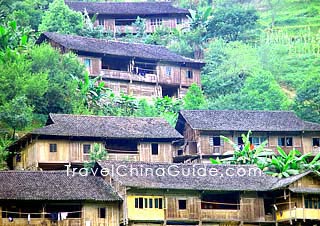 |
| Stilt-Houses of A Zhuang Village |
The Devil Festival, held on July 14th of the lunar month, is regarded as an occasion second to the Chinese New Year. The day before the Devil Festival, every family does a thorough house cleaning and makes special preparations of outfits used in the sacrifice. On that day, duck, pork and good wines along with some candies and fruits must be offered in order to show great respect to their ancestors.
The Ox Soul Festival held on April 8th of the lunar month is to celebrate the birthday of the king of oxen and to show their love and respect to the ox, therefore, each ox is relieved from their yokes and free from plowing. People give the ox a bath accompanied with beating drums. Parents of a family feed the ox with five-colored glutinous rice, while singing folksongs. It is a festival that represents their great hope for a good harvest.
The Singing Festival is a traditional occasion which was held before 1940 to visit graves of the ancestors. Now it has become a grand sentimental occasion using songs for their expression. On that day, after offering sacrifices to Sanjie Liu (a Zhuang minority girl good at singing), they will sing to each other to challenge each other not only the song itself but also wit. Lyrics are usually improvisational and humorous that makes every one burst into laughter. It is also a perfect day for the young men to express their love to the girls by singing, so it is also reputed as the Valentine's Day of the Zhuang ethnic minority.
Other Culture:Other cultures such as frescoes and bronze drums are also of splendid fame.
The Zhuang minority's frescoes carved on the steep cliffs are of extreme Zhuang characteristics. Figures, beasts and some other patterns carved 2,000 years ago will make everyone appreciate the image of their ancestors and the superb technique.
The bronze drum used both in sacrifice and festivals, delivers a special culture of the Zhuang ethnic minority. On the top and sides of the drums, the sun, frogs, dragon, dancing women and other patterns are decorated. It is a great revelation of their worship to the sun and frog. Nowadays, the bronze drum has become an indispensable musical instrument for the festivals. More Ethnic Groups in Guangxi Area:
Yao Miao Dong Mulam Maonan Gin