Yao Nationality
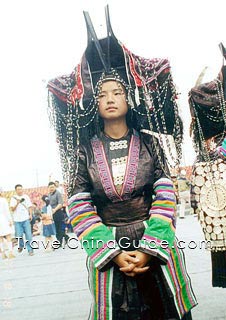 |
| Yao Minority in Guizhou |
Similar to the other 54 ethnic groups of China, they have their unique religious and cultural characteristics.
 Language:
Their language belongs to the Miao-Yao sub-group of the Sino-Tibetan language family. Most people speak the Yao language, some speak a language similar to the Miao language, and a few even use the Zhuang and Dong languages. Their language differs so much between regions that people from different areas have difficulty communicating with each other. They can also speak Han and Zhuang languages. As to the written characters, Nv Shu (a special written language in South China used only by women), are used. Han characters are widely used among Yao people, but written words were created by Central University for Nationalities in 1982. Thus, the written words are also used universally now.
Religion:
People living in different regions have differing beliefs. Some of them worship nature, some idolize their ancestors, and some adore the totem. Taoism (one of the accepted Chinese religions) also plays an important role in their lives, which includes the following of sacrificial ceremonies. Some people believe in wizardry.
Food:
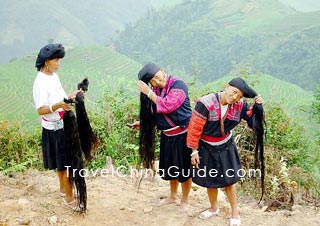 |
| Long Hair Yao Minority in Guangxi |
Crafts:
They are master at handicrafts. These crafts not only come in many variations, but also have special meanings. The ones they are most proud of are batik, sculpture, painting, and printing and dying.
Clothes:
Clothes differ according to the regions where they live. However, their clothes are mainly made of blue cloth with various pictorial designs on the fabric. Men wear short shirts without collars, and trousers or pants with the lower part wrapped. Women wear trousers, short skirts or pleated skirts decorated with unique embroidery. Also their special hair adornments are dazzling and attractive.
Festivals:
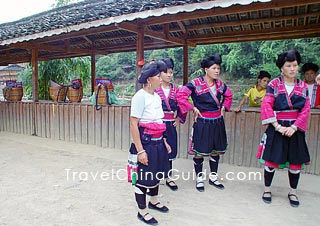 |
| Long Hair Yao Minority in Guangxi |
Other culture and arts are also worth appreciating, such as the ballads and legends with rich content and multiple styles that depict the nation's history, glorify the hard revolutions, or express their sweet love, with their distinctive music and songs as tambourine dance and timbal dance.
All in all, the moralities of diligence, faithfulness, hospitality, and braveness have been handed down from generation to generation , and have become their representative characteristics. More Ethnic Groups in Hunan, Yunnan and Guizhou Area:
Miao Tujia Yi Bai Hani Bouyei Zhuang Dong