Chinese Ethnic Groups
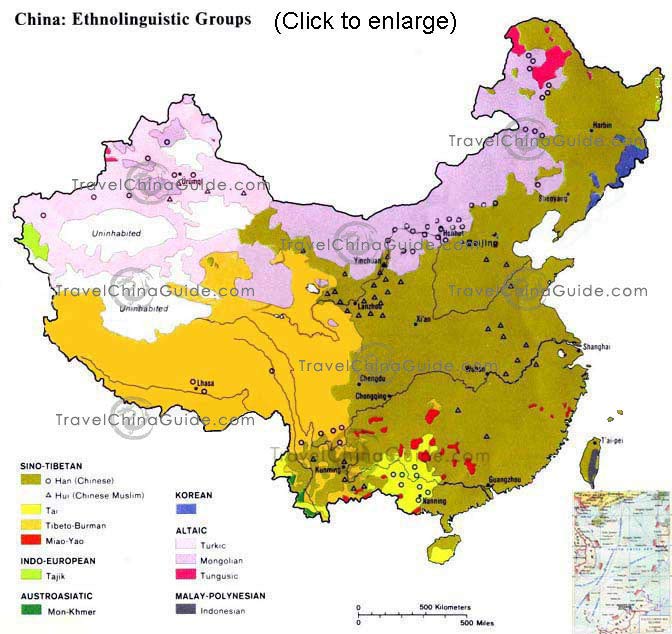 |
| Ethnic Groups Distribution Map (Click to enlarge) |
As a large united multi-national state, China is composed of 56 ethnic groups. Among them Han Chinese account for 91.59% of the overall Chinese population and the other 55 make up the remaining 8.41% according to the Fifth National Population Census of 2000. As the combined population of these other minorities is far fewer than that of the Han, they form the 55 minorities of China.
These numerous ethnic groups share China's vast lands but at the same time many live in their individual communities. The relationships between them have been formed over many years. Chinese Han People
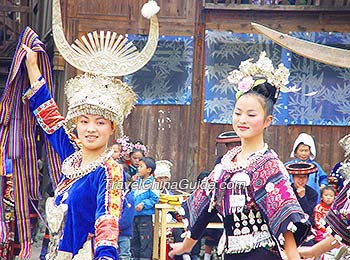 |
| Miao Minority in Guizhou |
With a population of 1159.4 million, the Han Chinese can be found in almost every part of China. However, they mainly live in the middle and lower reaches of the Yellow River, Yangtze River and the Pearl River, and also in the Northeast Plain Region (Songliao Plain). They form the largest ethnic group within China and also the largest in the world. The Han people have their own distinctive way of life. 55 Minorities in China
Although they make up only a small proportion of the overall Chinese population, the 55 minority ethnic groups are distributed extensively throughout different regions of China. The regions where they are most concentrated are Southwest China, Northwest China and Northeast China. No matter whether it is Inner Mongolia, Xinjiang, Ningxia, Guangxi, Tibet, Yunnan, Guizhou, Qinghai or Sichuan, Gansu, Hubei, Hunan or another province, one can find Chinese minorities. From the areas listed above, the greatest number of minorities can be found in Yunnan Province (25 ethnic groups). Zhuang has the largest population (more than 16 million) of minority ethnic groups.
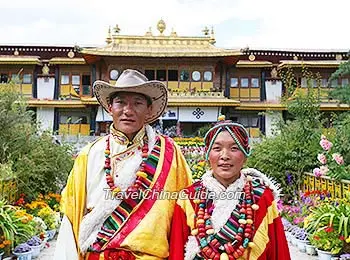 |
| Tibetan People |
 List of 55 Chinese minorities:
 Photos of Chinese Minority People
Tibetan People Photos Photos of Minorities in Yunnan
Guizhou Minority Photos Xinjiang Minority People Photos
|
|
 Ethnic Minority Tour:
 Reply
Reply 0
0 0ReplyReply00ReplyReply75Reply94Reply74Reply
For all I know, the major nationality around the Stone Forest is Yi. Maybe she is one of them.
00ReplyReply45Reply