Jino Nationality
The Jino (also spelled Jinuo) ethnic minority lives mainly in the Jino Town of Jinghong County, Xishuangbanna Dai Autonomous Prefecture in Yunnan Province. The expression Jino refers to an ethnic group that respects the mother's brother as a prominent person in the family.
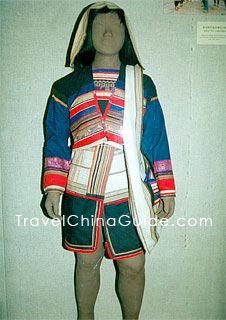 |
| Clothes of Jino Minority |
 Population and Language:
According to the fifth census in 2000, they had a population of 20,899. They speak the Jino language, a Tibetan-Burman branch of the Sino-Tibetan phylum. They have no written characters.
Belief: Their religion is animism, thinking everything has a soul. It is said that their ancestors who were part of the troops of Zhuge Kongming during the Three Kingdoms Period (220 - 280) were dispersed from the main force. Therefore, they regard Zhuge Kongming as a distinguished joss (god). They also worship Amo Yaobai who was said to have created the sky and land for the Jino people.
Crafts:Jino women learn to embroider in childhood while men like to carve the handles of sickles and musical instruments and to weave with thin bamboo strips. Boxes for betel nuts, cigarette cases, workboxes and desks all can be woven.
Food: They eat rice and corn; glutinous rice is cooked to treat guests and feed field laborers, and to celebrate festivals. Jino dishes are fresh and spicy and maintain the original fragrance of the ingredients. Jinos like brewing and drinking wine, which they feel help cure rheumatism and arthritis. They like to chew betel nuts. For a long time dyed-black teeth were thought to be beautiful and a protection from moths.
Festivals: The Iron Forging Festival, the most important festival, is held for three days in the twelfth lunar month. On the first day they dance to the beat of an ox hide drum, called the Sun Drum, the most holy altar ware. People expect it to bless their good fortune and bring a good harvest.
Adult Ceremony: At 15 years old, Jino youth attend the Adult Ceremony. Parents give their children the clothes, decorations and tools of an adult; girls change their hair to adult style; seniors lead people in singing the epics and discuss ethics and the hardships of labor. From then on, they undertake the same obligations as their parents and can get married.
New Rice Festival: As its name implies, Jino people eat newly ripe rice during the seventh or the eighth lunar month. They kill chickens and invite friends to share their happiness and success. Eating and singing, they often enjoy this pleasure overnight. Other Customs:
In their families, a mother's brother has nearly the rights of the children's father. With regard to the birth of a niece or nephew, or their engagement and marriage options, the uncles' ideas are highly regarded. They also respect their seniors, especially older women. Upon the building of a new house, or when worshiping in an Adult Ceremony, they hold the highest position. This is a vestige of ancient matrilineal clans.
There are many taboos in their daily life. For example, women cannot eat an egg when it is whole but only when it is cut in two, or her children will be sick; when hunting, men should not hurt monkeys, or their children will not be pretty; when a woman gives birth to a baby, the first meal she has must be chicken or a bird which is chosen as the most beautiful, so the baby will grow to be lovely.
More Ethnic Groups in Yunnan Area:
Yi Bai Hani Dai Zhuang Lahu Wa Yao Jingpo Nu