Zhuge Liang - Prime Minister of Shu Kingdom
Zhuge Liang, also named Kong Ming, was born into an official family in Yinan County, Shandong Province. He was a famous statesman, ideologist and strategist during the Three Kingdoms Period (220 -280). As the Cheng Xiang (an ancient term for prime minister) of the Kingdom of Shu, he devoted his life to his monarch Liu Bei, and to the existence of the Shu Dynasty.
Zhuge Liang had an unfortunate childhood. His mother died when he was three years old and his father died when he was eight. After his father's death, he and his brothers and sisters all lived with his uncle Zhuge Xuan, a local officer. his uncle passed away a few years later, and 16-year-old Zhuge Liang began to live on his own.
|
|
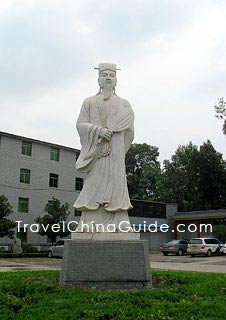
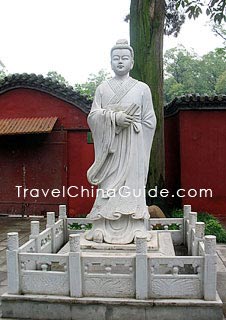
Unwilling to serve under Liu Biao whom his uncle had followed, Zhuge Liang moved to the country in the Longzhong area, of Xiangyang in Hubei Province. There worked as a farmer while studying. During his ten years of reclusion, he met a group of contemporaries including Xu Shu, Pang Tong and Sima Hui. These men were considered the most intelligent people of that period. Through study and astute observation, he was not only an expert in astronomy and geography, but also mastered military strategy and tactics, and carefully analyzed political situations with great ambition.
 See more Longzhong Scenic Area
In 207, on the recommendation of Sima Hui and Xu Shu, Liu Bei paid three visits to the thatched cottage of Zhuge Liang asking for his assistance. From the Longzhong area, he introduced his detailed plan for reunifying the whole nation. This both enlightened and pleased Liu Bei and his initiatives were subsequently called the 'Longzhong Dialogue'. From that point on, he began to assist Liu Bei in realizing his political goal to reestablish the Han Dynasty (206 BC - 220 AD).
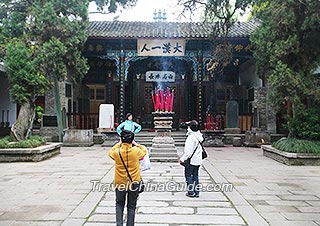 |
| Wuhou Temple, Hanzhong |
Zhuge Liang assisted Liu Bei and helped him through many difficult situations. Following his strategies, Liu Bei made an alliance with Sun Quan's group and defeated Cao Cao's troops in the Battle of Red Cliffs (the Battle of Chibi). Later, Liu Bei successfully captured Jingzhou, Yizhou and Hanzhong. With Zhuge's assistance, Liu Bei appointed himself emperor in 221 and He was appointed as Cheng Xiang to preside over political affairs. In 223 when Liu Bei died, he was entrusted with Liu Bei's son, Liu Shan.
See more Chibi Ancient Battlefield of Three Kingdoms
After Liu Shan succeeded his father, Zhuge Liang was authorized as Wuxiang Hou (also Wuhou or Marquis Wu, a title of vassal who was given the land of Wuxiang in current Hanzhong) and appointed the chief executive of Yizhou (most areas of current Sichuan Province). During his tenure, he was always diligent and conscientious in governing the Kingdom of Shu. As a loyal chancellor, he devoted all his efforts to realize Liu Bei's political ideal. He aligned the Shu with the Wu, implemented the Tun Tian System (farming done by soldiers) and consolidated the military strength of Shu. He launched six consecutive northern expeditions to the central plains. Unfortunately, he failed to conquer any northern area and did not accomplish Liu Bei's goal of full unification
In 234, during the last northern expedition battle with the general of the Wei Sima Yi, Zhuge Liang died of exhaustion at Wuzhang Plain (currently southwestern of Mei County in Shaanxi Province).
There are a number of memorial temples built in many places to memorize him. The most famous ones include the Wuhou Temple in Chengdu and the Wuhou Temple in Hanzhong.