Kingdom of Wei
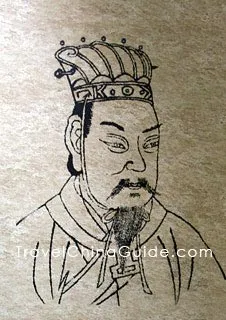 |
| Cao Cao |
As the most powerful kingdom of the Three Kingdoms Period, Kingdom of Wei was successively reined by six emperors including Cao Cao who was proclaimed as Wei Dynasty Tai Tsu after his death.
Cao Cao paid close attention to the application of talented people and economic development during his reign. In the beginning, he tried to recruit as many talented people as possible and made many reformations to discard the old political patterns of the Eastern Han (25-220). As a result, the monopolization of eunuchs was swept away and personages from different social status participated in the Court of Wei.
In order to have a continuous supply of soldiers, a special system called Shijia (family of warriors) System was founded by Cao Cao. Men in those families had to join the army or to do the corvee labor from generation to generation. In this way, the military force of Wei was guaranteed.
Economically, Cao Cao benefited a lot from the Tun Tian (farming done by soldiers) System. Since the productivity of soldiers was greater, the demand for combat food was well met in a short period of time. Besides, Hu Tiao (Tax Modification) System was also carried out, which to some extent added a burden to landlords while lightening the burden on farmers. Under all these policies, the social order of Wei became extremely harmonious.
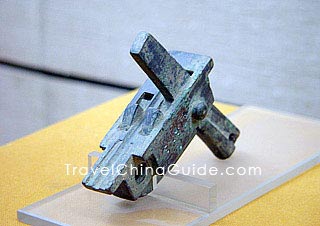 |
| Bronze Crossbow Trigger, Kingdom of Wei |
In addition, remarkable accomplishments were achieved in literature, philosophy and technique. Numerous predominant poets emerged from the Kingdom of Wei, including Cao Cao and his two sons Cao Pi and Cao Zhi as well as the seven leading writers during the Jian An Period. The noted Yuefu Poem-Peacock Flies to Southeast was also written in the Jian An Period. Metaphysics represented by He Yan and Wang Bi also came into being. In medicine, the commonly known 'Miracle Doctor', Zhang Zhongjing wrote the book Theory of Exogenous Febrile Disease which established the foundation of traditional Chinese medicine.
In the late Wei Dynasty, power struggles between the imperial clan of Cao Cao and the military official Sima Yi appeared within the Court. Finally, Sima Yi made contributions to the war and defeated Kingdom of Shu in 263. Two years later, a new dynasty - Jin Dynasty (265-420) was founded by the son of Sima Yi.
 Reply
Reply 0
0 0
0