Liu Bei - Emperor of Shu Kingdom
Liu Bei, better known as Xuan De, was born in Zhuo County in Hebei Province. His ancestor was Liu Sheng, son of Emperor Jing in the Western Han Dynasty (206 BC - 24 AD).Judging by his position in the family hierarchy, he was the last emperor of Eastern Han (25 - 220) - Emperor Xian's uncle. He founded the Kingdom of Shu and was regarded as a great statesman and strategist in the Three Kingdoms Period (220 - 280).
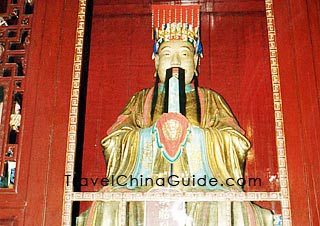 |
| Statue of Liu Bei in Wuhou Temple, Chengdu |
After the battle, Liu formally set up his military group and was soon appointed as a county governor. Later, he was successively promoted to chief executive of Xuzhou, Zhendong General, and chief executive of Yuzhou. However, because it was weaker militarily than other groups and without a stable military base, Liu Bei's group sought support temporarily under the domain of big warlords such as Cao Cao, Yuan Shao and Liu Biao.
In 207, after paying three visits to the thatched cottage of the great sage, Zhuge Liang, Liu received advice crucial to his subsequent role in political and military affairs. With Zhuge Liang as his military counselor, Liu Bei followed his strategic guidance to capture Jingzhou, with support from The Kingdom of Wu, by attacking Cao Cao's troops and to driving into Sichuan Province.
 |
| Tomb of Liu Bei, Wuhou Temple, Chengdu |
In 221, Liu Bei reclaimed himself emperor in Chengdu, establishing the Kingdom of Shu. As one of three kingdoms, The Kingdom of Shu covered the area of Sichuan Province, Yunnan Province, the northern part of Guizhou Province and the southern part of Shaanxi Province.
As an emperor, Liu Bei loved his people and treasured talented people very much. As an individual, he was fair and sincere, humane and righteous. The main features of his political characters embodied Chinese traditional political thoughts, especially Confucianism. Because of this, he always received courteous reception and deep respect wherever he arrived.
In 223, Liu Bei launched a battle against The Kingdom of Wu to avenge the death of his sworn brother Guan Yu. Unfortunately, he was defeated and had to draw back into the domain of Shu. In April of the same year, he died in Baidi City (currently Fengjie in Chongqing). On his death bed, he entrusted his son Liu Shan to Zhuge Liang.