Cao Cao - Emperor of Wei Kingdom
Cao Cao, with his more common name being Mengde, was born in Qiao County of Peiguo (currently Anhui Province). He was born into an eminent eunuch family, with his father Cao Teng, being one of the ten 'Chang Shi' (eunuch) of Eastern Han Dynasty (25-220). Being a master of both the pen and the sword, Cao Cao was considered an excellent strategist, politician and poet of late Eastern Han.
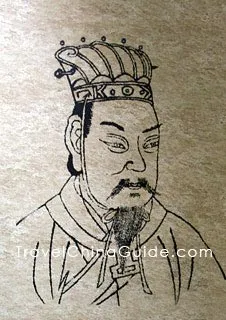 |
| Cao Cao |
In 190, he joined the military alliance fighting against Dong Zhuo (a treacherous court official of Eastern Han), and started to build up his own armed forces which were named the 'Qingzhou Army'. In 196, Cao Cao led his troops into the capital city Luoyang and forced the Emperor Xian of Han to carry out his commands in order to control the political situation. In 201, his troop defeated Yuan Shao's (leader of a rebel force against Eastern Han court) in the Battle of Guandu. From that time on, Cao Cao gradually unified northern China. However, his political aim of unify the whole of China was never achieved. In the Battle of Red Cliffs (the Battle of Chibi), which had the aim of capturing the southern area, he suffered a disastrous defeat in fighting with the allied forces of Liu Bei and Sun Quan.
 See more Chibi Ancient Battlefield of Three Kingdoms
As a politician, Cao Cao paid great attention to the development of an agricultural economy by setting up the Tun Tian (farming done by soldiers) System to promote productivity and meet the demands of the army's food supplies. Meanwhile, he also set up Zu Tiao (Tax Modification) System to ease the tax burden on farmers' while at the same time punishing the big landlords. All these efforts had consolidated a strong economic foundation for his military group. In dealing with human resources, Cao Cao focused close attention on recruiting talented people to strengthen the power of his group and was also considered an impartial dispenser of rewards and punishments.
Known as an illustrious poet, Cao Cao wrote a list of poetry anthologies, such as Haolixing, Duangexing, Guancanghai (The Sea) and Guisuishou (Though the Tortoise Lives Long). His poems were deeply influenced by Yuefu Poem pattern while being more creative in content. Therefore, his poems, as well as those of his two talented poet sons Cao Pi and Cao Zhi, began a new style of Jian An literature.
Cao Cao died of a head disease on March 15th, 220 and was posthumously titled Emperor Wu of Wei after his son Cao Pi succeeded him to the throne.