Three Kingdoms Period
Just as the name implies, there were three regimes during the Three Kingdoms Period, Wei, Shu and Wu, originated in 220 AD when Wei replaced the Eastern Han Dynasty (25 AD-220 AD) and ended in 280 AD when the Wu was defeated by the Court of Jin. It is considered to be a special historical period full of power struggles and sophisticated military strategies.
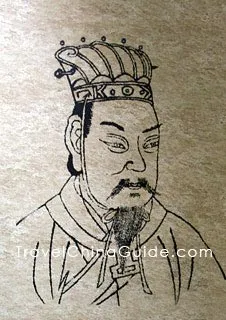 |
| Cao Cao |
Political History
In 189 when Emperor Ling of the Eastern Han dynasty died, a young emperor - Emperor Shao was put on the throne. Resenting the manipulation of eunuchs, two generals Yuan Shao and He Jin plotted to murder them. During the chaos caused by the fighting between the eunuchs and generals, Dong Zhuo, a treacherous court official of the Eastern Han drove his army into Luoyang. With full political power in his hand, Dong Zhuo dethroned Emperor Shao and put Emperor Xian on the throne. All Dong's deeds aroused strong protest from the courtiers and many local officials. As the political situation became acute, a large-scale civil war finally broke out.
After Dong Zhuo invaded Luoyang, Cao Cao fled to Chenliu (currently southeast of Kaifeng in Henan Province) and began to assemble military forces to revolt. In 193, Dong was killed in a mutiny but the melee remained. This period of unrest continued until 196, Balkanized areas were formed among which the most two powerful ones were those of Yuan Shao and Cao Cao.
In 196, Cao Cao held Emperor Xian under duress and took this advantage to strengthen his military power. In 201, with comparatively weaker strength, Cao Cao defeated Yuan Shao in the Battle of Guandu after which he gradually unified the northern area of China. In 209, Cao Cao drove his troops to the southern area and captured Jingzhou. But when he wanted to expand his power further to the south, he was defeated by the allied forces of Liu Bei and Sun Quan in the Battle of Red Cliff (the Battle of Chibi) and thus he withdrew his army back to the central plains of China.
 See more Chibi Ancient Battlefield of Three Kingdoms
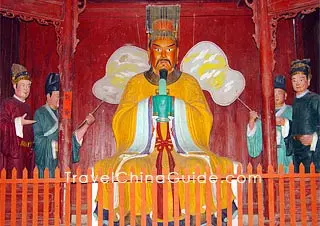 |
| Liu Bei |
In 220 when Cao Cao died, his eldest son Cao Pi proclaimed himself emperor, with Wei as his National Title and Luoyang as his capital city. In 221, Liu Bei proclaimed himself emperor, with Shu his national title and Chengdu the capital city. And in 229, Sun Quan proclaimed himself emperor in Wuchang (currently Wuhan), and later moved the capital to Jiankang (currently Nanjing), with the national title Wu. Since then, the so-called Three Kingdoms' Tripartite Confrontation was formed. On the whole, Wei occupied the north, Shu occupied the southwest and Wu occupied the southeast.
Upon the founding of the three kingdoms, rulers of each kingdom all committed to improve the way of ruling and develop their national economy. In the Kingdom of Wei, Cao Cao made many reforms to discard old policies inform previous dynasties. The Tun Tian (farming done by soldiers) System was also carried out, which greatly promoted the national productivity. In the Kingdom of Shu, Zhuge Liang set up strict social order and tried to govern the kingdom by law. With his assistance, Shu's agriculture and handicraft industry developed rapidly. Additionally, Shu formed a friendly relationship with ethnic minorities in southwestern areas. In the Kingdom of Wu, the shipbuilding industry was much more prosperous. As for the national strength, Wei ranked first, Wu second and Shu third.
Throughout the Three Kingdoms Period, battles between the three countries were countless. Among those, battles between Shu and Wu fighting for Jingzhou, Shu and Wei fighting for Hanzhong as well as Wei defeating Shu were all illustrious ones in Chinese history.
Finally, the end of the Three Kingdoms Period started from the Sima Yan (son of Sima Yi and chancellor of Wei)'s usurpation of Wei and the establishment of the Jin Dynasty (265 - 420). In 282 when the Jin army conquered the last kingdom - Wu's capital, the Three Kingdoms Period was ended.
Emperors during this Period
| Order | Name | Notes | Reign Time (years) |
|---|---|---|---|
| Kingdom of Wei (220-265) | |||
| 1 | Wei Wendi (Cao Pi) | The second son of the Chinese politician and poet Cao Cao; he is considered the founder of Wei | 220 - 226 |
| 2 | Wei Mingdi (Cao Rui) | Son of Cao Pi; during his reign, the Shu and Wu become more entrenched. Before he died, he entrusted his son Cao Fang to the regency of Cao Shuang and Sima Yi - ultimately a fatal mistake for his empire. | 226 - 239 |
| 3 | Wei Qiwang (Cao Fang) | Adopted son of Cao Rui, he was rumored to be the son of Cao Kai who was a grandson of Cao Cao. Although, he reigned longer than any other emperor in Wei's history, he did not have any real imperial authority. He was eventually deposed by Sima Yi. | 239 - 254 |
| 4 | Gaoguixiang Gong (Cao Mao) | A grandson of Cao Pi, his reign was under the domination of the Simas. He attempted a coup against Sima Zhao, but was killed by Sima's troop. | 254 - 260 |
| 5 | Wei Yuandi (Cao Huan) | A grandson of Cao Cao, and the last emperor of Wei who was still a figurehead of the Simas. During his reign, the Shu was defeated by the Wei. He was forced to abdicate by Sima Yan, and was given the title of "Prince of Chenliu" which he retained for the rest of his life. | 260 - 265 |
| Kingdom of Shu (221-263) | |||
| 1 | Zhao Liedi (Liu Bei) | A descendant of the Western Han (206 BC - 24 AD) imperial family and born into the commoner class. With military counselor Zhuge Liang's assistance, he founded Shu and became the first emperor of the Shu. | 221 - 223 |
| 2 | Hou Zhu (Liu Chan) | The second and last emperor of Shu. During his reign, he surrendered to the Kingdom of Wei in 263. | 223 - 263 |
| Kingdom of Wu (222-280) | |||
| 1 | Dadi (Sun Quan) | Son of Sun Jian and founder of Wu, Sun Quan had the longest reign among the emperors of Wu | 222 - 252 |
| 2 | Kuai ji wang (Sun Liang) | Sun Quan's youngest son and heir, he was known as the Prince of Kuaiji , a title given to him after he was removed by the regent Sun Lin | 252 - 258 |
| 3 | Jingdi (Sun Xiu) | Another son of Sun Quan and brother of Sun Liang, Sun Xu was known for being tolerant of differing opinions and for being studious | 258 - 264 |
| 4 | Wen Cheng Hou (Sun Hao) | The eldest son of Sun He and a crown prince of the first emperor Sun Quan. During his reign, he surrendered to the Jin Court. | 264 - 280 |