Kazak Nationality
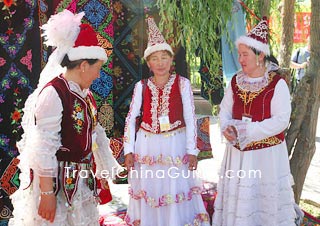 |
| Women of Kazak Minority, Xinjiang |
With a population of 1,250,458, the Kazak ethnic minority is mainly in Ili Kazak Autonomous Prefecture, Mori and Barkol Autonomous Counties in Xinjiang, as well as in Qinghai and Gansu Provinces. Language:
Their language belongs to the Turkic group of Altaic phylum. The Kazak language is written based on Arabian letters, but many people can use Chinese, Uigur and Mongolian. Religion:
In the past, they believed in the Shamanism. In about the 11th century, they began to turn to Islam while some continued to admire nature, soul and fire like the Shamanists. Many festivals, such as the Corban Festival which is also celebrated among the Hui ethnic minority, are close related to their religion.
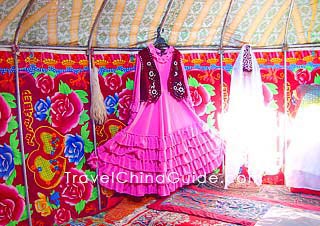 |
| Clothes of Kazak Woman |
People and Their Life: Only a few of them have settled down and are working in agriculture with most living a nomadic life as the alternation of seasons. This also affects all facets of their way of life.
The Kazaks are unconstrained, warm-hearted, and sincere in how they treat others. They love music so much that nearly every one is good at singing and dancing. The musical instrument, the Dongbula, is famous for its exotic timber. During festivals or other times of entertainment, lively girls and boys will sing with the Dongbula, and hold many activities. Horse-riding, wrestling, sheep-snatching and lady-chasing are their favorite.
Crafts:They are deft at making various crafts. Felt and woolen products are practical and attractive, and wooden, iron, jade, silver and bone wares are also of high quality.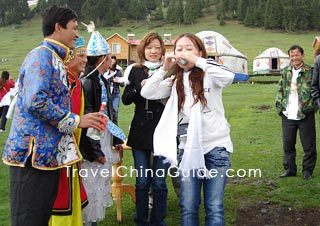 |
| Kazak people welcome guests. |
Food:Meat and milk are their staple foods every day. They enjoy the meat and milk of sheep, goats, oxen and camels. Milk tea is necessary for their daily life. Kumiss, mixed with horse milk, is quite a precious beverage. When visiting Kazak families, distinguished guests will be very lucky if they have the chance to taste this delicious drink.
House:For convenience, intelligent Kazaks invented a movable house - the yurt. Made up of woolen felt, palisades stay bars, a round roof, and shades; the yurt can be dismantled and reassembled. When they are migrating to another place, these 'houses' are easily carried by camels or oxen.
Other Customs: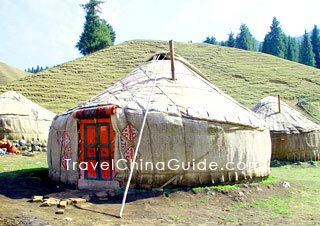 |
| Yurts of Kazak Nationality |
More Ethnic Groups in Xinjiang Area:Uygur Hui Mongol Kirgiz Uzbek Tatar Dongxiang Xibe Tagik Russ
- Last updated on Aug. 08, 2022 -