Mongol (Mongolian) Nationality
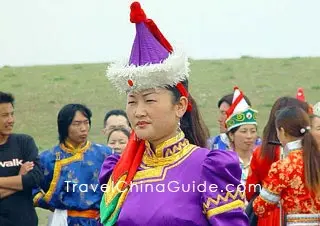
 Distribution and Population:With a population of 5,813,947, Mongol ethnic minority is distributed primarily in the Inner Mongolian Autonomous Region along with others in provinces like Qinghai, Gansu, Liaoning, Jilin, and Heilongjiang, etc. This ethnic minority is brave and unconstrained with a profound history. Though they called themselves 'Mongol', meaning everlasting fire, other people refer to them as 'an ethnic minority on the horseback'.
 History:
They originated from a tribe in Northern China in the seventh century of the Tang Dynasty (618 – 907). In the 12th century, a legendary leader, Temujin, unified the Mongolian tribes. Afterwards, Emperor Shizu Kublai established the Yuan Dynasty (1271 - 1368) when the Chinese territory reached its summit and the cultural communication had improved a great deal. In the Ming Dynasty (1368 - 1644), they separated into two branches.
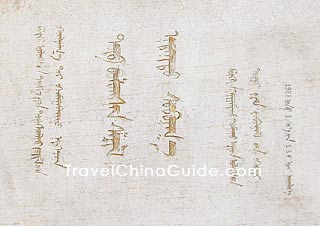
Language and Literature:Their language belongs to the Mongolian group of the Altaic phylum and has three main dialects. The written form is derived from that of the 13th century and experienced many changes. The Mongolians have made brilliant achievements in their literature; the 'Mongolian Secret History' has been listed among the world's famous works by UNESCO.
|
|
 Economy:
They are living on vast grasslands; therefore, stockbreeding played a major role in their development, together with agriculture, handicrafts, and other processing industries.
Religion:In the 16th century they believe in Shamanism but turned to Lamaism in the Yuan Dynasty.
Food: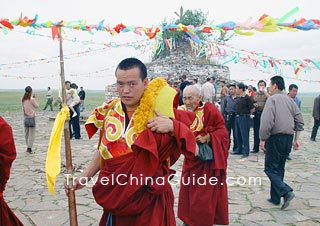 |
| Mongolian Lamaists |
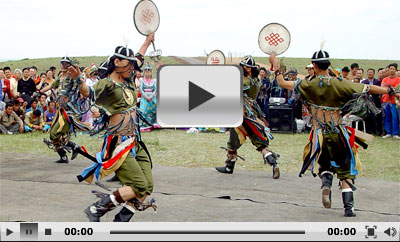
Festival:The grandest festival is the Nadam Fair for five to seven days during late August. Mongolian people, in new clothes, will gather from many areas. Many will participate in the exciting competitions of shooting, wrestling, and horse-riding.
Customs: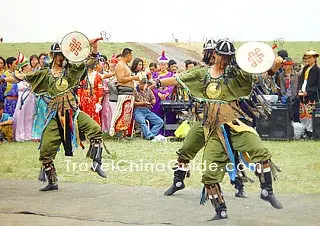 |
| Dance Show, Nadam Fair |
When visitors go to a Mongolian's home, they will be treated very well by being given wine. But they must fully respect their hosts' customs such as: they will not step on the threshold, sit beside the niche of Buddha, and touch children's heads, etc. They admire fire and water so guests should not dry their feet or boots on the stove, nor should they wash or bathe in the river, as it is holy and clean in their eyes. In the Mongolian culture, colors are significant. At a Mongolian funeral, red and white should be avoided, whereas during their festivals, black and yellow should not be used.
More Ethnic Groups in Inner Mongolia:Manchu Hui Daur Ewenki Oroqen
- Last updated on Aug. 07, 2025 by Gabby Li -