Religions & Beliefs in China
China has been a multi-religion country since the ancient times. It is well known that Confucianism is an indigenous religion and is the soul of Chinese culture, which enjoyed popular support among people and even became the guiding ideology for feudalism society, but it did not develop into a national belief. It makes the culture more tolerant to others, thus, many other religions have been brought into the country in different dynasties, but none of them developed powerful enough in the history and they only provide diverse people more spiritual support.
 |
Temple of Town God in Shanghai  Chinese Religion Pictures Chinese Religion Pictures |
 |
| Giant Wild Goose Pagoda, Da Ci'en Temple |
Now, Buddhism has developed into the most important religion in the country. The latest survey shows that 31% of the people who do not believe in this religion have participated in some Buddhist activities and about 17 million people have already become converts. Now more of those followers come from different walks of life such as the intellectuals, business elites and the common people. Recently, there is a new report, The Chinese Luxury Consumer White Paper 2012, jointly published by the Industrial Bank and Hurun Report, which shows that 39% of the intellectuals and businessmen have faith in Buddhism. Not only the number of the followers is increasing, and the education of Buddhism obtains more attention from the society. Under the Buddhist Association of China, 34 different levels of Buddhist academies as well as almost 50 magazines can be found. Now in mainland China, there are about 13 thousand temples and 180 thousand monks and nuns.
 |
| Jokhang Temple, the Typical Temple of Tibietan Buddhism |
 Han Buddhism: With 8,400 temples and 50 thousand monks, it is the largest branch on the mainland. Tibetan Buddhism: As the second large sect, it has 3,000 temples and 120 thousand monks. Southern Buddhism: Having 8,000 monks and 1,600 temples, this sect has the smallest scale.
Famous Buddhist Relics:
- Potala Palace, Lhasa
- Yonghe Lamasery, Beijing
- Jade Buddha Temple, Shanghai
- Big Wild Goose Pagoda, Xian
- Mt. Wutai, Shanxi
- Temple of Soul's Retreat, Hangzhou
- Longmen Grottoes, Luoyang
- Shaolin Temple, Henan
- White Horse Temple, Luoyang
 |
| The Granduer Potala Palace, Lhasa |
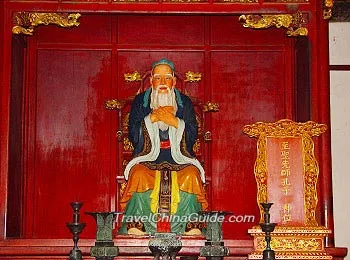
Confucianism, not a real religion, is just an ethical and philosophical system, which developed from Confucius’ thoughts and later was treated as a kind of belief to educate common people. It obtained its stable position under the reign of Emperor Wu of Han Dynasty (202BC-220AD), and became the ideology of the society in the feudal system since then. Based on the Four Books and Five Classics, the traditions and principles in the Confucianism played an important role in the formation of Chinese people’s thinking patterns and teaching methods. For instance, Doctrine of the Mean can be seen on communications among people. Now, to some extent, where Chinese people stay or live, there will be Confucianism.
Confucianism has worldwide influence. In many countries and regions of world such the UK, USA, branches of Confucius Institutes are established in recent years to spread Chinese culture and expand the language. In China, you can find many Confucius temples, which is an important place for the candidates for important exams. In Beijing, They hang some red wooden plates with lucky words in the Confucius Temple in the hope of gaining high marks and a good future.
|
|

Famous Confucius Temples:
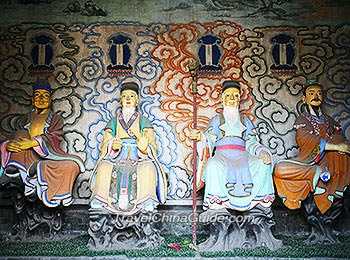
Taoism, with more than 1,800 years’ history originated in the Warring Period and came into being in Eastern Han Dynasty (25 - 220). Now about 300 Taoist Temples are scattered around China, in which about 30 thousand Taoists lived in. Around 5 Taoist schools exist in the country and two main sections are included in Taoism. In the 1,800 years, Taoism influenced the local culture deeply, especially on traditional medicine and literature. Based on some theories of alchemists such as Wei Boyang in Eastern Han Dynasty, different kinds of medicine prescriptions were created by Sun Simiao and many other doctors. In literature, many fictional characters are closely related with Taoism, such as the Jade Emperor. Apart from Mainland China, many Taoists live in Hong Kong, Macau and some foreign countries.
 |
| The Taoist Temple at Mt. Qingcheng, Sichuan |
Famous Taoist Relics:
Islam
 |
| Nanguan Mosque in Xining, Qinghai |
Famous Islamic Relics:
 |
| St Joseph's Church, Beijing |
Famous Churches:
- East Church, Beijing (St Joseph's Church)
- St. Ignatius Cathedral, Shanghai
- Churches in Hong Kong
- Saint Sophia Church, Harbin (an Orthodox church)
In addition to the five main religions, Chinese people have some other traditional folk beliefs. More than 200 million people believe the existence of the ancestors’ souls and worship them, while about 700 million have taken part in the activities to worship their ancestors or related activities. About 150 million people believe in Fengshui theory and 140 million people believe in God of Wealth. Chinese Astrology is very popular and many people think the sign can decide one’s characters and future. Thus, it is obvious that the traditional folk belief has a wide foundation among the local people. Now, more and more Chinese people are fond of constellation in western culture. In the beginning of a new year, some people will watch some fortune telling programs to see whether they can succeed in the next year and learn how to avoid back luck.