Confucianism
Confucianism
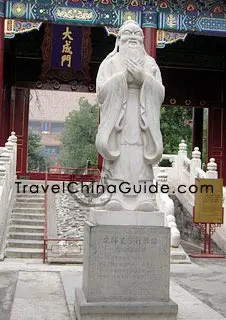 |
| Statue of Confucius |
Confucianism is the cornerstone of traditional Chinese culture as well as a complete ideological system created by Confucius, based on the traditional culture of the Xia, Shang and Zhou Dynasties. It has dominated a feudal society that in essence has lasted 2000 years and for that reason its influence over the history, social structure and the people of China cannot be overlooked.
Life of Confucius
He has proved to be the greatest influence over the Chinese character. Besides being a great educationist, thinker and unsuccessful politician, he was first of all an intellect with a noble morality. He pursued truth, kindness and perfection throughout his life and his success and failure were largely due to his character, which had an everlasting impact on Chinese intellect.
He was born in 551B.C in the State of Lu which is known today as Qufu in Shandong Province. In Chinese, his name was Kong Qiu. Kong was the family name while Qiu was his given name. This was because his parents had prayed for a son at Niqiu Hill and 'Qiu' was an appropriate token of their thanks and joy at having their prayers answered. Sadly, his father died when he was very young but despite a hard life, he dedicated himself to study at the age of 15.
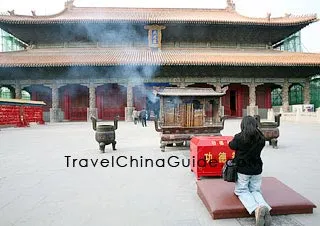 |
| Confucius Temple, Qufu, Shandong |
Patriotism was the driving force for the young Confucius and he set his sights on an official career as a means to apply his political ideals. He had gained some fame by the time he was 30 but it was not until he was 51 that his official life really assumed great importance. This eventful career was to last for only four years as he was forced to resign when he found it impossible to agree with the authorities. Such was the opposition to his ideas that he was obliged to leave his country and to travel around the states. During these 14 years, he was in danger on many occasions and even risked his life. At the age of 68 he was welcomed back to Lu but he was set up as a respected gentleman without any authority. He died of illness at the age of 73. A brilliant star fell into silence. His students treated him as father and wore the willow for three years. Zigong, one of the famous disciples, set up a cabinet near his tomb and stayed there for six years to mourn his beloved teacher. He could never have dreamed that his lonely tomb would develop into the large Cemetery of Confucius (Kong Lin) and that his ideological system would become the norm for Chinese society.
Compared to his frustrated political career, his career as a teacher and philosopher was brilliant and full of achievements.
Much of his approach to education was avante garde as he promoted the ideas "to educate all despite their social status" and "to teach according to the students' characteristics". The first of these broke with tradition as only the aristocracy had the privilege of education.
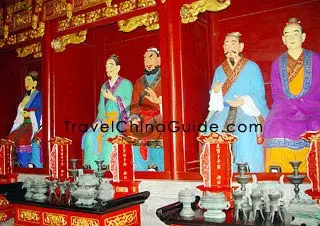 |
| Statues of Sages and Worthies |
He also proposed a complete set of principles concerning study. He said, "Studying without thinking leads to confusion; thinking without studying leads to laziness." Today's quality-education was nothing new to him.
Imparting knowledge was only part of his teaching; he was a living example of the concepts he promoted and this had a deep and lasting influence upon his disciples. His private life was a model of his doctrines. The Analects of Confucius provide a vivid record of his teachings but although he wrote nothing personally, his words were collected and recorded for posterity by his disciples. The accumulated words of wisdom have come down to us as "The Analects", one of the most important of all the Chinese classics.
He took great delight in studying and was modest enough to learn from anyone. He never tired of teaching his disciples while diligence, his unremitting pursuit of truth, ideas and perfect personality, his integrity, kindness, modesty and courteousness inspired his disciples and the intellects of subsequent generations. Uniquely, only he is qualified to be called "the teacher of ten thousand generations". It is said that among 3000 of his disciples, there were 72 who were brilliant and who succeeded in morality, literature, language, and especially politics. These politicians contributed much to the spreading, formation and development of Confucianism.
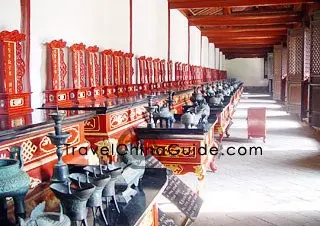 |
| Sacrificial Utensils |
He stuck to righteousness, saying, "Improper fortunes are just flowing clouds to me. For proper fortunes, I will do jobs such as a driver." He was quite easy with his ideas despite of poverty. He was virtuous, always ready to help others and treated others with tolerance and honesty. To him, a benevolent person is one who loves others. He said, "Do not give others what you do not want yourself", similar to the Bible teaching of "All those things which you would have men do to you, even so do you to them: because this is the law and the prophets." (Matthew7:12)
Influenced by Confucianism, in Chinese culture, an intellectual is not limited in study alone. He should be successful in being a human and in his bearing of himself. A key objective of an intellectual should be to make full use of his ability, personality and intelligence to do good for the state, society and the world at large. This idea is so precious that we cannot help asking why the products of today's education system are far from satisfactory! Why do not we pay attention to our ancestor's core values instead of wasting so much of our time and energy in word puzzles!
His marriage was ignored purposefully by his followers. All we know is he got married at 19 and divorced his wife at 23 and remained single for the rest of his life. As Confucianism laid down the social ethnics of the Chinese society, why he divorced remained a puzzle. We cannot find out how he behaved as a husband or as a father. However, the records show that he loved his disciples as much as his own children. He was not a cold or dull old man; instead, he was affectionate, humorous and optimistic. It is something of an enigma that this humble and wise man should have been first apotheosized as a Saint then demonized only to be re-established as a Saint by succeeding generations. In Chinese, he was known as Kong Sheng Ren (Saint Kong). We hope our introduction goes some way to show him as a truly human being.
Background
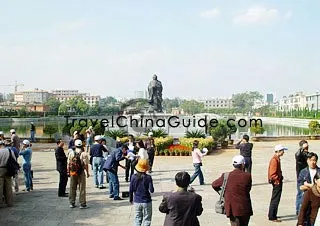 |
| Confucius Temple in Honghe, Yunnan |
He lived in the Spring and Autumn Periods, a time when the established system could not meet the demand of development as the ruling classes of China experienced the transition from a slave to feudalist society. It was a time of "the collapse of etiquette and the deterioration of music", which implies the ethics and moralities of society were in decline. The intellectuals of the day were concerned about the future mode of society, hence the most brilliant contention of a hundred schools of thought, such as Legist, Taoist, thrived in a vibrant period in Chinese history. This is often regarded as the most exciting of times for Chinese intellectuals as no single doctrine dominated their lives.
His proposal was to discipline oneself and to revive the ethics of Zhou Dynasty. Therefore, he brought forward a series of norms, which step by step developed into Confucianism.
Development History
Confucianism was further developed by Mencius (372B.C.-289B.C.) and Xun Zi. It was in the reign of Emperor Wu during the Han Dynasty that it was promoted to being the state ideology. Since then, it became the orthodox doctrine of Chinese society. And Confucius was glorified as a Saint instead of an ordinary man.
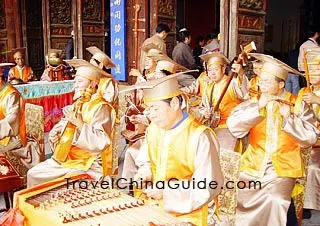 |
| Ancient Music Show in a Confucius Temple |
In the coming Wei and Jin Dynasties, Confucianism coexisted with Buddhism and Taoism. Up to the Sui and Tang Dynasties, the struggle for dominance between the three became heated. The Song Dynasty witnessed a vital period of its development. Featuring Confucian school of idealist philosophy of the Song and Ming dynasties, it restored its orthodox role for the following 700 years.
Waving the banner of science and democracy, the New Cultural Movement from 1915 attacked the feudal system, including its core ideological system of Confucianism. During the Cultural Revolution, it was once again under violent attack.
In recent years people can look at Confucianism with a more rational state of mind, some even suggest its returning for wisdom while opponents hold that it should be held responsible for the backwardness of China's development and for that reason its dominance should not be revived. In any event, that would not be possible.
To our delight, many scholars devote themselves to the study of Confucianism and its application to modern society. Such study is important as the Chinese language has experienced considerable changes over the centuries and the lack of any punctuation in the ancient classics has made it difficult for us to fully comprehend his ideology.
Confucianism is succinct as well as intensive. Strictly speaking, it is not a religion but more a doctrine than belief, while the meaning behind the beautiful words renders wordy post-modernism pale and dull. It is part of world cultural heritage and an integral part of Chinese life.
Related Links:  Confucius Temples
Confucius Temple in Qufu
Confucius Temple in Beijing
Confucius Temple in Nanjing
 Reply
Reply 0
0 0ReplyReply00ReplyReply00Reply