Huashan Mountain
 From July 15 to October 10, 2026, the Huashan Mountain Scenic Area will offer tourists a half discount on its entrance ticket. In this period, each adult ticket will cost CNY 80 and can only be bought online.
 What makes Huashan Mountain so dangerous? It is surrounded by cliffs that are nearly 90-degree steep. Some trails in the summit area are constructed on ridges, and when people hike on them, it feels as if they are on edges of knife blades. Some steep paths are between cliff walls, and narrow steps on them can only accommodate half a foot. Moreover, some dangerous passes are on the cliffside, and to brave them, people have to fasten the safety harness, grip the iron chain, and take each step with great care.
What are the wonders of Huashan Mountain? Unlike other continuous mountain ranges, the Mt Huashan is a single huge block of granite with five main peaks. From a bird's-eye view, the Huashan Mountain is like a blooming lotus flower. The scenery of the mount is impressive throughout the four seasons, especially the peach blossoms in spring and the red foliage in autumn. Moreover, the mount boasts a rolling sea of clouds and a gorgeous sunrise.
 |
| Huashan Mountain Pictures & Videos |
In addition, the Huashan Mountain is a holy place of traditional Chinese Taoist culture and has long been a vital spot to practice Taoist doctrines and preserve Taoist culture. The Jade Spring Temple at the mountain foot enshrines a Taoist hermit, and the Golden Heaven Palace is dedicated to the God of Huashan Mountain. Both are good places to pray for blessings.
|
|

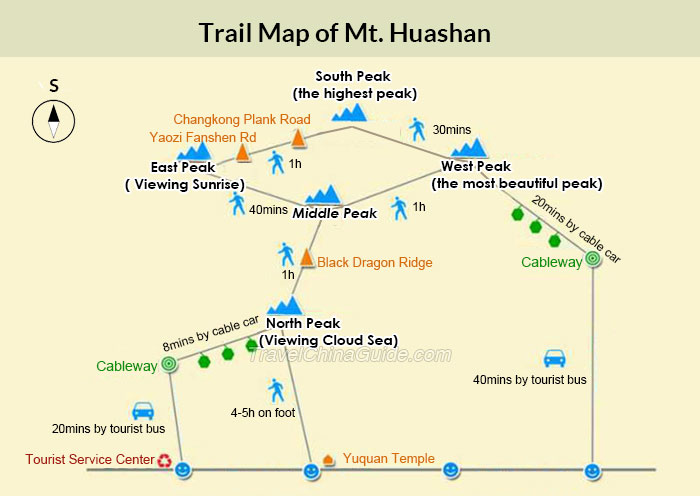
Five Main Peaks of Huashan Mountain
North Peak - The Lowest Peak, Accessible by Cable Car
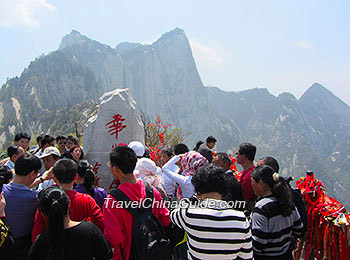
With the relatively low terrain, the North Peak provides an excellent view to admire the other four main peaks. What’s more, it’s surrounded by cliffs on three sides, and is truly a precipitous peak of Huashan Mountain. It’s said that martial arts experts flock here to compete in their skills for the title of “World’s Top Martial Arts Master”. Up to now, you can still find a large rock engraved with the words “The Duel on Huashan Mountain” on the North Peak.
Middle Peak - The Most Romantic Peak
|
|

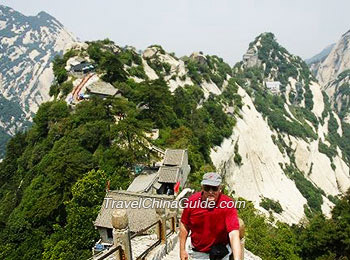
East Peak - Top Sunrise Spot
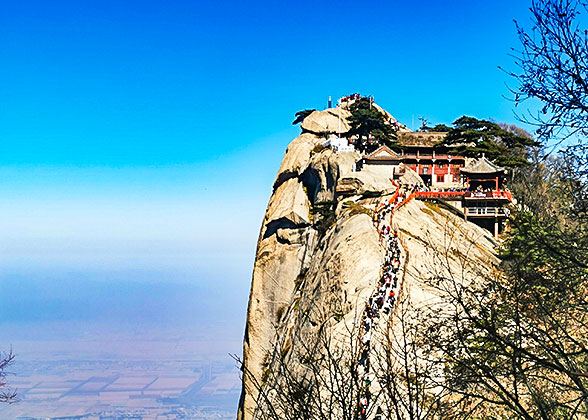
After the sunrise, as you look out at the scenery on the East Peak, the Chess Pavilion on a lower mountain with cliffs on its three sides will catch your eyes. The only way to the pavilion is “Hawk Turning Over”, one of the most dangerous passes of the mount. To brave it, you have to fasten the safety harness, grasp iron chains, and grope for the step downward. In short, it’s heart-stopping and highly demanding for arm strength.
|
|


South Peak - The Highest Peak
Another highlight of the South Peak is Huashan Mountain Plank Walk on it, which is one of the world’s top 10 scariest cliffside walks. The pass is constructed on the cliff, and the endless abyss is just beneath it. After you just face the precipitous cliffs and step down the vertical iron ladder, you have to press your body against the cliff wall and move slowly in each thrilling step. Compared with the other dangerous passes, this one can truly make your heart race with fear.
West Peak - Top Sunset Spot, Accessible by Cable Car
After getting out from the cable car, you have to pass the section of “Bluish-grey Dragon’s Back” to get to the West Peak Summit. This pass features a vegetation-covered gentle slope and a bare sheer cliff on both sides, and the sharp difference in scenery will amaze you.
 |
| Huashan Mountain West Peak with Yanggong Tower |
Is it Safe to Visit Huashan Mountain?
(1) Most dangerous passes are equipped with both handrails and iron chains, so that people can hold onto them during the hike. On certain sections, you can also find gentler trails nearby.
(2) To pass through some quite dangerous trails like Huashan Mountain Plank Walk and “Hawk Turning Over”, one has to meet many safety requirements and wear a harness all the way.
(3) Even at night, the hiking trail is illuminated, and you can enjoy your night climb securely.
Real factors causing danger are distraction during the hike, relatively low temperature in the mountain-top area, lack of physical strength, and extreme weather. To deal with these, it’s advised to focus on each step forward, keep warm in time, choose the right route for you, and keep an eye on the weather in advance.
Best Things to Do in Huashan Mountain Scenic Area
1. Challenge Dangerous Passes of Huashan Mountain
 |
| Tourist on Dangerous Pass of Mt. Huashan |
The Thousand-foot Precipice and the Hundred-foot Crevice are almost steep at a 70-degree angle with endless steps. Some people even scramble up with hands and feet together. The Black Dragon Ridge is like a sky ladder with a sharp cliff and a forest-covered valley on both sides. The Golden Lock Pass from North to Middle Peak is surrounded by cliffs and allows you to view towering mountains and deep valleys.
Climbing the precipitous Huashan Mountain at night will definitely be a memorable experience. After you have passed the dangerous passes and dealt with the temperature decrease in a high position, the sunrise above the East Peak must be a feast for your eyes.
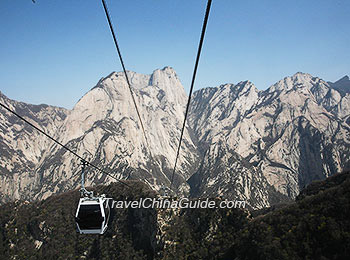
3. Descend Huashan Mountain by West Peak Cable Car
 |
| Gorgeous View from West Peak Cable Car |
4. Visit Jade Spring Temple & Xiyue Temple
How to Tour Huashan Mountain?
(1) West-up & North-down / North-up & West-down
 Duration: 5 - 6 hours.
These two routes go like this: a cable car ride up the mount, hiking in the summit area, and a cable car ride down the mount. By virtue of two-way cable car rides and sightseeing on the mount, these are the most popular choices among tourists. By contrast, North-up & West-down is more strenuous than West-up & North-down.
|
|

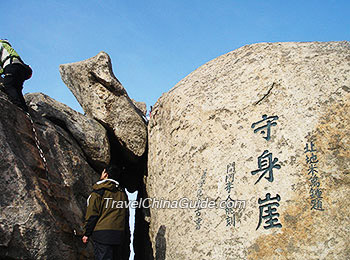
(2) West-up & West-down
Duration: 3 - 4 hours.This route includes two-way West Peak Cable Car rides and hiking on West and South Peaks, and thus is the most effortless one, especially for family travelers including the elderly and children.
(3) Hiking up at Night & Descending by West Peak Cable Car
Duration: 10-plus hours.For tourists who want to admire the sunrise above Huashan Mountain, this route is the best choice. After a strenuous night climb, you stand on the East Peak to admire the sunrise, and then you can either continue your tour to South and West Peaks or take the West Peak Cable Car to descend the mount. If you prefer sightseeing along the hiking trail and also the golden sunrise, you can take this route for two days, with hiking up on the first day, staying on the mountain overnight, and touring around the summit area on the second day.
|
|
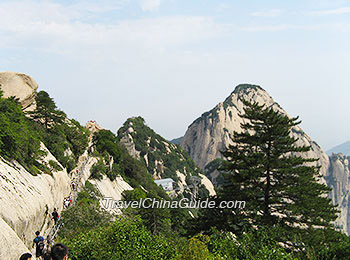
(4) Hiking up and down
Duration: 10-plus hours.Mountaineers will choose this route with two-way hiking to conquer the mount. It poses a great challenge to one’s physical strength, and thus is only recommended to those with extensive experience in mountain climbing.
 For details about the routes, see 6 Classical Routes for Huashan Mountain Hike.
|
|

When Is the Best Time to Visit Huashan Mountain?
 |
| Autumn Foliage Scenery of Huashan Mountain |
2. During your visit, you’re suggested to add clothes in time to keep warm, hike at a proper pace and take a break from time to time, and allocate enough time to queue for the cable car. Plus, please pay attention to your hike, and stop if you want to photograph the scenery.
3. After your visit, remember to properly stretch your muscles to relieve fatigue, and arrange low-intensity sightseeing afterward.
4. The two dangerous passes - Huashan Mountain Plank Walk and “Hawk Turning Over” are not necessary stops during your tour, but there are still plenty of people who want to brave them. To challenge them, one has to book the ticket on his phone in the summit area, and each ticket costs CNY 30.
Ticket Price & Opening Hours
| Ticket Price | CNY 100 from Dec. to Feb. CNY 160 from Mar. to Nov. Each ticket is valid for 48 hours after check-in, during which tourists can visit each of the mountain areas, the Jade Spring Temple, and the Xiyue Temple once. Free for children aged 6 and under or no taller than 1.2 m (3 ft 11 in), and half price for children over 6 and 1.2 - 1.5 m (3 ft 11 in - 4 ft 11 in) tall. For the elderly over 65, they can enter the attraction free, but still need to book a free ticket online. |
|---|---|
| Opening Hours | (1) Whole day for hikers. (2) The Tourist Center for people to check in and board the cable car opens from 8:00 to 16:00 between Dec. and Feb. and from 7:00 to 16:00 between Mar. and Nov. (3) The Jade Spring Temple opens from 8:00 to 17:00. (4) The Xiyue Temple opens from 8:00 to 18:00 between Dec. and Feb. and from 7:00 to 19:00 between Mar. and Nov. |
Information about Huashan Mountain Cable Car
| Operating Hours of West / North Peak Cable Car | ||
|---|---|---|
| Station | March - November | December - February |
| Lower Station | 7:00 - 16:00 | 8:00 - 16:00 |
| Upper Station | 7:00 - 19:00 | 8:00 - 18:00 |
| West Peak Cable Car Fare | ||
|---|---|---|
| Fare | March - November | December - February |
| Single Way per Person | CNY 140 | CNY 120 |
| Single Way Tourist Bus Fare | CNY 40 per person | |
| North Peak Cable Car Fare | ||
|---|---|---|
| Fare | March - November | December - February |
| Single Way per Person | CNY 80 | CNY 45 |
| Round Way per Person | CNY 150 | CNY 80 |
| Single Way Tourist Bus Fare | CNY 40 per person | |
Note: Free for children aged 6 and under or no taller than 1.2 m (3 ft 11 in), half price for the elderly over 65, and 90%-discount price for people aged 6 to 18 and no taller than 1.5 m (4 ft 11 in).Step 1: from Xi’an to Huayin County, where Huashan Mountain is located
By High-speed Train, the Fastest WayRoute: Xi’an North Railway Station → Huashan North Railway Station
Duration: about 30 minutes.
Ticket Fare: CNY 54.5 to 57
By Normal-speed Train, the Cheapest WayRoute: Xi’an Railway Station → Huashan Railway Station
Duration: 1.5 hours.
Ticket Fare: CNY 18.5 to 30
For detailed information about railway lines, see Xi’an - Huashan Train; Huashan - Xi’an Train. You can also get transportation information between Huashan Mountain and Beijing / Luoyang / Shanghai.
|
|

 By Direct Tourist Bus, with No Need to Transfer
Route: Xi’an Coach Station / Fangzhicheng Coach Station → Huashan Tourist Center
Duration: 2 hours.
Ticket Fare: CNY 39
By Taxi, a Flexible but Expensive WayRoute: Downtown Xi’an → Huashan Tourist Center / Jade Spring Temple
Duration: 1.5 to 2 hours.
Ticket Fare: CNY 300 to 600
Step 2: from Huayin County to Huashan Mountain
(2) The Jade Spring Temple is the destination for hikers in this step, and they can choose to take a free shuttle vehicle, taxi, or Bus No. 603.
Mount Huashan is listed among the “Five Great Mountains in China” by virtue its precipitous terrain, and the other four are: the majestic Taishan Mountain in Shandong, the elegant Hengshan Mountain in Hunan, the secluded Hengshan Mountain in Shanxi, and the profound Songshan Mountain in Henan. You may also like:Top 10 Things to Do in Xi'an
10 Famous Places in China with Rising Popularity over the Web
15 Spectacular Natural Wonders of China
Recommended Tours

- Last updated on Jul. 16, 2026 by Alex Jin -